The Live Oaks at Ocracoke!

By Jane Malec EMGV

My husband and I along with our two golden retrievers made our first journey to the Outer Banks a few weeks ago.  We have been North Carolinians for 15 years now but never manage to get there.  Those of you that have explored the Outer Banks probably are familiar with some of this background information but many life long residents, I found, have never been to this part of of our state.

Ocracoke is a small unincorporated village near the end of Ocracoke Island which is the southern most island in the Outer Banks.  Its actually a CDP, census designated place,  but I don’t think many year rounders appreciate that definition. The 2010 census shows the population at 948 brave residents.  It sits out into the Pamlico Sound sort of like the knuckle of your index finger.  You don’t stumble upon Ocracoke on a “honey let’s take a drive” Sunday afternoon.  Its a commitment…just ask the afore mentioned golden retrievers, Layla and Max.  So for most of us that means a six to seven hour journey depending on which of the ferries you chose.

If you don’t fish or surf, the pace during the off season very is slow and relaxing.  Unless, of course, you are there during the Pirate Festival which is a story for another time.  Being a curious gardener, I decided take time to learn about and enjoy the plant life at Ocracoke during our week on the island. I quickly found that there wasn’t much still  growing in late October.  There were many interesting natives such as dune marsh elder and yaupon holly and a host of rugged looking azaleas.  Many home owners had decorated their front yards with beautiful pots of fall annuals and lots of pumpkins. I love the fall!

What struck me the most were the old and weathered trees lining the neighborhood streets.  The trees had arching canopies and appeared much older than the cottages they stood in front of.  They were simple, beautiful and reflected the casual nature of this unique area.  The Southern Live Oak, Quercus virginiana, as in much of the south, is plentiful in Ocracoke but the two trees that captured my attention were the Live Sand Oak, Quercus geminate, and the Laurel Oak, Quercus laurifolia.

So, did you know the name Quercus comes from two Celtic words?  Quer means beautiful and Cuez which means tree?  These trees both live up to their names.

Both share characteristics of their sibling the southern live oak but are different in their own right.  For an example, neither one achieves the towering heights of the southern live oak, plus their leaves and acorns are shaped differently.  All three are grown for their ornamental features and they have no lumber value except for firewood.

As you would expect, the Sand Oak loves the sandy scrub habitat of the coastal areas.  This is the work horse of ornamental island trees.  It is one of the top hurricane resistant options in our area.  The sand oak can grow up and over 50′ tall although some forms are shrub like and less treelike than others .  The bark is dark grayish brown and deeply furrowed.  Its leaves are leathery, deep green, a gray to almost white underside and small hairs.  This is one of the features different from live oaks.  They have large egg shaped acorns which provides a food source for many wild life.

LyraEDISServlet

The Laurel Oak is not an obvious choice for an environment such as Ocracoke.  This tree is listed basically as a “do not plant if there is any chance of a hurricane” specimen.  Yet there they are in yards around the  village.  It is sort of like planting a weak structured tree like a Bradford Pear, Pyrus calleryana, in the Triangle with all the ice storms we have.  People know its wrong but do it anyway.   The laurel likes moist soil but not prolonged wetness.  The bark is dark gray to blackish and not excessively furrowed.  It has thick, lustrous and dark green leathery leaves with a lighter green underside.  Their acorns a bit smaller, nearly round and also provide lots of food for wildlife.

o

The sand oaks in the village looked strong and sturdy… warrior like.  A few of them appeared to have never seen a strong wind let alone a hurricane although them most certainly had.  They are an important part of the landscape.

I must confess, I loved the laurel oaks the most.   Each one had a weathered look as if they fought to survive many storms.  Most had parts of limbs missing at the wrist or elbow, were bent over like they were hiding from the next strong gust or were surviving with only half of the tree remaining.  The laurel oaks had a unique character about them as if they each had a story to tell….yielding yet determined to survive.  I mentioned earlier that there were under 1,000 brave full time residents in Ocracoke.  They embrace thousands of tourists through the hot summer months then live with the isolation of long winter nights with one restaurant, no movie theaters or shopping centers.  They weather the storms, grow and determinedly flourish.

It made perfect sense to me that they would plant live laurel oaks in their little village on Ocracoke Island.

IMG_1645

http://edis.ifas.ufl.edu/LyraEDISServlet?command=getImageDetail&image_soid=FIGURE%202&document_soid=FR311&document_version=41162

http://lee.ifas.ufl.edu/Hort/GardenPubsAZ/LiveVsLaurelOaks.pd

https://archive.org/stream/plantcoveringofo00kear#page/268/mode/2up

A few of our favorite things: Garden Tools

When gardeners get together, we often talk about our favorites – plants we adore, techniques we swear by, and tools we just can’t live without. Our blog team recently shared photos and descriptions of a favorite tool or two each. As Master Gardeners, we cannot recommend specific brands, but we’re happy to tell you all about the types of tools we consider our “must haves”. Here are a few:

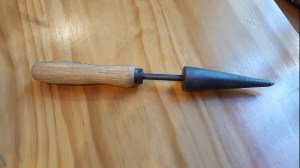
Jane Malec:  I love this little tool! It weeds (shave off at/below ground), cultivates, edges, digs and even helps with digging holes for small bulbs. It works great in cleaning up sidewalk and rock garden weeds. I can use it with either hand which really helps when my arthritis acts up. Plus, it will scrape out the mud and dirt from the bottom of my gardening boots!

Andrea Laine:  This is my favorite tool and I don’t even know its name! This weeding tool was gifted to me when I began volunteering at a public garden. Leave it to the pros to know what is best! Sure, I had used an asparagus fork before but this tool’s twist on that model makes it a far better weeder. The angle of its approach (like a sneak attack from behind) is just enough to loosen the soil near the plant’s base and enable me to gently pull it out of the ground, roots and all. By disturbing the surrounding soil as little as possible, it minimizes weed seeds embedded in the soil from having an opportunity to germinate.

FullSizeRender (1)
Photo: Kim Cherry

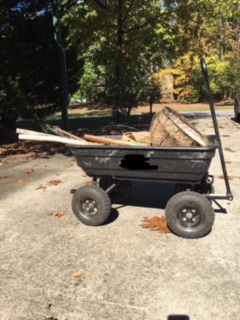
Kim Cherry:  My can’t live without garden tool is a solid walled garden cart. I just love this cart. I use it to move my garden containers around. It is useful for potting plants as it can hold a large bag of potting soil. It is helpful for garden cleanup. The cart can hold a heavy load and the dumping feature allows you to collect all your yard waste and easily move and put it the desired location. I also use it to move mulch in the spring. The cart has very sturdy wheels that allows it to be pulled over most terrain. The garden cart has been well worth the investment. I would recommend it to all avid gardeners.


DSC_4248
Photo: Wendy Diaz

Wendy Diaz : A couple of days ago, I abandoned my indoor responsibilities and decided to enjoy North Carolina’s beautiful fall weather by planting some red, white and blue spring bulbs which were gifted to me by my friend when she heard I became an American Citizen this September. Although the 24-inch bulb planter or auger is not my favorite old garden tool, it is now my favorite new garden tool. I was able to easily attach to it to my husband’s (fully charged) drill, excavate regularly spaced three-inch diameter holes at the required depths, plant 8 tulip, 8 iris and 16 narcissus bulbs, fertilize and water them at two different locations, all within one hour. The auger and drill combination works best in loose garden soil and it doesn’t work at all if you hit a pebble.  If you get stuck, just reverse the drill. When you have a lot of bulbs to plant this is the tool to use for the job. I want to thank whoever gave this at the last Master Gardener Christmas Luncheon gift exchange.


20171102_140627
Photo: Ann Barnes

Ann Barnes: Two things I love to plant in fall are garlic and daffodils. Last year, I borrowed a bulb dibber (also known as a dibble or dibbler) from a friend when I put garlic in the ground and was amazed that it was so much easier to use than my trusty old trowel. I was given one of my own just in time to plant this year’s garlic bulbs – fall birthdays are so handy. Simply push or twist the dibber into the soil, wiggle it around if you need a bigger hole, remove, and drop your bulb in. Cover and you’re done. Dibbers have been around since Roman times, and they can also be used for planting seeds or seedlings. I was planning to use this tool to add more daffodils to an expanded flower garden, but now I’m thinking of calling Wendy to see if I can borrow her new favorite.


claw tool
Photo: Andrea Laine

Andrea Laine: My husband spotted this handy tool in a big box store at the time that I was renovating a mature bed in our landscape. Since the site is home to some canopy trees as well as a few understory trees and shrubs, there were many good size roots to contend with. I did not want to use machinery to till the soil and risk harm to those roots. Yet I still needed to loosen the first few inches of soil so that I could add compost and fertilizer, as my soil report recommended, and mix it all together. I had been using a pitch fork, but this tool was more effective and easier on my back and knees. It is 38-inches tall with a cross handle at the top like what you would see on a jack hammer or a pogo stick. I place the tool upright on the soil and push down and with a twist to the right. The claws below do the hard work.


20171030_164135
Photo: Ann Barnes

Ann Barnes:  Every gardener needs a good pair of hand pruners; maybe even two if they want both bypass and anvil types. What they probably don’t need are 5 or 6 cheap pruners that are half broken, uncomfortable to use and don’t cut well. I have learned from those mistakes. Bypass pruners, which have two curved blades that pass one another like scissor blades, are the type I use most often. Anvil pruners have a single blade that closes on a sturdy flat edge and are great for tougher jobs. I’ve invested in a good quality pair of bypass pruners, and they are by far my favorite garden tool. They have smooth action, cut cleanly and easily, and came in a smaller size that fits my hand. The handles have good ergonomics, so I can prune without discomfort. The steel blade can be sharpened, and it and other parts can be replaced when needed. I will have these pruners for many years. Thankfully, the bright red handle should help keep them from getting lost in the garden.