
By Marcia Kirinus, NC State Extension Master GardenerSM volunteers of Durham County
This article is Part One of a two-part series on starting seeds indoors using a light cart. 1
In this first installment, we focus on lighting and environmental setup, the foundation for growing compact, healthy seedlings indoors. Part Two will cover watering, fertility, and pest management, including strategies to prevent common issues such as fungus gnats and nutrient stress.

A basic light cart built using a utility cart and LED shop lights from a big-box store – an affordable, accessible setup for home seed starting. (Image credit: Marcia Kirinus)
Light Matters
Starting seeds indoors gives gardeners a valuable head start on the growing season, but success depends on more than good intentions and a sunny window. Indoors, light is often the limiting factor. Insufficient or inconsistent light leads to leggy, weak seedlings that struggle to support themselves and often fail after transplanting.
While countertop indoor hydroponic gardens are convenient for herbs or small greens, they are limited in space, light output, and flexibility.
Light carts offer a simple, effective solution. Used by Master Gardeners and growers alike, they provide consistent light, stable growing conditions, and flexibility for a wide range of plants. This article explains how light carts work and how to use them successfully at home, without specialized equipment or advanced technical knowledge.

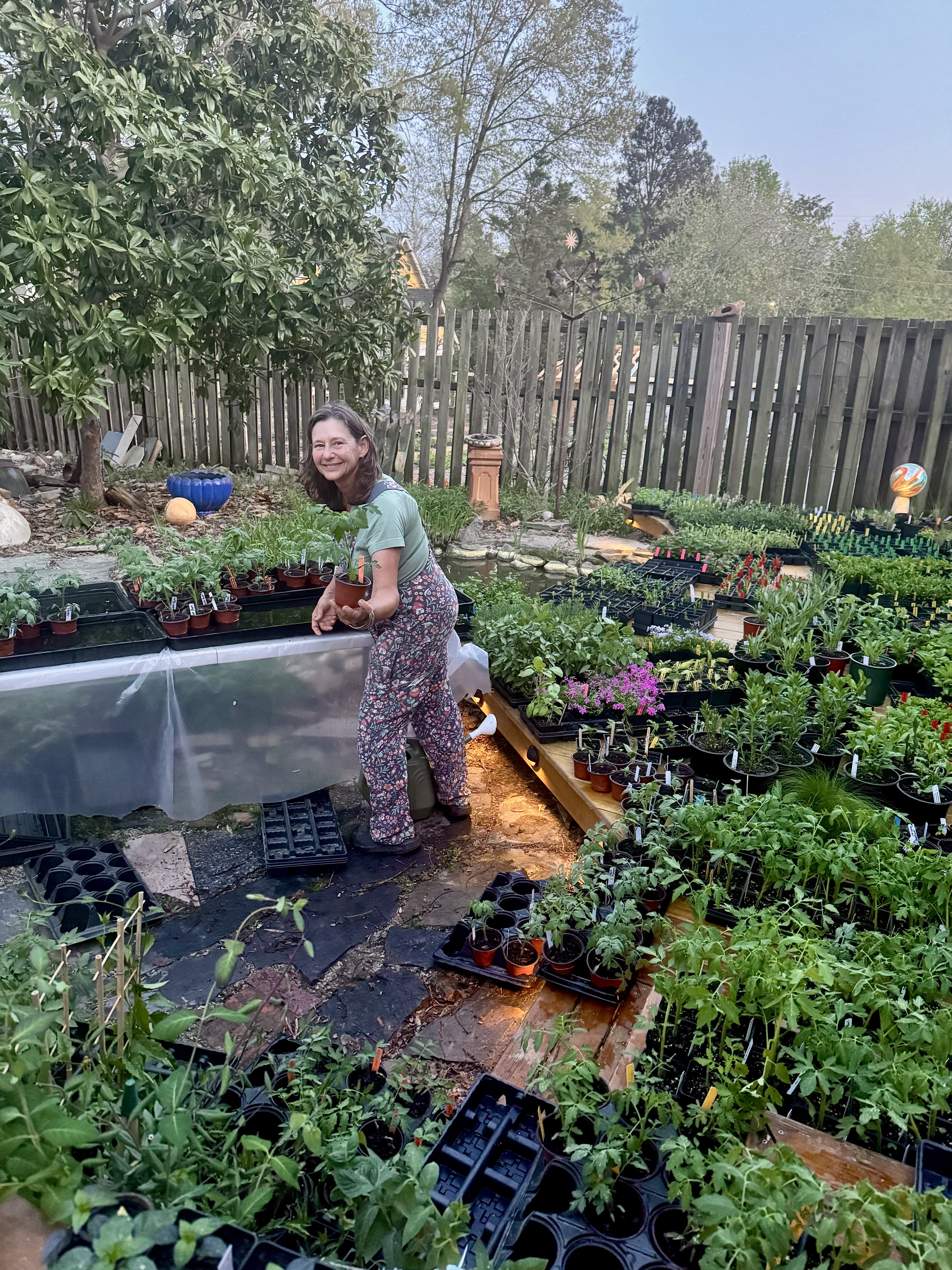
Light carts allow large numbers of strong, healthy seedlings to be started efficiently. Left: 15–20 young healthy tomato plants grown in soil blocks under lights. Right: Getting ready for the planting season. Thousands of plants started on three light carts, with an additional 3,600 plants beyond the fence – all established in the field after being grown the same way. (Image credit: Mehmet Ozturk)
Choosing the Right Location for a Light Cart
Before setting up lights and water-filled trays, consider where your light cart will live. Grow lights are bright and typically run for up to 16 hours a day, so choose a location that won’t interfere with daily household routines or sleep.
You’ll also need easy access to water. Bottom watering keeps water contained, but spills can still happen, so choose a location where occasional moisture won’t be a problem. Basements, garages, utility rooms, or spare rooms are often good options.
If growing on concrete floors, insulate trays from cold surfaces using foam boards or wooden risers. Avoid drafty locations or areas with large temperature swings – consistency is key for healthy seedling development.
Temperature, Humidity, and Air Movement
Seedlings thrive in stable, moderate conditions. Aim for air temperatures between 65–75°F (18–24°C) during the day and no lower than 60°F (16°C) at night.
While air temperature matters, soil temperature is even more critical during germination. Soil temperatures are naturally cooler than air temperatures and so heat mats with thermostatic control can maintain ideal soil temperatures of 72–78°F (22–26°C), promoting faster and more uniform germination.
After emergence, moderate humidity, around 40–60%, helps prevent excessive drying without encouraging disease. Gentle air movement from a small fan strengthens stems, discourages fungal growth, and helps equalize temperature throughout the growing area.
Understanding Plant Light ( Getting Technical Without Getting Technical)
Plants use light differently than people do. While our eyes perceive brightness, plants respond to both wavelength (color) and quantity (how much light reaches the leaves).
Wavelength determines what type of light plants receive, while quantity determines how many photons are available for photosynthesis. Both matter, but for home seed starting, managing light quantity is usually the most important factor.


Light behaves as both a wave and a particle. Left: the photosynthetically active radiation (PAR) range, 400–700 nm, shows the wavelengths plants use for photosynthesis. Right: photosynthetic photon flux density (PPFD) illustrates how much PAR light reaches one square meter. (Image credit: Wikipedia & AI-generated)
For practical purposes, most modern white or neutral-spectrum LED lights already provide the wavelengths plants need. What gardeners must control is how much usable light reaches the plant canopy and how evenly it is distributed.
To evaluate light, growers use the following terms:
- PAR (Photosynthetically Active Radiation) refers to light in the 400–700 nm wavelength range, which is the portion of the spectrum plants primarily use for photosynthesis. You can think of this as the section of the rainbow that the plant wants to eat all the time.
- PPFD (Photosynthetic Photon Flux Density) measures the number of PAR photons reaching the plant canopy per second. It is the standard way growers quantify light intensity for plants. Think about this as the section of the rainbow (400-700nm) that the plant can eat for lunch or for dinner. We are measuring a point in time. This is the number most growers will use to space their shelves.
- DLI (Daily Light Integral) describes the total amount of light a plant receives over a full day. While it’s commonly used in greenhouses to account for cloudy weather, it also helps explain why consistent light duration indoors can compensate for moderate light intensity. Think of this as what the plant ate all day – breakfast, lunch, dinner, snacks and if you knew this number, you would know if your plant was light starved or had too much.
You don’t need to calculate these values to grow good seedlings, but understanding them explains why consistent, evenly distributed light produces better results than short bursts of intense light or uneven coverage.
By using your phone and one of the light meter apps for plants, you can easily figure out what the distance of your shelving should be for the right amount of light needed to produce strong robust seedlings. Phone-based plant light apps estimate PPFD from visible light readings. While they are not lab-accurate, they are very useful for comparing relative light levels across shelves and adjusting fixture height consistently.
What Good Light Looks Like for Seedlings
Most seedlings grow best under moderate, consistent light, rather than extremely intense light. A practical target for many common seedlings is 200–300 µmol·m⁻²·s⁻¹ measured at the plant canopy over a 16-hour photoperiod.
This level of light encourages compact growth, healthy leaf development, and strong stems without stressing young plants. Shade-adapted species may require less light, while full-sun plants often benefit from higher levels once established.


Left: Eastern columbine (Aquilegia canadensis) is a woodland plant that prefers lower light levels. Too much light can stress seedlings, resulting in short internodes, thickened leaves, and occasional purpling or scorch. On a light cart, columbine seedlings thrive in the 100–200 µmol/m²/s range. (Image credit: Debbie Roos)
Right: Purple coneflower (Echinacea purpurea) is a full-sun prairie plant and responds well to brighter conditions, performing best at 250–400 µmol/m²/s once true leaves develop.
While both species require minimal light during germination (a typical cart setting of 50–100 µmol/m²/s), their light needs clearly diverge after true leaves emerge. (Image credit: Marcia Kirinus)
Duration matters as much as intensity. Long, steady days mimic natural spring conditions and support balanced growth. Aim for 16 –18 hours of light per day.
Setting Up a Light Cart for Success
A good light cart setup prioritizes uniformity and flexibility. Using multiple lower-intensity light bars per shelf provides more even coverage than one or two very bright fixtures. This reduces hotspots, minimizes stretching at tray edges, and allows shelves to be spaced closer together, maximizing growing space.
Lights should be adjustable so they can be raised as plants grow. If fixtures are difficult to reposition, plants can be raised instead using shallow trays or boxes. Timers are strongly recommended to ensure consistent day length and to eliminate daily guesswork.
Young seedlings are particularly sensitive to uneven light. Overlapping light patterns from multiple fixtures create a uniform canopy that encourages balanced growth across the entire tray.
Reading the Plants: Too Much or Too Little Light
Seedlings respond quickly to lighting conditions, and their appearance provides valuable feedback.


Reading your seedlings: Left: Silene caroliniana, a woodland – edge of meadow plant that is showing signs of receiving too much light. Note leaf cupping/puckering, thickened and rigid leaves, pale areas along veins and margins, minor edge browning/scorch. Right: spindly seedlings not getting enough light. they are stretching toward the light; if not corrected quickly, they will grow weak and lanky. (Image credit: Marcia Kirinus)
Signs of too much light include:
- Bleached or pale leaves
- Leaf cupping or “taco-shaped” foliage
- Very short internodes or hardened growth
Signs of too little light include:
- Tall, leggy seedlings
- Pale color
- Slow or uneven growth
If seedlings stretch, lower the lights closer to the plants. If leaves bleach or curl, raise the lights or add light diffusion, such as a layer of cheesecloth over the fixture. Small adjustments can make a big difference. Take readings using your phone app so you can dial it in easier. It takes all of the guess work out.
Buying Grow Lights: What Matters (and What Doesn’t)
Grow light packaging can be confusing, often emphasizing marketing terms rather than plant performance. When choosing lights for a cart system, focus on even coverage, moderate output, and fixtures designed for close placement.
High wattage and exaggerated brightness claims are not better for seedlings. In fact, they often limit shelf spacing and make uniform lighting harder to achieve. Average white (full) or neutral-spectrum LED shop lights work extremely well for early growth, especially when multiple fixtures are used per shelf.
What matters most is how evenly light is delivered across the shelf and how easily the system can be adjusted as plants grow.
Common Marketing Terms That Sound Impressive, but Aren’t Helpful
“Grow Light” – The label alone doesn’t guarantee the light is appropriate for seedlings.
“Full Spectrum” – Most white LEDs already provide a usable spectrum; the term is often vague.
“Ultra-Bright” or “High Output” – Higher wattage can be excessive for seedlings and reduce usable shelf space.
“Equivalent to 200W / 500W / 1000W” – Comparisons to older lighting technologies are not meaningful for LEDs.
Purple or “blurple” lights – Effective, but unnecessary for seed starting and uncomfortable to work under.
Consistency Over Complexity
Successful indoor seed starting isn’t about expensive equipment or perfectly dialing in every number. It’s about creating steady, supportive conditions and observing how plants respond.
Light carts simplify the process by removing many of the variables that cause problems indoors. With consistent light, moderate temperatures, and small adjustments based on plant feedback, gardeners can grow strong, healthy seedlings ready for the garden.
Footnote:
- A light cart is a sturdy wire shelving unit, much like you would use in a garage or basement. It is outfitted with low-output LED shop lights mounted beneath each shelf. This straightforward setup allows you to control light, space, and timing in ways a sunny windowsill rarely can.
Additional Information and Resources
- Past Blog Post: What I love about starting seeds using a soil block: https://wp.me/p2nIr1-4rv
- Lighting for indoor plants and starting seeds: University of Minnesota: https://extension.umn.edu/planting-and-growing-guides/lighting-indoor-plants
- Lighting options for starting seed (LEDs vs. Fluorescent), Kansas State Extension, Johnson County: https://www.johnson.k-state.edu/programs/lawn-garden/agent-articles-fact-sheets-and-more/agent-articles/vegetables/lighting_options_for_Seeds.html
- Central North Carolina Planting Calendar for Annual Vegetables, Fruits, and Herbs: //content.ces.ncsu.edu/central-north-carolina-planting-calendar-for-annual-vegetables-fruits-and-herbs
- Find any plant and its preferred growing condition that grows in NC in the NCSU Plant ToolBox: https://plants.ces.ncsu.edu/find_a_plant/


