
By Jeff Kanters, NC State Extension Master GardenerSM volunteer of Durham County

“The only true wisdom is in knowing
you know nothing.”
–Socrates
In November of 2023, I planted in eight new one-year-old apple tree whips at the Briggs Avenue Community Garden’s teaching orchard. While most of the trees were planted along a designated row, two of the apple trees were planted differently. I planted each one in large rectangular raised beds that flanked an arbor between the north and south orchard. I intended to train them into espalier along a large panel of cattle fencing constructed at each side of the arbor.

Arbor with cattle fencing to train trees to espalier. (Image credit: Jeff Kanters)
The History of Espalier
For those who may be unfamiliar, the term ‘espalier’ (pronounced /eh·spal·yay/) is French to describe a fruit tree or ornamental shrub whose branches are trained to grow flat against a wall, and/or supported in flat fashion on a lattice, a framework of stakes, or fencing in some ornamental design.
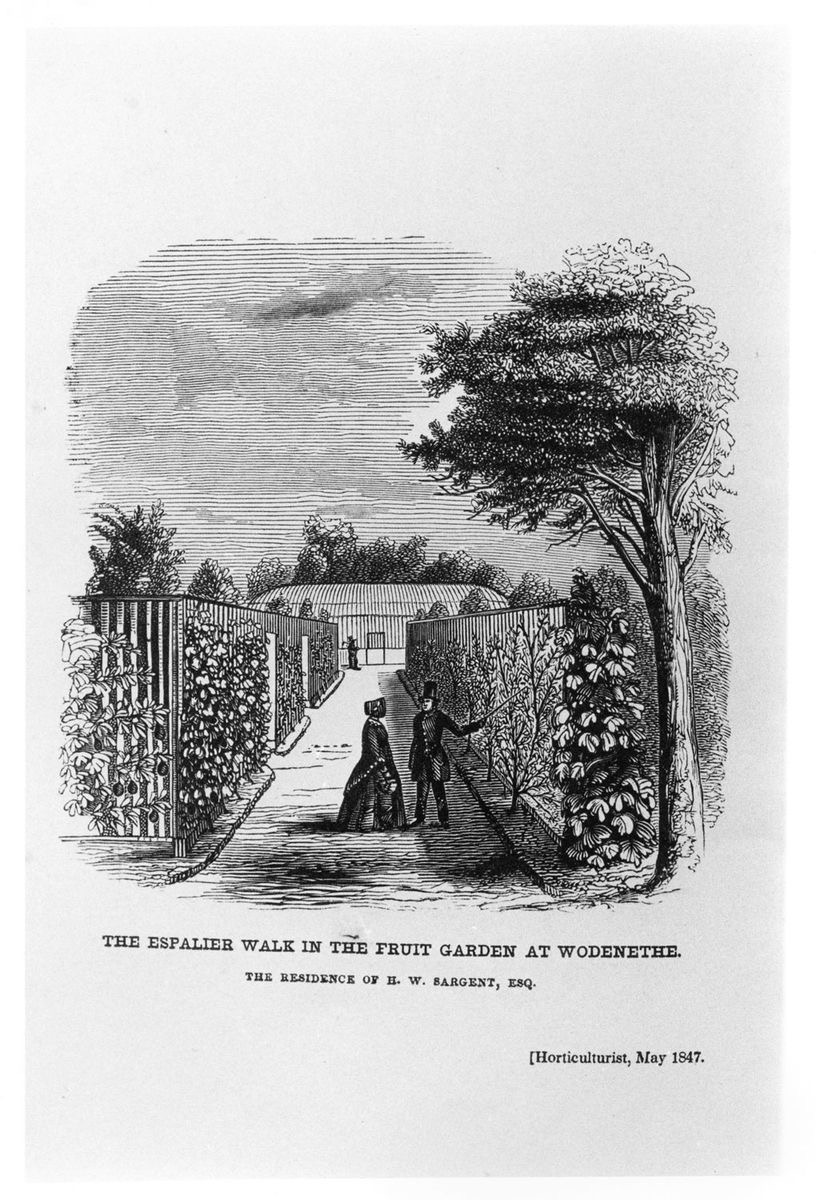
Mid-19th-century rendering of espalier at a garden estate in Beacon, New York. (Image credit: Courtesy of the National Gallery of Art. Anonymous, “The Espalier Walk in the Fruit Garden at Wodenethe,” in A. J. Downing, ed., Horticulturist 1, no. 11 (May 1847) CC BY-NC-SA 4.0)
The practice of espalier has been around for centuries — even since ancient times. The application of espalier became formalized in medieval Europe, used primarily to maximize fruit production within confined or limited spaces. The practice evolved further during the Renaissance, particularly in France which embraced both its functionality and its design aesthetic. Eventually the practice found its way to England and then the American colonies in the 1700s. And here we are.
What Apple Trees Make Good Espalier?
Two tree varieties were selected for espalier at Briggs, ‘Horse’ and ‘Aunt Rachel,’ both heirloom apple trees grown in North Carolina. What made these apple trees unique and good for espalier training is that they are spur producing. This means that apples develop on short twig-like spurs along a branch, rather than clustered on the tips of new growth. The apples produced are more easily harvested along the flat plane of the espalier shape, and the trees are easier to train, prune, and manage without sacrificing fruit production.
Tip-bearing varieties on the other hand produce fruit on the tips of branches and pruning to manage an espalier shape would likely remove too many potential fruit buds, reducing fruit production. Another advantage of espalier-trained trees is that the shape improves air circulation and makes disease and insect control easier.
There are many espalier shapes available. I chose to train each tree up and along a cattle fence support into a flat candelabra shape. This would allow a maximum of growing area for fruit production and establish an ornamental look to the trees.

Planned candelabra shape for the apple trees. (Image credit: Jeff Kanters)
Espalier Plan for Apple Trees Put into Action
The new tree whips were planted in November 2023, centered at each fence panel and within six inches of the fence. The top one third of each whip was pruned off to a healthy bud to support and reduce stress on the young roots and stimulate lateral bud growth for the next growing season. The young trees initiated their first growth in the spring through the summer of 2024. The next decision I needed to make was when to prune and initiate the training of the new tree growth.

As indicated by the white arrows, new apple tree whips planted in each bed November 2023. (Image credit: Jeff Kanters)
Training and Pruning Apple Trees for Espalier
There are different approaches about when to start training and pruning a young tree for espalier. The climate zone, annual rainfall, temperature changes, soil structure, and type of tree are some of the factors that influence the growth rates of apple trees to take into consideration. Whereas some trees may put out enough growth the first year to begin the training of growing branches immediately, other trees may need a full year to grow and build adequate sugar reserves in their roots.
During the following winter dormancy, selective pruning is done to encourage the tree to put out the additional lateral growth needed to further develop new branches for training that second year. Whatever the approach, espalier training on an apple tree should be started when the tree is young during its first couple years of growth. Starting from the lower base of the tree, the training will continue as the tree grows to utilize as much space and branching as possible.
Because the young trees were initially slow in putting out their first new growth in 2024, I chose to allow them to grow their first full-summer season before initiation of training in 2025. During winter pruning in January 2025, I did prune out developing branches that were growing outward away from the flat plane of the fence. I also pruned off another third of the vertical top trunk of the tree to stimulate lateral buds to grow branches when growth began again in the spring.


(Left to right) The ‘Horse’ variety and ‘Aunt Rachel’ after summer growth of August 2024. (Image credit: Jeff Kanters)
This spring of 2025, both trees put out robust growth and I was able to identify better developed lateral growing branches to initiate training to a two-dimensional form. New branches growing into and through the fence and/or outward away from the fence were again snipped off to focus all branch growth laterally along the same plane as the fence to position and secure the developing branches in a flat horizontal manner along the fence.


(Left to right) Pictures of ‘Horse’ and ‘Aunt Rachel’ trees putting out new growth after espalier training started in April 2025. The candelabra design begins to emerge. (Image credit: Jeff Kanters)
Tips for Training New Espalier Growth
A note of caution when training new growth: take care to allow any new lateral branch growth to get enough length and firm up past the very new, soft-green stage before beginning the training. Attempting to bend a growing branch when it is too soft could result in its snapping off from the trunk. A month or two of slow hardening of the new limb will enable the growing branch to be positioned properly and secured at the fence without breaking off.
There are many kinds of ties, bands, or wraps that are used to secure the flexible branches to train espalier that are effective. I chose one that is high-quality cloth fabric, stretches, is non-constricting for limb growth, provides good support, and holds up for at least eighteen to twenty-four months before degrading or removal. This gives the branches over a year to harden off in position.

Securing a branch laterally with a band on the fence. (Image credit: Jeff Kanters)
As new growth continued to pop outwards from the trunks, I identified newly-developing lateral branches, starting with the lowest set about three feet from the ground. Each opposite set of laterals was trained to grow out from the trunk and parallel to the ground along the fence. Working upward, another set of developing lateral branches were selected growing about twelve inches above the ones below. As new lateral branches grow out up from the trunk for upcoming growing seasons, the same process is followed, striving to maintain a distance of about ten to twelve inches between each lateral branch along the fence.
The espalier training of both young apple trees has progressed nicely this second season as both trees have produced four sets of lateral scaffold branches trained on the fence already. I will continue to head off the top growing vertical trunk to get more lateral limb development each season.


The espaliers really taking shape in summer of 2025 with ‘Horse’ on the left, “Aunt Rachel’ on the right. (Image credit: Jeff Kanters)
If you have limited space, a sunny area, want to grow apples, and have an artistic bent, espalier trees may be for you. Growing espalier takes attention to detail and some patience, but the payoff can be most gratifying.
Stop by Friday or Saturday between 9:00 am and Noon for a visit at Briggs Avenue Community Garden‘s teaching orchard at 1314 S Briggs Avenue, Durham, and check out the developing espalier trees. I will provide updates in coming blogs as the trees grow and training continues to the first apple harvests.
Resources and Additional Information:
Growing fruit trees in central NC–read more on our blog: https://wp.me/p2nIr1-2ln
A History of Early American Landscape Design: https://heald.nga.gov/mediawiki/index.php/Espalier
History of Espalier: https://hort.extension.wisc.edu/articles/espalier/
Garden Techniques for Limited Space: https://extension.usu.edu/ogdenbotanicalgardens/edible-garden-techniques
Incorporate the Art of Espalier in Your Landscape: https://extension.missouri.edu/news/incorporate-the-art-of-espalier-in-your-landscape https://lancaster.unl.edu/espalier-create-living-art-form-and-function
Edited by Susan Sharp and Melinda Heigel, NC State Extension Master GardenerSM volunteers of Durham County
Article Short Link: https://wp.me/p2nIr1-6lv