Safely Gardening With Children

By Jean Findlay, EMGV

It is so rewarding to see children get excited about gardening. They get outdoors with fresh air and exercise, away from screens, learn about plants and soil, and maybe improve their diet when they can eat and prepare what they have grown. And gardening can be done anywhere, and from a young age. This little one started to help garden at age two on a rooftop in Kuala Lumpur, Malaysia!

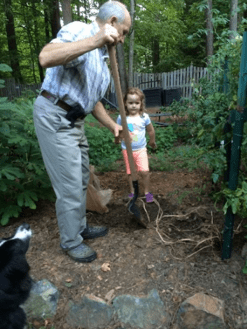
While you are planning quiet summer afternoons in the back yard, your children may be plotting some mischief! A little preparation will help prevent a trip to the emergency room on an otherwise peaceful afternoon. So here are a few suggestions to keep everyone safe and happy.

Do a tour of your back yard to check for hidden dangers. Check for poisonous plants and remove them if possible. A plant ID app can identify the name, and the printable publications below (references 5 and 6) list plants poisonous to humans and animals respectively.

Have a first aid kit handy, as well as the phone number for poison control:

1-(800)-222-1222

Make sure chemicals and petroleum products are safely stored. Pesticides and other chemicals can be absorbed through the skin, so they should never be handled by children. Ingestion of petroleum products can cause severe pneumonia. Make sure you watch chemicals while you are using them, until safely stored again.

Keep young children off a newly treated lawn for 48 hours.

If there are water features, rain barrels, paddling pools or drainage ditches, be sure there will be adequate supervision of toddlers. Toddlers have been known to do headstands in the toilet bowl, and if exploring a water feature combines with a fall, the result can be disastrous. Keep hoses coiled to prevent tripping.

Time for the pre-gardening lecture!

Before heading out to the garden to plant those prized heirlooms you’ve grown from seed, go over the rules. Garden tools are not toys or weapons, boys and girls! They should always be put on the ground with sharp points down. If tools are not scaled to size, make sure each little gardener is aware that there is a long handle behind them that can hit another child if too close.

They should wear sturdy shoes, and when appropriate, hat, sunscreen, eye protection, and insect repellant. Have plenty of water available to drink in hot weather.

Instruct them to only eat fruit or vegetables under adult supervision. Not all blue berries are blueberries; Poke berries for instance, are very toxic to young children. And Swiss chard looks quite like rhubarb whose leaves contain too high levels of oxalic acid for children to tolerate. For the vegetables and fruits you do harvest together, it is a great time to maybe let them taste some new and healthy food, and learn how to cook them with you.

Plants, pests, and power tools:

Some general recommendations from AAP and CDC:

  • Sunscreen: SPF 15 or more, apply 30 minutes before exposure and every 2 hours of exposure, and after swimming.
  • Insect repellent: 2 months and older : 10% DEET for up to 2 Hours exposure, 30% for up to 5 hours. Wash it off when return indoors.
  • Light colored clothing, avoid perfumed products, and cover up as much as practical.
  • Check for ticks each day. If found, remove carefully and record the date.
  • Combination sunscreen-DEET products risk extra exposure to DEET since it should be applied more frequently.
  • Power tools: only over 14 years of age, and if able to handle the equipment.
  • Mowers: This is my pet peeve! No matter how cute they look, NEVER let a child ride on a tractor or ride-on mower. They can fall off, sustain a head injury, be run over, or lose part of an arm or leg. It happens more often than people realize.
  • Age 14 + to operate a walk-behind mower, and 16+ for ride on mower.
  • Be sure to turn off the mower before removing grass from the blades (yes, I know someone who didn’t and got more than his nails trimmed)

Additional Information and References:

  1. Gardening Safety for Kids, Part 1: Getting Ready for the Garden (MSU Extension)
  2. Gardening Safety for Kids, Part 2: Using Tools and Preventing Injury (MSU Extension)
  3. Water Safety and Young Children (American Academy of Pediatrics)
  4. Choosing an Insect Repellant for Your Child (American Academy of Pediatrics)
  5. Poisonous Plant Resources (NC State Extension)
  6. Plants Poisonous to Livestock and Pets in North Carolina (NC State Extension)
  7. Guide to Accidental Plant Poisoning (Carolinas Poison Center)
  8. Sun Safety (CDC)

June: To Do in the Garden

By Gary Crispell, EMGV

RAIN!!!  Honest to goodness real water-out-of-the-sky RAIN!  I’m pretty sure I heard a collective sigh from all the plants that I have only watered sparingly.  Hopefully the forecasted above average chance of rain for the first half of June actually comes to fruition.  Hard to believe that we nearly drowned in February.

The Accidental Cottage Garden is quite different this year.  There is a plethora of lance leaf coreopsis (Coreopsis lanceolata), a few galardia (Galardia pulchella) and one poppy (Papaver orientale).  The prairie coneflower (Rudbeckia hirta) and the Asiatic lilies (Lilium x ‘Corsica’ & and an unnamed orange one) are quite pleased with their new blanket of mulch.  The butterfly weed (Asclepeis tuberosa) has taken the spotlight from the dianthus (Dianthus ‘Sweetie Pie’). The as yet unidentified spreading garden chrysanthemum is trying to take over the floor of the garden under the English daisies (Bellis perennis).  And that’s the news from the Accidental Cottage Garden.

LAWN CARE

If you have heretofore procrastinated on this item it is TIME to fertilize warm season grasses (i.e. Bermuda, Zoysia, St. Augustine).  It is also the best (and really only) time to fertilize Centipede.  The general recommendation is for ½ lb. 15-0-14 or equivalent per 1000 sq ft.  Should you desire to be truly accurate- GET a FREE SOIL TEST.  Kits are available by calling the Extension office 919 560-0525, or by picking one up from the blue cabinet on the north side of the office (721 Foster St).

It would be difficult to core aerate our clayey soils too much, so a day or two after a rain (like any day this spring) or a good irrigation would be an ideal time do just that.

When mowing warm season grasses a good rule of thumb is to remove 1/3 of the new growth per mowing.

If you have been drooling over your neighbor’s Zoysia lawn June is a good time to start your own with sod or plugs.

FERTILIZING

After getting your FREE SOIL TEST in order to avoid over fertilizing now is the time to feed your dogwoods following the recommendations.

Vegetable gardens would like a side dressing of fertilizer about now to maximize production.

PLANTING

Again, for the procrastinators out there, if you want a crop this year better get these plants (too late for seeds) in the ground ASAP:  tomatoes, peppers, black-eyed peas, lima beans, green & wax beans, pumpkins, sweet potatoes.

Start (from seed) Brussel sprouts & collards to set out in mid-July.

 PRUNING

Coniferous evergreens (They produce seeds in cones.) like pines, cedars, junipers, arborvitaes, etc. may be pruned now.

Hedges can be pruned now but be advised do not remove more than a third of the total plant top (The green part.)

Keep pinching your garden mums until mid-July.

Hydrangea macrophylla (the ones with the BIG leaves) can be pruned when the flowers fade.

Azaleas may be pruned until July 4. (An “old wives tale” that works.)

Dieback in ericaceous plants (acid loving) such as azalea, rhododendron, Pieris, etc. can be pruned out now.  Remember to cut below the damage and to sterilize the pruner with 10% bleach between cuts.

PEST CONTROL & HERBICIDES

Patrol your shrubs for the following likely suspects: lace bugs, leaf miners, spider mites, aphids and bag worms.  Use appropriate measures to curtail their destructive tendencies.  If the bag worms have already bagged themselves you will have to hand pick them and destroy them in any manner you see fittin’.

June is also the beginning of the invasion better known as Japanese beetles.  There is a myriad of treatment options out there.

Keep an eye out for tomato early blight.  Watch for dark spots on the leaves and treat with an appropriate fungicide.  There are some good organics out there.

June is a good month to eradicate poison ivy, kudzu and honeysuckle.  Get while they are rapidly growing with an appropriate herbicide.

As with shrubs it is time to be on guard in the garden.  Several (many?) insects are looking for gourmet gardens to satisfy their gastronomic inclinations.  Look for a variety of worms on cruciferous veggies (cabbage, broccoli, cauliflower), cucumber beetles on cucumbers (ironically), squash borers on other cucurbits-squash and melons, flea beetles on green beans, tomatoes & eggplant and aphids on anything green.

Continue with regular pest management programs on bunch grapes, fruit trees and roses.

Use pesticides wisely, sparingly and only when necessary.  Always read the label and follow directions.

OTHER FUN GARDEN STUFF TO KEEP YOU OUTSIDE

Water lawns as necessary but try to do it early in the day to avoid evaporative loss.  Watering lawn in the evening promotes disease.  Lawns and gardens need about 1 inch of water per week either from natural sources or irrigation. 

Strawberry beds can be renovated now.

It is also a marvelous time to sit on the deck or patio with a glass of your favorite cold beverage and enjoy your garden.  You can even invite friends this year especially if everyone is vaccinated.  Break out the grille and let’s party.

See y’all at the ballpark.

Views from the Accidental Cottage Garden. Photos by Gary Crispell.

*Resources and Further Reading

All About Soil Sampling and How to Get Supplies from Durham County Cooperative Extension
https://durham.ces.ncsu.edu/2020/05/nows-the-perfect-time-to-test-your-soil/

Organic Lawn Care Guide
https://content.ces.ncsu.edu/organic-lawn-care-a-guide-to-organic-lawn-maintenance-and-pest-management

Central North Carolina Planting Calendar for Annual Fruits, Vegetables, and Herbs
https://content.ces.ncsu.edu/central-north-carolina-planting-calendar-for-annual-vegetables-fruits-and-herbs

General Pruning Tips
https://content.ces.ncsu.edu/general-pruning-techniques#:~:text=Remove%20dead%20branches%2C%20suckers%2C%20crossing,died%20due%20to%20water%20stress.

Learn more about insects and how to control them from the North Carolina Extension Gardener Handbook
https://content.ces.ncsu.edu/extension-gardener-handbook/4-insects

NC Extension Gardener Plant Toolbox (find your perfect plant or figure out what that unknown weed is!)
plants.ces.ncsu.edu