By Gary Crispell, NC State Extension Master Gardener SM volunteer of Durham County(aka the Accidental Cottage Gardener)
So, after nearly a year of minimal to no rain, we have been deluged. Not complaining here, but it sure would be nice to spread the precipitation out just a little more evenly. At deadline time 8.64” of the stuff has passed through the rain gauge with more predicted between now and the end of July. Needless to say, (but I’m gonna say it anyway) the Accidental Cottage Garden is bonkers. There are 19 varieties of plants in bloom. They are listed at the end of the post.
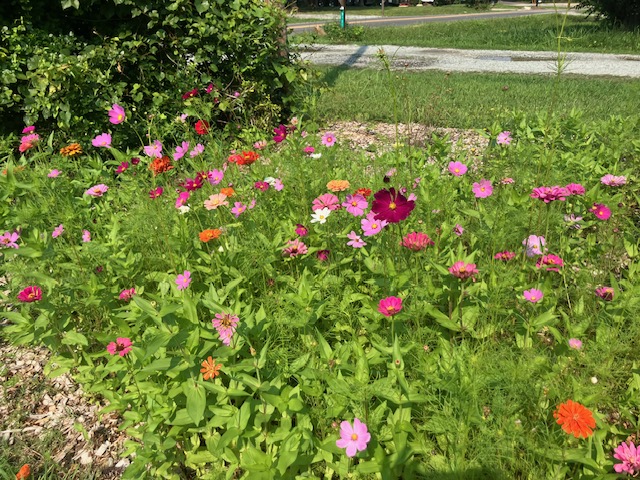
Zinnias and Cosmos are easy to start from seed and bloom abundantly in the Accidental Cottage Garden despite the weird weather. (Image credit: Gary Crispell)
All these plants have been remarkably nonchalant about the drought. They looked sad for a while, but as soon as they got a drink…they took off. The seeds that I sowed in April, Zinnia (Zinnia elegans) and Cosmos (Cosmos bipinnata), and that I stopped watering in mid-May are just fine, thank you. Bloomin’ their li’l hearts out, they are.
Enough about my compact world. The calendar is what you came for and here it is.
Lawn Care
Several species of grubs are actively feasting on lawn grass roots (probably yours) this time of the year. If you notice fist size brown spots on your lawn, it might just be grubs. Carefully dig up a spot to see if there is a grub down there. They are usually white or cream colored with a darker head. They are the larvae of various beetles, including the Japanese kind. There are several products on the market with which to treat them (i.e., kill ‘em dead). There are both liquid and granular products. Always read the label and follow the instructions. If you plan to renovate or reseed a cool season grass (fescue, bluegrass, perennial rye) lawn, then toward the end of the month is the time to prep (spray out weeds, core aerate, amend the soil, etc.) the area in question.
Fertilizing
If you are growing strawberries, they would be ecstatic if you threw a little nitrogen fertilizer in their general direction. DO NOT, he repeated, fertilize trees or shrubs between now and December at which time you may give them their holiday bonus in balanced fertilizer pellets.
Planting
Do you like to start plants from seed? It is fun to watch them sprout and develop. So, have I got a present for you! It’s time to get dirt under your fingernails and your shirt and shorts dirty. Start by sowing pansy seeds in flats. Pick a variety you can’t get at the big box store and be the envy of your neighbors when you set them out in September. There are also several perennials that can be direct sown now to get a jump on spring: Stokes aster (Stokesia leavis), hollyhock (Alcea rosea), and larkspur (Delphinium elatum and several more species) are good ones to try. There are many others. Search “perennial seeds” to learn more. Prep the bed by lightly loosening the soil surface. (No more deep tilling. Leave the sequestered carbon where it is.) Then sow the seeds per instructions on the package (or YouTube, naturally).
Plant a fall garden and eat fresh veggies for Thanksgiving. Salad greens such as Chinese cabbage, kale, many lettuces, arugula, and mustard will survive frost and light freezes. Root crops like beets, turnips, rutabagas, radishes and carrots will keep you in fresh vegetables nearly to the winter solstice. Other fast-growing veggies like winter squashes and cucumbers will be a pleasant surprise for your Thanksgiving dinner guests.
Pruning
Forget I even mentioned it. I would leave this topic blank, but that would raise more questions than telling you to put away all the pruning equipment until after Thanksgiving. The one exception would be if a named tropical cyclone lays waste to your landscape. In that case pruning would be appropriate. (The HOA would no doubt insist.)
Spraying
Not a whole lot different from July. The same heat-seeking, sap sucking, miserable insects and arachnids that found your garden to be a delectable feast in July are still there and many of them will be there until frost. Deal with it. Oh, right. Here’s how. Coniferous evergreens (juniper, cryptomeria, chamaecyparis, arborvitae, Leyland cypress, etc.) are a favorite target for spider mites. Azaleas and pyracantha will still be hosting lace bugs which are active year-round whenever leaf surface temperatures are above 40 degrees F. And anything and everything actively growing will attract aphids.
While we’re here (talking about insects) let’s have a conversation (monologue, actually) about white flies. For years they were the bane of my existence. I could not rid our hibiscus of them. This was serious because we have four hibiscus plants in 25-gallon pots. Them suckers would be 8 feet tall if’n I didn’t cut ‘em back every winter afore puttin’ ‘em in the garage (which seriously crowds the Mustang). They get wheeled out whenever there are going to be three or four nights above freezing. So, you see, we kinda like our hibiscus. Back to the dratted whiteflies. They are pernicious little…well, you know where that was going. I finally had success using an organic horticultural oil. It smothers all five (yes, five) stages of their life cycle (egg, crawler, nymph, pupae, adult). There are numerous other lethal chemicals available. See NCSU Entomology Insect Notes: Greenhouse Whitefly; Dr. Steven Frank and Dr. James Baker professors of entomology and plant pathology.
Only spray when necessary. Know your enemy (pest I.D.). ALWAYS read the label and FOLLOW the instructions. Did I repeat myself? It’s important. That’s why. Stay safe. Wear the proper clothing and equipment. This “stuff” can kill you or at least make you very ill. Be smart. I know you are. You read this.
Propagation
You can still take cuttings of most trees and shrubs.
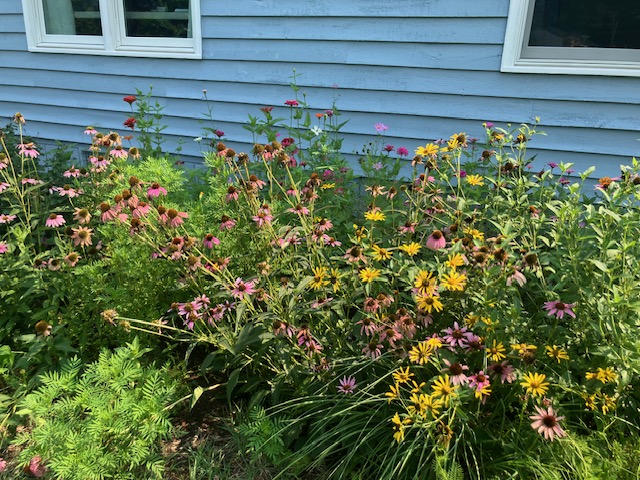
Purple coneflower is a star in the late summer garden. (Image credit: Gary Crispell)
So, if you really love the August heat you can do these:
Walk around the yard with your landscape plan (Everyone has one, right?) to see if there are changes you want to make.
Start a neighborhood pool concerning when the next rainstorm will pass by to the north or south.
Install an outdoor shower and live under it.
Catch the odd not blistering evening and dine al fresco on the deck or patio.
Stay hydrated. Cool and safe. September is just around the corner.
by Jeff Kanters, NC State Extension Master GardenerSM volunteer of Durham County
Whether you water your plants with a watering can, hose, sprinkler or rain it is critical to know where that water came from and how it has been treated before it gets to your plants. (Image credit: AI generated on 7/25/26 using Nano Banana 2)
Much of North Carolina has been challenged by record drought and excessive heat the past months. Water restrictions have reminded me how valuable water is as a commodity in terms of availability and quality. Then I thought in conversations with other gardeners that in addition to our drinking water we also need to consider the quality of water that we use to water or irrigate our plants both indoors and outdoors. Let’s explore this further. All plants need water, some more than others of course. Water is critical for nutrient transport, cellular integrity, and photosynthesis. Water that we use to irrigate our outdoor gardens and planters, and indoor potted plants may come from different sources that have benefits and risks that we need to consider to ensure our plants thrive.
Municipal Water
Depending on your city or county, water is raw sourced from nearby lakes and reservoirs and undergoes treatment to disinfect it of bacteria and harmful germs and remove harmful substances. In Durham, NC, city water is sourced from Lake Michie and Little River Reservoir and treated at the Williams or Brown Water Treatment Plants, primarily utilizing chloramines for disinfection and other chemicals to reduce corrosion of pipelines and maintain a near neutral pH of around 7.0. If you’re wondering about chloramines, they are a chemical compound derived from chlorine that has the same disinfecting properties of chlorine but has been found to be safer than chlorine. Fluoride is also added to prevent tooth decay. The water is monitored by the City of Durham Department of Water Management to strictly meet EPA safety standards.
The benefit of municipal water is that there is a consistent supply that has been filtered for sediment, trace minerals (like calcium, magnesium, sodium, and copper), and no maintenance hassle for the homeowner. The risk is the presence of residual chlorine/chloramines, and potential exposure to lead or “forever chemicals” (PFAS) picked up in aging municipal pipes before reaching your home. Fluoride at a low concentration of between 0.47 to 1.0 mg/L (ppm) has been added to the water within the optimal public health recommendation range.
How does municipal water affect your plants?
The good news about chloramine is that while this compound is more stable in water than chlorine, it breaks down almost instantly on contact with soil due to the high concentrations of organic matter and microbes that rapidly neutralize the compound. While microbes in the top half inch of the soil may be affected, their populations recover quickly. The vast biological ecosystem deeper in the soil remains entirely unaffected.
Water born fluorides at concentrations below 1.0 mg/L (ppm) are generally safe for plants but have the potential to damage plants that are sensitive, particularly tropical plants. This may show up as tip burn on the margins of leaves. At a higher pH of 6.0 to 6.5 the fluoride reacts with minerals and becomes permanently fixed or insoluble in the soil and cannot be absorbed by plant roots. Adding organic matter amendments to outdoors soil can help dilute contaminants and reduce the active concentration of fluoride. Indoors, consider watering sensitive house plants using rainwater, distilled water, or reverse-osmosis water.
The EMG Demonstration Garden and the Cocoa Cinnamon Container Garden are maintained by Durham EMGs. They both rely on municipal water through irrigation and hand watering. (Image credit: Allie Mullin)
Purified Water
Many homeowners choose to further purify tap water using distilled water, carbon filtration, or a reverse osmosis system installed for drinking water and watering our plants. Depending on the exact method used, purified water may still retain some essential trace minerals. Reverse Osmosis or Distilled water creates a pure water that is effective for extremely sensitive plants but requires you to add fertilizer back in to prevent nutrient deficiencies.
Distilled Water
Distilled water is produced exclusively through the boiling and condensation process. It is extremely pure and strips away almost all minerals. Distilled water is 100% safe for plants regarding toxins, as it is free of chlorine, chloramine, fluoride, and heavy metals. However, because it lacks essential minerals like calcium and magnesium that support plant health, we should use it strategically to prevent nutrient deficiencies or soil leaching over time. Because it is free of chlorine, heavy metals, and mineral buildup, it provides a clean environment that discourages bacterial or fungal rot. It is especially recommended for fluoride-sensitive tropical house plants like Calatheas and Dracaenas. However, since it is completely deionized (stripped of minerals and salts), it acts as a solvent in the soil and can actively leach essential nutrients away from roots and potting mix. Adding fertilizer provides essential minerals and nutrients. One of the disadvantages of distilled water is that it can be expensive and cumbersome to store and use.
What about water from air conditioners?
Water formed and collected from the coils of air conditioning units is distilled. But, water that is created from air conditioner coils may grow bacteria, mold spores, and algae inside the dark air conditioner pan. Water running over the coils and components picks up trace metals and chemical residues. Therefore, this type of distilled water would be less pure for watering plants.
Is distilled water good for plant propagation?
Distilled water is good for plant propagation like rooting cuttings. Since distilled water lacks natural trace minerals, you should not leave the cutting in the rooting medium long-term. Once the new roots reach 1–2 inches long, pot the plant in fresh potting soil and add a weak liquid fertilizer.
The Durham County EMG propagation team offers workshops on best practices (including watering) related to propagation. Check the Durham County Extension Master Gardener webpage to see when the next workshop will be. (Image credit: Allie Mullin)
Filtered Water
Many of us use or have used standard carbon-based water filters, such as pitchers or fridge filters. Although used primarily for drinking water, filtered water is safe for watering plants. These are fairly cheap and preserve beneficial macronutrients like calcium and magnesium. They are effective at removing most harmful heavy metals (like lead) and “forever chemicals” (PFAS). However, based on the type of filter used their effectiveness varies widely. Some may be less effective against heavy metals and dissolved chemicals.
Filtered water is excellent for propagating plant cuttings in a soil mix. Because it is stripped of salts, heavy minerals, and contaminants, it prevents mineral burn on delicate new roots and stops harmful bacteria from causing stem and root rot. While cuttings don’t need nutrients immediately, As with distilled water, pure filtered water has no minerals. After roots have established, your should incorporate a highly diluted, balanced liquid fertilizer to support foliage growth.
Reverse Osmosis (RO) Water Filtration
Some homeowners have a reverse Osmosis (RO) system installed. A reverse osmosis (RO) water filter is an advanced purification system that forces tap water under pressure through a tightly woven, semi-permeable membrane. This membrane’s microscopic pores block up to 99% of dissolved salts, heavy metals, and contaminants, flushing them down the drain while letting only pure water through. The benefits of RO are that it: Removes up to 99% of impurities; Provides exceptionally pure water on demand for drinking and for watering plants; and provides superior protection against a wide spectrum of tap water contaminants.
A disadvantage of filtration is that the process inherently flushes rejected contaminants down the drain and significant water is wasted. Modern systems are often ratioed at 1 gallon of purified water for every 2 to 3 gallons flushed, so the waste remains a downside. A second disadvantage is that RO strips out salts and dissolved solids, it removes healthy minerals like calcium and magnesium. The process can lower the pH slightly. Some systems incorporate a demineralization stage to add minerals back for better taste and higher pH. These options are more expensive. Most systems are tank-based and require a dedicated faucet installed on your sink. They take up considerable space under the sink and require routine maintenance (filter and membrane replacements every 6 to 24 months).
RO water is safe for propagating plant cuttings because it is free of most harmful salts, heavy minerals, chloramine/chlorine, fluoride and pathogen. Therefore, it prevents mineral burn on delicate new roots. While cuttings don’t need nutrients immediately, after roots have established, you should incorporate a highly diluted, balanced liquid fertilizer to support foliage growth.
Water Softening
The city water we usually get may be ‘hard water.’ This water contains minerals like calcium and magnesium that over time may build up scale in our pipes decreasing their efficiency. Many homeowners opt to install a water softening system. Hard water contains dissolved positively charged minerals, primarily calcium and magnesium. Water passes through a tank filled with resin beads carrying sodium ions. The resin has a stronger attraction to calcium and magnesium, “swapping” the sodium ions into the water in exchange for trapping the hard minerals. The benefit of this is that soft water prevents mineral scale buildup on pipes. The disadvantage is that the softening process adds sodium to the water. The buildup of sodium in soil over time can be toxic to plants and cause stunted growth and yellowing of leaves. If your home’s water supply is completely softened, you can protect your plants by using bypass taps. Water plants from taps that are from a a hose bib, outside faucet, or sink that bypasses your softener system. This is recommended for those who draw on city water for their outside garden irrigation. Rainwater, water filtered by RO and distilled water are much safer than water that has traveled through a water softener.
Well Water
Many homeowners live outside a city or urban area and get their water from wells. The source of the water is untreated groundwater pulled from a drilled or bored well, commonly found in rural/unincorporated areas of Durham County (outside city limits) pumped directly from an underground aquifer. There is no regulatory oversight. The NC Department of Health and Human Services recommends private owners test their wells annually for bacteria, heavy metals, and nitrates.
The benefit of well water is that there is no monthly water bill. The natural mineral content is higher and the water continues to flow during natural disasters, though you will need a generator or battery backup during power outages.
The homeowner bears 100% of the cost for pump repairs, water softening, and filtration systems to address issues like iron, low pH, or sediment. Well water contains a mix of naturally occurring minerals and trace elements picked up as it travels through soil and rock. It can also contain man-made contaminants and microorganisms if the groundwater is exposed to surface runoff or nearby agricultural and industrial pollution.
Rainwater
Photo of rain barrels on downspouts of garden shed, photo of daisy chain of three rain barrels collecting home rooftop rainwater. (Image credit: Jeff Kanters)
Rainwater is considered the most ideal water for watering plants. It is naturally soft (fewer salts than city water), has a near neutral pH, lacks heavy minerals, and is free of harsh treatment chemicals making it easier for plant roots to absorb soil nutrients. The benefits of rain water are:
No Chemical Buildup: Tap water often contains heavy minerals and water-softening salts that accumulate in the soil over time and harm sensitive roots. Rainwater flushes these toxins out.
Natural Fertilizer: Rainwater contains atmospheric nitrates, which provide plants with a readily usable form of beneficial nitrogen to support leafy growth of plants, shrubs, and trees.
Highly Oxygenated: Raindrops absorb oxygen as they fall, providing a rich oxygen boost to the root zone that helps prevent root rot.
Ideal pH: Most plants prefer a slightly acidic pH (between 5.5 and 6.5). Rainwater sits perfectly in this range, whereas treated tap water is usually slightly alkaline to protect municipal plumbing.
Trace Nutrients: Can contain small amounts of dissolved minerals picked up from the atmosphere.
Rainwater collected by runoff from roof tops and stored in rain barrels or cisterns changes the safety profile in terms of its use on our plants, especially our vegetable crops The disadvantages of rainwater that is collected from rooftops are variable based on the type of roof:
Asphalt Shingles: Common, but they can contain small amounts of algae and leach trace amounts of petroleum-based residues and metals, so avoid drinking the water or washing off any vegetable garden produce.
Metal or Galvalume Roofs: These are considered the safest for capturing water.
Treated Wood-Shake, Copper, or Tar/Gravel Roofs: Avoid. These leach toxic chemicals (like copper or anti-moss agents) and should only be used to water lawns.
Care of Your Rain Barrel
Water from rain barrels is not drinkable (non-potable) and generally should not be used to irrigate or wash edible plants like vegetables, fruits, greens and edible flowers. The best way to water your produce garden is with water from a municipal source or well. Use rain barrels with a screened top that sift out solids that wash off the roof before collected. Rain barrels must be cleaned and maintained to prevent algae from clogging the water outlet. We follow these steps:
Drain the barrel completely.
Remove any debris in the barrel.
Use a long-handled brush to scrub the inside of the barrel with water and detergent. Rinse with clean water.
If you live in a colder climate it is recommended you store your rain barrel upside down or covered over the winter.
Remove the hose and screen and store them in a garage or shed.
Make sure your rain barrel is empty as any water left in the barrel may freeze, expand and crack your rain barrel.
While Fall is considered a good time to clean out a rain barrel and consider storage in colder climates, in our zone (8a) our rain barrels, full of rainwater, never freeze during the winter. We do an initial Spring cleaning of the rain barrels in early May after the pine pollen season to remove the pollen residue and keep it from decomposing in the barrels. We follow that with a Fall cleaning and allow the barrels to fill up with new rainwater. If a hard freeze is expected in winter, we cover them with a tarp.
Additional Reading and Resources
You can view comprehensive, up-to-date monthly and yearly monitoring data by reviewing the City of Durham Annual Water Quality Report. The report includes information on: Disinfection: Chloramine (ClNH₃) is used to kill bacteria and germs maintaining an average concentration of 2.9 mg/L.; Corrosion Inhibition: Zinc Orthophosphate (ZnPO₄) is used to prevent the leaching of lead and copper from service lines; pH Balance: Sodium Hydroxide (NaOH) is used to adjust the pH and make the water less acidic; Dental Health: Fluoride is added to promote dental health.