
By Melinda Heigel, NC State Extension Master GardenerSM volunteer of Durham County


(Left to right) The carnivorous butterwort cultivar ‘Aphrodite,’ which needs constant moisture, sitting in an inch of distilled water (a tray watering system). The simple yet stunning butterwort flowers emerge and will eventually fade to pale pink. Note the butterwort’s flat thin leaves that at first blush resemble those of a succulent. (Image credit: Melinda Heigel)
I recently attended a talk by a commercial orchid grower who introduced the audience to a plant most of us had never heard of—the carnivorous butterwort plant (Pinguicula spp.). Most were acquainted with the NC native Venus flytrap (Dionaea muscipula) or even the pitcher plant (Sarracenia spp.) —but the butterwort? Butterworts, also called “pings” for short, are not the easiest plant to find at the local nursery. That makes them a favorite of collectors and plant hobbyists alike. In addition to their rarity, butterworts have some interesting characteristics. Most notable is their source of nutrition.
The butterwort plant is a bit like old-fashioned fly paper. Its shiny, sticky leaves trap prey on their surface, and their digestive enzymes consume small pests by literally dissolving them. The orchid grower finds it most helpful to control small flying visitors in his greenhouse. If you are a houseplant lover, you might find it a trusty friend in controlling fungus gnats (Lycoriella spp. and Bradysia spp.) that hitch a ride home on your newly-purchased plants. And if you are a produce or fruit lover, fruit flies (Drosophilidae family) are also on the butterwort’s menu. This feature alone makes it a great plant for a bright kitchen window.

Check out the ‘Aphrodite’ butterwort in action. The fine translucent hairs of its leaves emit a sticky, greasy mucilage that traps prey like these fungus gnats that the plant will ultimately consume. (Image credit: Melinda Heigel)
I sometimes suffer from these annoying “house guests,” so I bought a butterwort cultivar called ‘Aphrodite’ (Pinguicula agnata x moctezumae. ‘Aphrodite’) and trekked it home over 1,000 miles to central North Carolina to try my hand at growing it.
Characteristics of Butterwort Plants
There are some types of “pings” that are native throughout North, Central, and South America and exist in varied environments, but you don’t need to travel thousands of miles to find them. Some butterwort species are native to parts of the southeastern and the southern US including North Carolina, where they grow in moist environments. Blue butterwort (Pinguicula caerulea) prefers sun and often grows in the sandhills of both North and South Carolina. Yellow butterwort (Pinguicula lutea) prefers the poor, acidic, and sandy soil of bogs with partial shade. There are many species and cultivars (human-bred plant varieties) of butterwort, but they they are all perennial plants with long rounded leaves that resemble those of succulents.

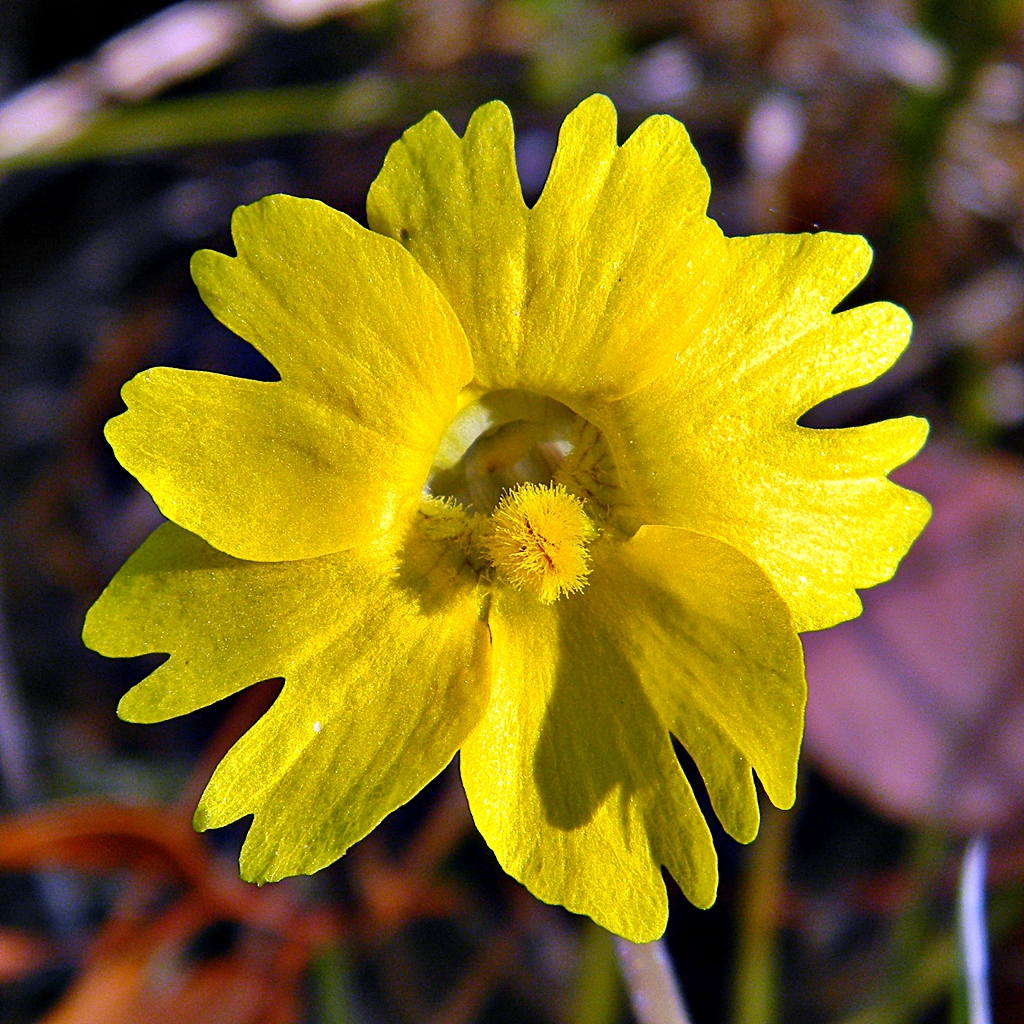
(Left to right) Butterworts native to North Carolina like the blue butterwort (Pinguicula caerulea) and the yellow butterwort (Pinguicula lutea) grow in sandy soil and in wet environments. (Image credit: Eleanor CC BY-NC 4.0; Bob Peterson CC-BY-SA 2.0)
The ‘Aphrodite’ butterwort cultivar I am growing is known as a Mexican or tropical cultivar. It has leaves that can grow up to 10 inches in length. They have a slight downward growing habit and range from bright green to a deep pink, depending on the light level and overall conditions. This cultivar generally grows as a basal rosette and can reach up to 6 inches tall. Butterworts can appear fragile, but they have a reputation for being easy to grow and quite vigorous. This plant has delicate short-lived flowers on long spindly stalks that emerge as deep violet and fade to a pale pink. Plants can flower year-round, but most are more prolific during warmer months. Make no mistake, though. You won’t be growing this plant for showy flowers; you’ll be growing it for its insect-eating super power.
Growing Conditions and Care of Butterwort Plants
Light
As a potted plant grown indoors, cultivated butterworts like sunny to part-sun conditions. A south facing windowsill is great, and supplemental lighting can also be helpful especially during the winter. Avoid too much exposure to hot sun, though, especially if you periodically put your plant outside during warmer months. Outdoors, they require only part sun. Although native butterworts in NC are cold hardy to our winter temperatures and require a period of dormancy, cultivars like ‘Aphrodite’ are considered tropical plants that cannot tolerate frost.
Growing Media
Butterworts have very shallow roots whose main job is to provide anchoring for the plant. They require a special medium in which to grow. Some experts recommend a mix of 1 part peat to 3 parts perlite, vermiculite, or sand. Very loose, well-draining soil is a must. If you don’t want to mix your own, carnivorous plant mixes are available commercially online and in some local nurseries.
Water
Despite their resemblance to succulents, butterworts have very different water requirements than their look-a-likes. They need to always stay moist and should never dry out during their active growing seasons in warmer months. Planting butterworts in a plastic pot with drainage holes instead of a porous terracotta one can help mitigate evaporation and keep the plant moist. Some experts recommend placing them in a bowl or saucer of water 1-inch deep. This eliminates the need for overhead watering. Especially important is their need for low mineral content, so do not use tap or well water. Likewise, chlorine in most municipal water systems will damage the plant. Instead, only use distilled water or rainwater to keep these carnivores happy.
If your ‘Aphrodite’ or other Mexican-type butterwort leaves begin to plump up like those of succulents during the winter, you can limit the tray watering and keep them only slightly moist. They are experiencing a type of dormancy. Once the thinner flatter leaf shape returns, begin watering again with the tray system. However, most experts recommend that you do not force this dormancy. If there are no appreciable changes in the leaves, you don’t need to change your watering methods. Just carry on with sitting the plant in the 1 inch of water as normal.
Nutrition
Butterworts do photosynthesize, but they receive most of their nutrition from the insects they trap and ingest on the surface of their sticky leaves. Most experts contend that carnivorous plants generally do not require supplemental fertilizer. According to the North Carolina Botanical Garden, which does fertilize their carnivorous pitcher plants sparingly, “all carnivorous plants are extremely sensitive to over fertilization.”1 Best to let insects do the work for you.
Discover something new with the butterwort. Hopefully you’ll take care of any pesky flying gnats in your home and have a great conversation piece! You can easily find the cultivar ‘Aphrodite’ and other butterworts online. If your local nursery stocks any carnivorous plants, ask them if they have access to the plants as well. And while some of the native “pings” can be found in nature, they can be rare, and on private or public land, so it’s best to leave them undisturbed. Instead seek out cultivated options in the commercial arena from a reputable seller.
Notes
1–See NC Botanical Garden’s guide to growing native carnivorous plants for more information.
https://ncbg.unc.edu/wp-content/uploads/sites/963/2020/02/GrowingCarnivorousPlants.pdf
Resources and Additional Information
For general information on butterworts (Pinguicula spp.) see North Carolina State University’s Plant Toolbox site.
https://plants.ces.ncsu.edu/plants/pinguicula
To learn more about how scientists are researching the genes of butterworts and other carnivorous plants to reduce pesticide and fertilizer use for crops, see Penn State University’s site.
https://www.psu.edu/news/research/story/little-crop-horrors
Visit the University of Illinois Extension’s page to learn more about carnivorous house plants and their care.
https://extension.illinois.edu/news-releases/bugged-houseplant-pests-give-carnivorous-plants-try
For some stunning photos of carnivorous plants including the butterwort, check out Duke University’s page featuring a photo gallery of their live plant collections.
https://liveplantcollections.biology.duke.edu/featured-collections/carnivorous
Article Short Link https://wp.me/p2nIr1-3SL