The Budding Orchardist’s Espalier Apple Tree Journey

By Jeff Kanters, NC State Extension Master GardenerSM volunteer of Durham County

Color illustration of a man gardening, holding a shovel in one hand and a plant in the other.

In November of 2023, I planted in eight new one-year-old apple tree whips at the Briggs Avenue Community Garden’s teaching orchard. While most of the trees were planted along a designated row, two of the apple trees were planted differently. I planted each one in large rectangular raised beds that flanked an arbor between the north and south orchard. I intended to train them into espalier along a large panel of cattle fencing constructed at each side of the arbor.

Wooden arbor structure with cattle fencing, designed for training apple trees, in a community garden setting.

Arbor with cattle fencing to train trees to espalier. (Image credit: Jeff Kanters)

The History of Espalier

For those who may be unfamiliar, the term ‘espalier’ (pronounced /eh·spal·yay/) is French to describe a fruit tree or ornamental shrub whose branches are trained to grow flat against a wall, and/or supported in flat fashion on a lattice, a framework of stakes, or fencing in some ornamental design.
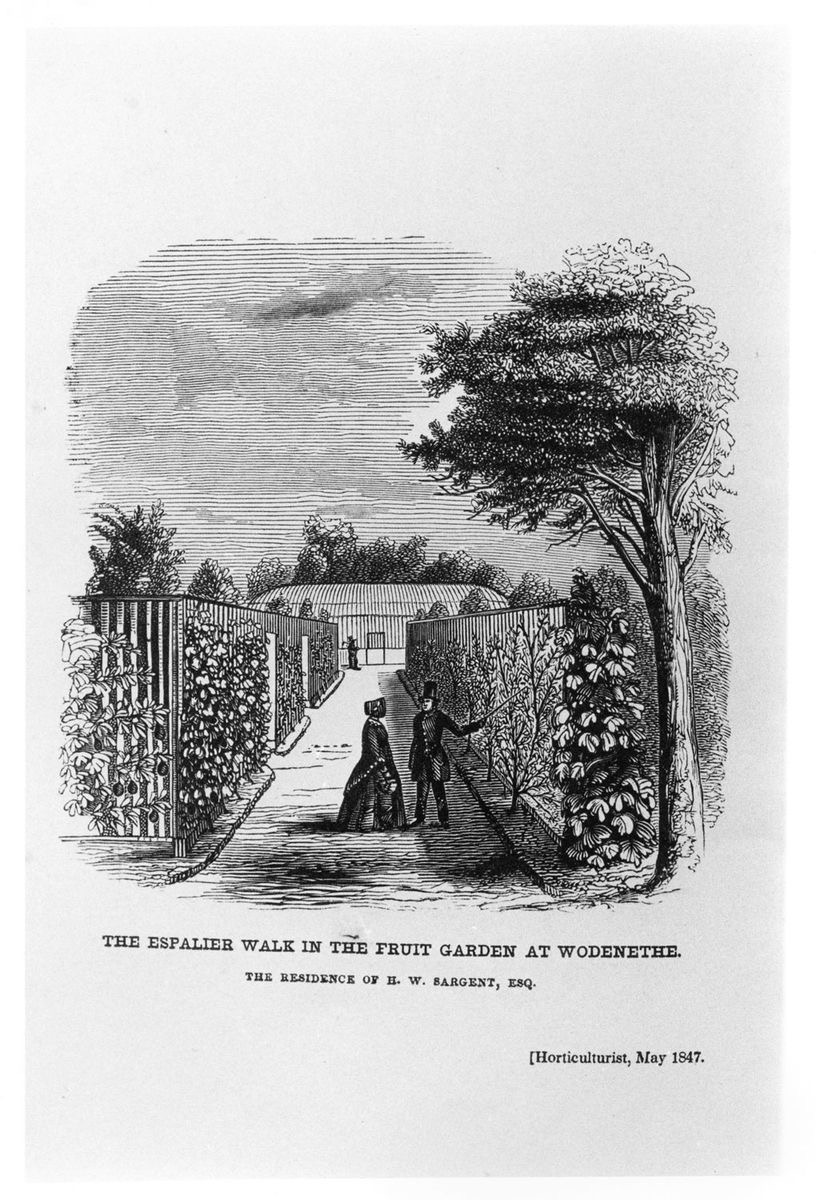
Black and white illustration from 1847 of an espalier walk in a fruit garden, featuring two figures among fruit plants against a trellis backdrop.

Mid-19th-century rendering of espalier at a garden estate in Beacon, New York. (Image credit: Courtesy of the National Gallery of Art. Anonymous, “The Espalier Walk in the Fruit Garden at Wodenethe,” in A. J. Downing, ed., Horticulturist 1, no. 11 (May 1847) CC BY-NC-SA 4.0)

The practice of espalier has been around for centuries — even since ancient times. The application of espalier became formalized in medieval Europe, used primarily to maximize fruit production within confined or limited spaces. The practice evolved further during the Renaissance, particularly in France which embraced both its functionality and its design aesthetic. Eventually the practice found its way to England and then the American colonies in the 1700s. And here we are.

What Apple Trees Make Good Espalier?

Two tree varieties were selected for espalier at Briggs, ‘Horse’ and ‘Aunt Rachel,’ both heirloom apple trees grown in North Carolina. What made these apple trees unique and good for espalier training is that they are spur producing. This means that apples develop on short twig-like spurs along a branch, rather than clustered on the tips of new growth. The apples produced are more easily harvested along the flat plane of the espalier shape, and the trees are easier to train, prune, and manage without sacrificing fruit production.

Tip-bearing varieties on the other hand produce fruit on the tips of branches and pruning to manage an espalier shape would likely remove too many potential fruit buds, reducing fruit production. Another advantage of espalier-trained trees is that the shape improves air circulation and makes disease and insect control easier.

There are many espalier shapes available. I chose to train each tree up and along a cattle fence support into a flat candelabra shape. This would allow a maximum of growing area for fruit production and establish an ornamental look to the trees.

Sketch of a planned espalier apple tree design resembling a candelabra shape, with green foliage and a grid background.

Planned candelabra shape for the apple trees. (Image credit: Jeff Kanters)

Espalier Plan for Apple Trees Put into Action

The new tree whips were planted in November 2023, centered at each fence panel and within six inches of the fence. The top one third of each whip was pruned off to a healthy bud to support and reduce stress on the young roots and stimulate lateral bud growth for the next growing season. The young trees initiated their first growth in the spring through the summer of 2024. The next decision I needed to make was when to prune and initiate the training of the new tree growth.

Garden arbor structure with cattle fencing, used to train apple trees into espalier, surrounded by a stone path and planting area.

As indicated by the white arrows, new apple tree whips planted in each bed November 2023. (Image credit: Jeff Kanters)

Training and Pruning Apple Trees for Espalier

There are different approaches about when to start training and pruning a young tree for espalier. The climate zone, annual rainfall, temperature changes, soil structure, and type of tree are some of the factors that influence the growth rates of apple trees to take into consideration. Whereas some trees may put out enough growth the first year to begin the training of growing branches immediately, other trees may need a full year to grow and build adequate sugar reserves in their roots.

During the following winter dormancy, selective pruning is done to encourage the tree to put out the additional lateral growth needed to further develop new branches for training that second year. Whatever the approach, espalier training on an apple tree should be started when the tree is young during its first couple years of growth. Starting from the lower base of the tree, the training will continue as the tree grows to utilize as much space and branching as possible.

Because the young trees were initially slow in putting out their first new growth in 2024, I chose to allow them to grow their first full-summer season before initiation of training in 2025. During winter pruning in January 2025, I did prune out developing branches that were growing outward away from the flat plane of the fence. I also pruned off another third of the vertical top trunk of the tree to stimulate lateral buds to grow branches when growth began again in the spring.

(Left to right) The ‘Horse’ variety and ‘Aunt Rachel’ after summer growth of August 2024. (Image credit: Jeff Kanters)

This spring of 2025, both trees put out robust growth and I was able to identify better developed lateral growing branches to initiate training to a two-dimensional form. New branches growing into and through the fence and/or outward away from the fence were again snipped off to focus all branch growth laterally along the same plane as the fence to position and secure the developing branches in a flat horizontal manner along the fence.

(Left to right) Pictures of ‘Horse’ and ‘Aunt Rachel’ trees putting out new growth after espalier training started in April 2025. The candelabra design begins to emerge. (Image credit: Jeff Kanters)

Tips for Training New Espalier Growth

A note of caution when training new growth: take care to allow any new lateral branch growth to get enough length and firm up past the very new, soft-green stage before beginning the training. Attempting to bend a growing branch when it is too soft could result in its snapping off from the trunk. A month or two of slow hardening of the new limb will enable the growing branch to be positioned properly and secured at the fence without breaking off.

There are many kinds of ties, bands, or wraps that are used to secure the flexible branches to train espalier that are effective. I chose one that is high-quality cloth fabric, stretches, is non-constricting for limb growth, provides good support, and holds up for at least eighteen to twenty-four months before degrading or removal. This gives the branches over a year to harden off in position.

A hand securing an apple tree branch to a cattle fence using a green tie for espalier training.

Securing a branch laterally with a band on the fence. (Image credit: Jeff Kanters)

As new growth continued to pop outwards from the trunks, I identified newly-developing lateral branches, starting with the lowest set about three feet from the ground. Each opposite set of laterals was trained to grow out from the trunk and parallel to the ground along the fence. Working upward, another set of developing lateral branches were selected growing about twelve inches above the ones below. As new lateral branches grow out up from the trunk for upcoming growing seasons, the same process is followed, striving to maintain a distance of about ten to twelve inches between each lateral branch along the fence.

The espalier training of both young apple trees has progressed nicely this second season as both trees have produced four sets of lateral scaffold branches trained on the fence already. I will continue to head off the top growing vertical trunk to get more lateral limb development each season.

The espaliers really taking shape in summer of 2025 with ‘Horse’ on the left, “Aunt Rachel’ on the right. (Image credit: Jeff Kanters)

If you have limited space, a sunny area, want to grow apples, and have an artistic bent, espalier trees may be for you. Growing espalier takes attention to detail and some patience, but the payoff can be most gratifying.

Stop by Friday or Saturday between 9:00 am and Noon for a visit at Briggs Avenue Community Garden‘s teaching orchard at 1314 S Briggs Avenue, Durham, and check out the developing espalier trees. I will provide updates in coming blogs as the trees grow and training continues to the first apple harvests.

Resources and Additional Information:

Growing fruit trees in central NC–read more on our blog: https://wp.me/p2nIr1-2ln

A History of Early American Landscape Design: https://heald.nga.gov/mediawiki/index.php/Espalier

History of Espalier: https://hort.extension.wisc.edu/articles/espalier/

Garden Techniques for Limited Space: https://extension.usu.edu/ogdenbotanicalgardens/edible-garden-techniques

Incorporate the Art of Espalier in Your Landscape: https://extension.missouri.edu/news/incorporate-the-art-of-espalier-in-your-landscape https://lancaster.unl.edu/espalier-create-living-art-form-and-function

Edited by Susan Sharp and Melinda Heigel, NC State Extension Master GardenerSM volunteers of Durham County

Article Short Link: https://wp.me/p2nIr1-6lv

Bringing Plants of the Piedmont back to Downtown Durham

By Eric Wiebe, NC State Extension Master GardenerSM volunteer of Durham County

A once neglected site, Rotary Plaza in downtown Durham comes alive in July 2021 with sunflowers that produce seeds for wildlife. Millet, a grain used here in the design and novel to many urban dwellers, also serves as a great food source for gold finches and other birds. (Image credit: Ben Bergmann)

Have you noticed changes to the plantings in downtown Durham over the past few years? If not, you need to head on down, walk around, and appreciate the transformation of the many of the city-owned green spaces. This transformation, and the strategies behind it, point to a new way of thinking about our relationship to the landscape, both in urban settings like downtown, but also in our own yards. 

I had the pleasure of both walking around downtown Durham with and then sitting down and talking to Ben Bergmann, the architect of this transformation. Ben was hired by City of Durham in September 2020 and charged with re-envisioning and elevating horticulture in downtown Durham, including creating a Downtown Horticulture Crew within Landscape Services. Ben brought a widely varied background to this position, trained with BS, MS, and PhD degrees in plant sciences, and working as everything from small business owner and farmer to tropical agroecologist and research scientist. One thing all this work has in common is plants and his great love of them. Ben feels this broad range of experiences has helped prepare him for a job that has him applying both the art and science horticulture to a municipal government position with its many constraints and opportunities and multitude of stakeholders. 

“When I started, I realized I needed a mission statement to clearly and concisely communicate to my supervisors and the public what I and my unit in government is doing.” He stated that his landscape design and management are guided by the goal of enhancing

  • Environmental sustainability
  • Programmatic stability
  • Aesthetic appeal
  • Service benefits

He notes that it is important to recognize that these categories are not mutually exclusive, but each has a role to play in his horticultural work supporting the living landscape in downtown Durham. 

Designing Sustainably

Ben explains that a crucial re-orientation is to start planning a landscape by thinking about how it can best align with the ecosystem, and that means starting with native plants that can be used. “For urban contexts some people would say that there is nothing native to these downtown spaces, and they will use this as an ‘out’ to plant whatever they want. I don’t embrace this–something was native, originally, in these spots. Many times these native plants can and will grow and thrive in these spaces.”

When Ben thinks about which native species to use, he first looks for plants native to the North Carolina Piedmont and secondarily to the larger Piedmont of eastern U.S. He notes, however, that it is very important to select plants with a long-range vision. That is, when accounting for global climate change, plants that are going to be here in 20 years may very well be in an environment that looks more like the southern Piedmont, our coastal plains, or South Carolina.

(Left to right) By selecting plants that can cope with a warming environment, Bergmann installed dwarf palmetto (Sabal minor), a plant typically associated with climates in the native ranges east and south of Durham, NC, and shown in green on the USDA’s zone map. (Image credit: Ben Bergmann; https://plants.usda.gov)

While native species take the lead when planning bed renovations, Ben states that non-native plants can still play a role. Returning to his guiding principles, non-natives can help fill functional gaps that might be hard to resolve in the short run with native species. Similarly, there are times that a spot planting of a non-native will help achieve a particular aesthetic goal by providing highlight color, texture, or architecture.

(Left to right) Before, a non-imaginative flag pole bed at Durham Parks and Recreation building included a highly invasive and exotic species: Nandina domestica. After a re-imagining, the same bed demonstrates there is a place for non-native plants alongside natives, especially during transition phases. (Image credit: Ben Bergmann1

Because the legacy plantings downtown were almost 100% non-native, it means that during a bed’s transition period, some non-natives may be left to help visually and functionally stabilize the bed until new, native plants can get established and then take over. Among other things, the non-native plants retained just for the transition can provide shelter from the sun and wind during establishment.

(Left) The process of establishing an urban prairie at the Rotary Plaza began in September 2020 with beds filled with weeds and remnants of long past garden attempts. (Middle) In March 2020, the the beds are full of cover crops: crimson clover, a nitrogen fixer that is great for pollinators in early spring, and winter rye, which has high biomass production and deeply penetrating roots. The intricate planting pattern reflects intentionality and provides visual interest. (Right) By July 2022 the Piedmont Prairie Garden at Rotary Plaza is realized and chock-full of sustainable native plants. (Image credit: Ben Bergmann)2

Even given how much he has achieved is such a short time, Ben still takes the long view when planning and planting. For example, cover crops have been used in very purposeful ways in areas such as the Rotary Garden. During the initial transition of this space, cover crops were planted and maintained in ways that not only helped build the soil, but created visual interest. Over time, the cover crops matured and eventually replaced with native perennials, creating an evolving horticultural narrative in this space. As Ben said, “Some [landscape] designers shy away from transitions–they want to ‘put a tarp over it’ until it has reached its final phase. I don’t shy away from transitions; they are an important part of my plans.”

Ben notes that using select non-native plants, cover crops, and other annuals allows him to more easily use seeds, plugs, and small plants in the beds. In the case of herbaceous perennials and woody plants, besides being less expensive, younger, smaller plants will typically develop more robust root systems and quickly outgrow their bigger counterparts.

Addressing Urban Challenges

Ben was quick to remind me of the many contextual limitations and challenges the Downtown Horticulture Crew faces daily that home suburban gardeners rarely have to contend with. For example, CPTED (Crime Prevention Through Environmental Design), is an important set of guiding heuristics that often preempts other design considerations. In addition to making sure plantings do not screen illicit activities, it also disallows designs that interfere with security cameras or impair pedestrian safety, including driver site lines at street crossings. 

The center of the Chapel Hill Street parking lot is a perfect example of an urban heat island with even hotter microclimates where landscapes are needed. (1) In January of 2022, the lot was cleared of weeds and other unhealthy, dated, and non-native landscape plants. (2-5) The view in 2024, after Bergmann and his team revitalized the area with an assortment of heat-tolerant natives. (Image credit: Ben Bergmann)3

Most of the beds Ben and his crew manage are surrounded by heat absorbing asphalt and concrete and buildings with glass that intensify solar radiation by reflecting light onto them. This creates heat islands much hotter than in surrounding communities. In addition, tall buildings funnel wind through these spaces and block rain, further desiccating plants. 

Humans also are unhelpful, by walking on, driving over, or otherwise physically challenging plantings. Some soils are more like landfill or construction sites, and many have the negative impact of overuse by dogs on their walks. Even with these challenges, Ben has identified quite a few native species that are up for environmental extremes while still fulfilling functional and aesthetic goals. Not surprisingly, he is currently exploring the possibility of a demonstration xeriscape-inspired bed. This one may very well include some non-native plants more typically found in desert environments.

Educating the Community

Ben understands that an important part of his job is educating not only the workers and residents of downtown Durham but all city residents and visitors as to a new way of envisioning landscapes. Landscapes that, while they exist in a human-built environment, much more clearly reflect real ecosystems of the NC Piedmont. This means not only planting predominantly native species but planting them in soil nourished by natural mulches created by the plants themselves rather than imported, dyed wood chips. He also allows the plants to go through full cycles, creating visual landscapes that sometimes predominate in browns, grays, and blacks, as much as greens, yellows, and reds. 

(Left to right) The Piedmont Prairie Garden at Rotary Plaza in early January with the last vibrant colors and in late February, when the remaining plants still create an almost black-and-white picture. (Image credit: Ben Bergmann)4 (Below) By designing a phenology calendar for his plantings, Bergmann pays careful attention to nature’s timing. This tool helps gardeners know when to plant, specific bloom times, and when colors, textures, and other elements are present throughout the seasons. For a closer view, click on the link for an electronic version of the calendar in our Resources and Additional Information section below.

He is heartened that there is a growing critical mass of professionals helping him in this educational work. The City of Raleigh and Wake County has been hard at work creating plantings that reflect this same vision. He also has strong allies at Duke Gardens, where Annabel Renwick, has provided both inspiration and plants for some of the bed designs. Ben recognizes that it will take a while both for his beds to reach the final stages of their design vision and for Durham residents to embrace this new look, but he has already received lots of positive feedback for his renovated beds. It will also be up to Durham Master Gardeners, and committed gardeners everywhere, to help continue to educate the public and support this work.

Plant lists for featured Downtown Durham Sites

1–The planting design at the Parks and Recreation administration site include a mix of natives (*) and non-native plants: threadleaf coreopsis* (Coreopsis verticillata), creeping phlox* (Phlox subulata), eastern ninebark* (Physocarpus opulifolius), panicle hydrangea (Hydrangea paniculata), lantana (Lantana camara), coleus (Solenostemon scutellarioides).

2–Plants in the Piedmont Prairie Garden at Rotary Plaza include swamp milkweed (Asclepias incarnata), blue mistflower (Conoclinium coelestinum), purple coneflower (Echinacea purpurea), Joe-Pye weed (Eutrochium fistulosum), Spotted Joe-Pye weed (Eutrochium maculatum), common sunflower (Helianthus annuus), scarlet rosemallow (Hibiscus coccineus), larger blue flag iris (Iris versicolor), cardinal flower (Lobelia cardinalis), switch grass (Panicum virgatum), garden phlox (Phlox paniculata), hoary mountain mint (Pycnanthemum incanum), brown-eyed Susan (Rudbeckia triloba).

3–Center of Chapel Hill Street parking lot showcases the following native plants: sedge (Carex bicknellii), purple love grass (Eragrostis spectabilis), Elliott’s lovegrass (Eragrostis elliottii), scarlet rosemallow (Hibiscus coccineus), swamp rosemallow (Hibiscus moscheutos), Virginia sweetspire (Itea virginica), tulip poplar (Liriodendron tulipifera), black-eyed Susan (Rudbeckia hirta).

4–The Piedmont Prairie Garden at Rotary Plaza in late February still offers color, texture, and winter interest. They include climbing aster (Ampleaster carolinianus), scarlet rosemallow (Hibiscus coccineus), switch grass (Panicum virgatum), hoary mountain mint (Pycnanthemum incanum), white goldenrod (Solidago bicolor), showy goldenrod (Solidago speciosa)–with touches of hopeful green, beardtounge (Penstemon digitalis), eastern beardtounge (Penstemon laevigatus), stoke’s aster (Stokesia laevis), adam’s needle yucca (Yucca filamentosa).

5– See below for Bergmann’s list of natives that are tried-and-true performers for Durham and central North Carolina.

Resources and Additional Information

Piedmont Prairie Garden at Rotary Plaza Bloom Time / Color Calendar (electronic version)

https://go.ncsu.edu/piedmontprairiecalendar

NC State Extension on landscaping for wildlife with native plants in urban environments

https://content.ces.ncsu.edu/landscaping-for-wildlife-with-native-plants

North Carolina Native Plant Society’s list of recommended native species

NC State Extension on all things native plants

Article Short Link https://wp.me/p2nIr1-4Ku