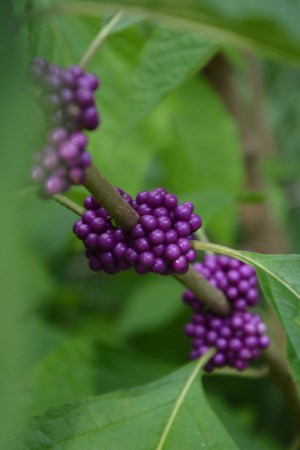
The Native Yaupon Holly, Ilex vomitoria.

Dear Reader: We are reposting this article because Ilex vomitoria is a tough, reliable, native plant that everyone should know about.It’s got flowers, berries, and evergreen leaves! And how about it’s name?I. vomitoria – there is a story there.

Original article and reposted article by Wendy Diaz, NC State Master Gardner SM volunteer

Berries of Ilex vomitoria. Image credit: Wendy Diaz

In 2020, I wrote an article about receiving platinum certification from the New Hope Audubon Society (NHAS) for a bird friendly yard. It was titled Gold is Good but Platinum is Better. Since then, I continue to replace exotic species with native plants. At one point I removed four large severely-pruned Burford hollies (Ilex cornuta ‘Burford’), which formed the foundation hedge along the front of the house.

Left: Original landscape using exotic Burford holly as a foundation hedge. Right: After the removal of Burford holly and replanted with native dwarf Yaupon holly . Image credit: Wendy Diaz

NHAS suggested native alternatives such as dwarf Yaupon holly, (Illex glabra) or sweet pepper bush (Clethra anifolia) to replace the old hedge. I chose and purchased three, 3 gallon Ilex vomitoria ‘Nana’ or Dwarf Yaupon Holly, from my local nursery, to anchor this west facing 12 foot long front bed. After the old hollies were removed, I had additional space in front of the new shrubs to plant native herbaceous perennials like Coreopsis, ‘Cosmic Eye’, Eastern Grey Goldenrod, (Solidago nemoralis) and Bee Balm, (Monarda didyma). This increased the diversity of plants in my front bed.

Some Basics: 

Yaupon Holly, (Ilex vomitoria) is a broadleaf evergreen shrub or small tree and a great landscape plant. It is also a native.[1]  They are naturally adapted to the maritime forest of the North Carolina coastal plain and can grow on dunes as well as in wet swamps and are more tolerant of heat than other hollies.[2] They can get as tall as 25 feet and form thickets. They can have multiple trunks.

The species prefers acidic, organically rich, well-drained soils with medium moisture. They can take full sun or part shade conditions. There are no serious insect or disease problems but avoid heavily compacted wet soil as this can be stressful. Once established they tolerate drought. The branches have smooth light gray bark but the young stems are burgundy. The leaves are small, thick, leathery, evergreen, and elliptical-shaped. They average 1 to 3 inches long and have a crenate or toothed leaf margin [4].

The leaves contain caffeine. Native Americans would dry the leaves and make a ceremonial emetic drink. When consumed in large quantities it would induce vomiting; hence the Latin name vomitoria applied to this species [2].

Spring Flowers

The flowers are tiny, white and fragrant. They appear in April and attract many different bee species. The Yaupon holly is dioecious meaning the male and female flowers occur on separate plants. Only female Yaupon hollies produce the attractive red berries (drupes) that form in the fall and last into the winter months. The light gray bark contrasts well with the red berries giving it great winter interest [4].

Spring Bud and flowers of Ilex vomitoria. Image credit: NC State Plant toolbox, Camelia TWU CC BY-NC-SA 2.0

Wildlife Value

It is a larval host plant for the Henry’s Elfin Butterfly (Callophrys henrici) and the Holly Azure Butterfly (Celastrina idella). [4]

The genus Ilex supports the specialized bee Colletes banksi [4]. Small mammals and birds eat the red berries. Birds also like to nest and shelter in the thick branches of my weeping yaupon holly, (Ilex vomitoria ‘Pendula’). Our resident green anole hides in the thick branches as well.

Left: Henry’s elfin butterfly (Callophrys henrici) Image credit: Flickr, Frode Jacobsen. Right: Holly Azure butterfly (Celastrina idella). Image credit: Flickr, Gail Hampshire

Cultivars

There are different forms of this cultivar making it useful in a wide variety of areas in the garden landscape. It can be used as a hedge, foundation shrub, windbreak, screen or specimen plant.  All cultivars can be clipped and shaped making it an ideal choice for topiary or bonsai[4]. 

Ilex vomitoria, ‘Pendula’, is a weeping form which makes it an ideal specimen tree)[5]. It can grow 15 to 30 feet in height and get 6 to12 feet wide.  Mine tends to get thick and twiggy and I frequently have to prune dead branches from its center.

Ilex vomitoria ‘Nana’, is dense, compact , rounded and mounded in form. This dwarf cultivar typically grows to 4 feet in height and has brittle, close-knit branches. It is a slow growing cultivar and spreads wider (3 to 5 feet spread) than it grows tall. The leaves tend to be darker green on the top than beneath the plant and new leaves are a yellow-green in color. The red berries (drupes) are not as common or as visible on this cultivar as in ‘Pendula’ but they will occur if the flowers of the female plants are pollinated[6]. This cultivar is popularly used for bonsai.

Some other dwarf cultivars are: ‘Bordeaux®’, ‘Schillings’, and Taylor’s Rudolph’. ‘Taylor’s Rudolph’ is reliably female and so will have berries if pollinated.

Ilex vomitoria, ‘Virginia Dare’, is taller and widely used for hedges. It will produce berries.

Ilex vomitoria, ‘Will Fleming’ , is a pencil-thin upright form.

This evergreen plant has definite appeal during all four seasons in the garden landscape with fragrant flowers that attract pollinators in the spring, glossy green foliage in the summer, attractive red berries in the fall that attract birds and evergreen foliage in the winter. If you need a shrub for a border, hedge, foundation plant or you just need a specimen tree, consider a cultivar of Yaupon holly. Choose the form you need for the space you have and it will improve the aesthetic value and ornamental interest in your garden landscape year round while also providing support for wildlife.

Resources and Additional Information:

Article Short Link: https://wp.me/p2nIr1-3Zm

Create a Bird-friendly Yard and Receive Recognition

by Wendy Diaz, EMGV

On August 5, 2018, the New Hope Audubon Society visited my yard after I filled out a simple online request form1. I heard about their Bird Friendly Habitat Certification Programafter attending the Backyard Biodiversity talks which were presented at the Chatham Conservation Partnership meeting on July 19, 2018. My growing interest in the importance of my garden to wildlife came about because I began reading Doug Tallamy’s book, Bringing Nature Home3. The book was recommended at a Durham Garden Forum discussion this spring on native plants by Ken Moore, assistant director of NC Botanical Garden Emeritus.

Before The Visit

The certification level (silver, gold or platinum) is determined by calculating the percentage of your available property (about 13,250 sq.ft. in my case) covered by native or invasive plant species and the number of wildlife habitat optionsavailable in the yard. My 0.37 acre (16,117 sq. ft.) pie-shaped property benefits from a mature hardwood  buffer area in the backyard so I thought I would achieve at least some degree of bird friendliness. The process is more efficient if you have a good plot survey of your property and a preliminary list of your plant species. I already had these items as a master gardener because we compiled these documents in our Landscape Management Plan as part of the Master Gardener Certification. I was also thankful that in previous years we removed invasive species such as the ice-damaged Bradford Pear (Pyrus calleryana) and a messy mimosa tree (Albizia julibrissin). There are multiple lists of invasive species to avoid planting in the Piedmont available at education institutional websites such as the North Carolina Botanical Gardenand North Carolina State University Going Native website6as well as other organizations7,8.

During the Visit

Three representatives from the New Hope Audubon Society slowly walked around my yard and natural buffer area and patiently answered all my questions and took notes pointing out species of plants that were good, not so good and considered an invasive threat for birds. It was a customized assessment of my yard and garden with respect to native plant species and wildlife habitat and a very educational two hours. I was very delighted to be informed that I had the diminutive native Crane-fly orchids (Tipularia discolor) under my beech tree (Fagus grandifolia) which I had never noticed until they pointed them out as well as identified a shade-tolerant native Redring Milkweed (Asclepias variegata L.) near a very large white oak (Quercus alba).  One of North Carolina’s smallest woody plants, Spotted Wintergreen (Chimaphila maculata, aka pipsissewa) was observed in the natural area. A native ground cover of Virginia snakeroot (Aristolochia serpentaria) was also scattered throughout the leaf litter. Other native shrubs of arrowwood (Viburnum dentatum) and St. Andrew’s-cross (Hypericum hypericoides (L.) Crantz) were quite common in my backyard, not to mention a young Black gumtree (Nyssa sylvatica).

DSC_9075
Crane-fly orchids (Tipularia discolor) Photo taken by Wendy Diaz on August 9, 2018

DSC_6987
Redring Milkweed (Asclepias variegata L.) Photo taken by Wendy Diaz on May 22, 2016

As a gardener, I have been reformed through education. The New Hope Audubon Society pointed out the many invasive species and also the natives in my yard. Why are natives important? Native plants, especially native trees, host a variety of insects that are necessary for birds to feed their young and these plants host the insects that are vital to birds and the complex food webs that have evolved in our local area2,3. Lists of native plants ideal for your area can be found on these educational institution websites5,6 or you can use the helpful online toolby just entering your zip code into the Audubon Society database of over 700 bird-friendly North Carolina native plants10. I obtained a list of 116 native plants that are important bird resources, relatively easy to grow and available at area native nurseries for my area.

Native plants covered about 30% of my available property (14 native canopy trees, 10 understory trees, 11 native shrubs, 18 native herbaceous plants, 8 native vines as well as leaves and decaying ground matter). I would like to take credit for most of these plants but the truth is, the homebuilders left the natural area behind my house with the existing forest more or less intact. Nevertheless, I did plant several native herbaceous plants such as beauty berry (Callicarpa Americana) in my perennial borders, pollinator and rain gardens and native magnolias (Magnolia grandiflora) and red cedars (Juniperus virginiana) for privacy screens. I also had several wildlife habitat options such as a snag (part of a dead tree), leaves left as mulch, pollinator garden, bundles of branches, blue bird houses, bird baths and no cats.

I did some damage in the past and roughly 10 % of my available property contained what they referred to as high threat invasive plants. When I first moved to the United States, I was a dangerous gardener ecologically speaking. Armed with very little knowledge of the southeast ecology but a strong desire to plant attractive flowering trees and vines that I could not grow in Canada, I planted a golden rain tree (Koelreuteria paniculata)8, Chinese wisteria (Wisteria sinensis), a mimosa (Albizia julibrissin), burning bush (Euonymus alatus), Bigleaf periwinkle (Vinca major) and English ivy (Hedera helix). The Bradford Pear (Pyrus calleryana) planted by the homebuilders was not my fault. The Japanese honeysuckle (Lonicera japonica), Japanese stiltgrass (Microstegium viminium), heavenly bamboo (nandina) and purple beautyberry (Callicarpa dichotoma) invaded from elsewhere.

DSC_9064
Volunteer invasive purple beautyberry (Callicarpa dichotoma)  Photo taken by Wendy Diaz on August 9, 201

DSC_9230

Native beautyberry (Callicarpa Americana) Photo taken by Wendy Diaz on August 9, 2018


After the Visit

The following week, I went to work pulling up some of the invasive species. I already was in the habit of pulling up mimosa seedlings as they germinated after a good rain; despite the removal of the mimosa tree over 3 years ago! Also on the clean up list were a small patch of Japanese stiltgrass, spiny olive, Chinese holly seedlings and the bigger job of removing tall nandina.

DSC_9080
Examples of invasive species removed from my garden and yard: Japanese stiltgrass (Microstegium viminium), spiny olive (Eleagnus pungens), chinese holly (Ilex cornuta) Photo taken by Wendy Diaz on August 9, 2018

DSC_9086
Heavenly bamboo (nandina) removed from holly hedge.  Photo taken by Wendy Diaz August 9, 2018

A few weeks after their visit, I received a package from the New Hope Audubon Society. In the end, my garden was certified a Gold Level wildlife habitat garden. They provided a plaque/sign that I hung proudly near our porch, a two page summary of their assessment listing number of native plant species in the canopy, understory, herbaceous and native vines along with recommendations for habitat improvement and provided a list of alternative plants to achieve the same landscaping goals only with native plants11. They also provided recommendations on the highest threat invasive species (10%) and other potentially invasive species. Am I going for a Platinum certification in the future?  Yes, but that requires reducing the available property with high threat invasive species to less than 10% and increasing the coverage by natives from 30% to 50%! I will do the work in stages after I make a plan and that will be the subject of my next blog.

Ever since their visit, three things have happened to me 1) I am noticing invasive species everywhere and 2) I am more observant of the birds and caterpillars and enjoy taking their photographs and 3) I am more appreciative of the commonly ignored but important native species in my yard. Our HOA discourages fences so I have resolved to embrace the wildlife that use my yard as a transportation corridor and as for my much loved ornamentals like hostas and other deer-loving plants, they are restricted to zones near my house where the deer do not seem graze. I found this exercise educational and rewarding and I enjoyed getting the attractive sign and recognition for my gardening hobby and stewardship. I encourage like-minded gardeners to contact the Audubon Society for their own certification.

DSC_0535.JPG
“Certified Bird Friendly Habitat” sign that came with the Gold Level Certificate and two-page wildlife habitat assessment. Photo taken by Wendy Diaz on October 25, 2018

DSC_9210
Cardinal eating in native beautyberry (Callicarpa Americana) Photo taken by Wendy Diaz on October 11, 2018


References:

  1. http://www.newhopeaudubon.org/conservation/bird-friendly-certification/form/
  2. http://www.newhopeaudubon.org/wp-content/themes/nhas/library/docs/certificationBrochure.pdf
  3. http://www.bringingnaturehome.net
  4. http://www.newhopeaudubon.org/conservation/bird-friendly-certification/creating-a-bird-friendly-habitat/
  5. http://ncbg.unc.edu/uploads/files/ControllingBooklet.pdf
  6. https://projects.ncsu.edu/goingnative/howto/mapping/invexse/index.html
  7. http://www.ncwildflower.org/plant_galleries/invasives_list
  8. http://moinvasives.org/wp-content/uploads/2016/03/MNRC_EmergingInvasives_QuinnLong_2016_0203_NotesPage.pdf
  9. https://www.audubon.org/native-plants/search?zipcode=27713
  10. http://nc.audubon.org/700?ms=nc-eng-email-ea-newsletter-20181004_%5bnc%5d_2018_native_plants_week&utm_source=ea&utm_medium=email&utm_campaign=20181004_%5bnc%5d_2018_native_plants_week
  11. http://nc.audubon.org/conservation/bird-friendly-communities/bird-friendly-native-plants