Upcoming Gardening Events for August 2024

Ask a Master Gardener

(Image credit: Allie Mullin)

The Ask a Master Gardener Program is an opportunity for members of the community to ask questions about gardening and learn more about the NC State Extension Master GardenerSM program. Durham County Master Gardener volunteers are available to provide answers using research-based information about plants and plant problems. They come prepared with a variety of gardening handouts, seeds for planting, and even some games for children!

You’ll find Master Gardener volunteers at the following community events this month ready for your questions:

August 20: Durham Farmer’s Market at Central Park, 8 am-12 Noon and North Durham Farmer’s Market, 12 Noon-4 pm

August 31: South Durham Farmer’s Market, 8 am-12 Noon (now located at Hub RTP, 500 Park Offices Dr., Durham)

Durham Garden Forum (DGF)

Matt Archibald, ISA board certified master arborist at Leaf & Limb, will deliver the DGF’s annual keynote address titled “Nine Ways to Help Heal the Earth” on Tuesday, August 20 at Sarah P. Duke Gardens from 7-8:30pm. Come early from 6-7pm and take part in the plant swap! Free for Durham Garden Forum members and $10 for non-members. Free parking provided for the event. To learn more about DGF and how to become a member, check out their site at https://durhammastergardeners.com/durham-garden-forum/.

Durham County Public Library

(Image Credit: Allie Mullin)

Sprouting Connections Garden Lecture Series: Fall Vegetable Planting with Master Gardener volunteer Monica Mense. Saturday, August 3, 10-11am. Main Library.

Plant Swap (Bring a plant, take a plant). A Master Gardener volunteer will be on hand to answer questions. Saturday, August 17, 2-3pm. Southwest Regional Library.

Please check website. Registration required; spaces limited. https://durhamcountylibrary.libcal.com/calendar?cid=14288&t=d&d=0000-00-00&cal=14288&inc=0

Pollinator Identification Workshop

(Image credit: Melinda Heigel)

Join the NC Wildlife Federation and NC State Extension for a Pollinator Identification Workshop at Briggs Avenue Community Garden in Durham. NC State ecologist Dr. Hannah Levenson will teach participants how to identify various bees and pollinators in preparation for the Great Southeast Pollinator Census 2024 (see below). Saturday, August 3, 9-10:30 am.

This in-person event is free and open to the public. Pre-registration is required. For details, see https://ncwf.org/event/pollinator-identification-workshop/.

Great Southeast Pollinator Census

Created by University of Georgia Extension, this citizen science project is open to all NC residents for participation in counting pollinators in your own yard or community. The event takes place on August 23 and 24 and aims to educate citizens about pollinators, generate useful data, and create more pollinator habitat. For more information on how to take part in this event, including how to count pollinators and report your findings, visit https://gsepc.org.

Article Short Link https://wp.me/p2nIr1-4Q3

Identifying and Controlling Leaf-footed Bugs in Your Garden

By Michelle Wallace, former Durham County NC Cooperative Extension Horticulture Agent


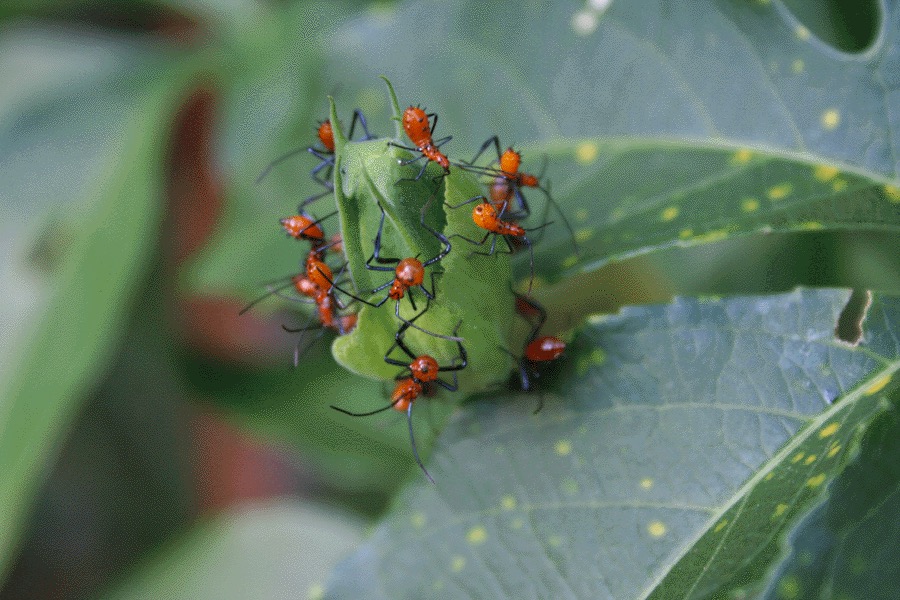
(Left to right) Detail of leaf-footed bug eggs on the underside of a tomato plant. They are cylindrical, laid in a single row, and typically hatch in 5-7 days. Leaf-footed bug nymphs often cluster together. (Image credit: Debbie Roos, NC Cooperative Extension, Chatham County Center; Texas Master Gardeners, Galveston County)

I work in a garden with a group of volunteers. The other day, a sharp-eyed person pointed out some bright orange-red bugs like these on the leaves of one of our potato plants.

Identifying Leaf-footed Bugs

These are the nymphs of the leaf-footed bug, a relative of stink bugs. Adult leaf-footed bugs are brown, with a flattened, leaf-shaped area on their hind legs. Both the nymphs and adults are pests that damage buds, flowers, fruits, and seeds. Leaf-footed bugs feed on many plants, including tomatoes, peaches, blueberries, beans, okra, and pecans. When these bugs feed on tomato fruit, they cause yellow, hardened spots to develop. Feeding on other fruits can cause brown spots to shriveled, misshapen fruits, depending on the number of bugs and the time the fruits are damaged.

Stippling and yellow spots on the tomato caused by piercing and sucking mouthparts of both stinkbugs and leaf-footed bugs. The crack in the tomato is most likely due to inconsistent moisture, not insect damage. (Image credit: University of Georgia Cooperative Extension)

Adult leaf-footed bugs overwinter in weedy areas or under mulch and debris. They lay eggs in a row on the undersides of leaves or on stems. Eggs hatch in 5-7 days, and nymphs mature in 25-30 days.

Leaf footed bug adult Photo: Debbie Roos, NC Cooperative Extension


Adult leaf-footed bug.
There are 7 known species of leaf-footed bugs in the southeastern US. Identification tip: One species common in our region, the eastern leaf-footed bug (Leptoglossus phyllopus), is chestnut brown in color and has a distinctive horizontal white stripe on its back. (Image credit: Debbie Roos, NC Cooperative Extension, Chatham County Center)

Controlling Leaf-footed Bugs

Leaf-footed bugs and their stinkbug relatives are difficult to control, but scouting for these pests now will help keep populations from building up throughout the season. Removing the nymphs and adults by hand and dropping them into a container of soapy water is an effective means of control when populations are small. You may want to wear gloves when picking leaf-footed bugs from your plants – they do have an unpleasant smell. There are few organic pesticides that are effective on these bugs, but hand picking now and reducing places where the adults can overwinter will help keep next year’s population in check. If you choose to use an insecticide to control a large population of leaf-footed bugs, pyrethroids can be used carefully and as directed.1

Just a quick word of caution, though – some assassin bugs (they are beneficial insects) are also orange and can look similar to the leaf-footed bug nymphs shown above. For photos of assassin bugs, see the University of Kentucky Entomology website.2

Notes

1–Leaf-footed bugs are also susceptible to insecticidal soaps. According to NC State’s Plant Disease and Insect Clinic, pyrethroid pesticides labeled for use by homeowners are also toxic to fish, so avoid using around pools, ponds, and streams. Pyrethroids are also toxic to beneficial insects like bees.

2–Consider a biological control method. Beneficial insects that are natural predators of leaf-footed bugs include look-alike assassin bugs, tachinid flies, native parasitic wasps, and spiders. Birds also prey on leaf-footed bugs. Making your garden attractive to beneficials may help curb unwanted pest populations.

Resources and Additional Information

NC Plant Disease and Insect Clinic Factsheet on the eastern leaf-footed bug

https://content.ces.ncsu.edu/eastern-leaf-footed-bug

Clemson Cooperative Extension’s Factsheet on attracting beneficial insects to your landscape

https://hgic.clemson.edu/factsheet/incorporating-beneficials-into-the-gardeners-toolkit/

Article Short Link: https://wp.me/p2nIr1-4KP