
One gardener’s attempt to bring a little laboratory precision to the backyard flower farm – for $150.
By Marcia Kirinus NC State Extension Master Gardener SM volunteer of Durham County
Images by Marcia Kirinus
For much of my career, I grew plants for research in highly controlled environments, from growth chambers to specialized greenhouses. In these settings, very little was left to chance. Temperature, humidity, light, moisture, and even carbon dioxide levels could be precisely controlled and monitored. Conditions were calibrated and documented so that experiments could be repeated and results trusted. As a research plant scientist, I understood how much the growing environment could influence a plant’s journey from seed to maturity.

One of the many greenhouses I managed in my career
I loved that work. After 35 years, I retired, only to discover something rather inconvenient: I still wanted to grow plants as though I had that kind of luxury. The problem was that all that useful equipment stayed behind as I moved on.
I commandeered our storage shed, trading space occupied by Christmas and Halloween decorations for plant-growing light carts. I cobbled together shelves and grow lights, repurposed an old refrigerator for seed storage, and found an old oak table that became my potting and germination station, complete with a potting tray and heat mat. I was learning to make do with the equipment available to a home gardener.
But there was one piece of equipment I really missed: a seed-treatment chamber.
I knew how valuable precise temperature control could be when germinating difficult seeds. Professional chambers offered the control I wanted, but even used chambers cost thousands of dollars. As much as I love growing plants, I couldn’t justify that kind of investment for my backyard flower-growing obsession.
So I started looking for an alternative.
An Unexpected Solution
Native seeds can have surprisingly specific germination requirements. Some germinate readily with suitable moisture and warmth; others have dormancy mechanisms that must be overcome first. Depending on the species, they may need several weeks or months of cold, moist stratification, sometimes preceded by a warm treatment. After stratification, some seeds need warmer conditions to germinate, while others respond to cooler temperatures.
I needed a way to provide these conditions without relying on an ordinary refrigerator, which is designed to keep food cold rather than accommodate a range of seed-treatment temperatures. My house could be too warm, while outdoor temperatures in Durham, North Carolina, were often unpredictable, particularly in late summer and early fall.
At first, I considered a wine cooler. Its adjustable temperature seemed promising, but the models I found had limitations. Their temperature ranges weren’t always suitable, and their bottle-shaped shelving would have to be modified to accommodate seed trays.
Then Facebook Marketplace offered an unexpected alternative. As I searched for wine coolers, beverage coolers kept appearing in the listings. Unlike many wine coolers, these had flat shelves that could accommodate trays. They also offered adjustable temperatures.
I eventually found a used Colzer beverage cooler for $150. Its adjustable controls and removable shelves made it a promising candidate, and its temperature range of 36°F to 50°F suited the treatments I wanted to try. It wasn’t designed for seeds, but it could provide the controlled temperatures I needed.

My $150 seed-treatment chamber. The records on the door help me keep track of each seed batch inside
How I Use the Beverage Cooler
Before starting, I researched the germination requirements of the seeds I wanted to grow. For those that needed cold stratification, I had to decide how best to keep them moist during treatment.
The literature describes several methods. One is to wrap seeds in damp paper towels and place them in a sealed plastic bag. Another is to mix them with a small amount of moist sand or vermiculite. Moisture is just as important as temperature. These methods help keep seeds moist without leaving them waterlogged. For the large seed I used paper towels and sand but for the small seed, I decided to use a different method.
I decided to try a third method: soil blocks. I sowed seeds directly onto the surface of the blocks and placed them in gallon-size plastic bags to retain moisture. Some seeds are so tiny – like dust. They can be difficult to recover from sand or vermiculite. I was also concerned that if they should germinate, emerging roots might become entangled in paper towels, or tumbled by heavy sharp sand making the seedlings difficult to remove without damage.
The soil blocks proved to be a good solution for handling these tiny seeds. Germination was strong in three of the four species I tried: Lobelia cardinalis, Lobelia siphilitica, Veronicastrum virginicum, and Eupatorium perfoliatum. The important advantage was that the seeds and emerging seedlings could remain in the growing medium rather than having to be separated from sand or paper towels.
For my first batch, I kept the cooler set to 38°F throughout the entire time. I used the setpoint as a guide rather than assuming that every part of the cooler maintained an identical temperature.
The key to managing multiple batches is keeping good records. Native seeds have different requirements, and it’s easy to lose track of which batch needs to come out on which day. I organized the seeds according to planned cold-stratification periods of 30, 60, or 90 days, staggering the batches so they wouldn’t all come out at once and overwhelm me.
The first batch came out on September 12. Some of those seedlings are still under grow lights for 18 hours a day, while others have already made their way into the garden.
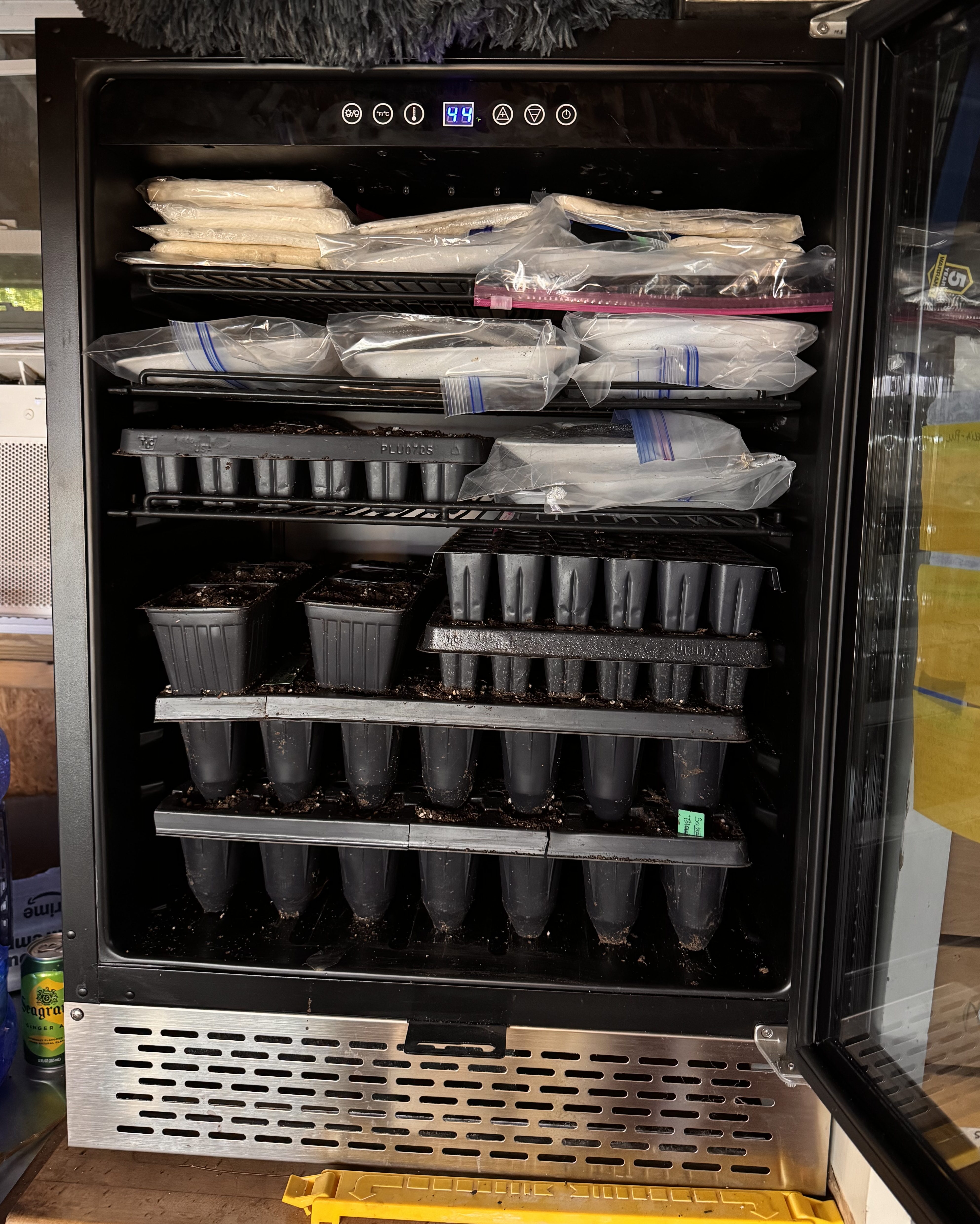
Different seed batches in soil blocks, paper towels and moist sand bags, each with a different schedule. Labels and written records help me keep the treatments straight. Plug trays contain the most recent batch of Rununculus sp. and Anemone sp. which will germinate in the chamber and then be transplanted out in the field.
What Have I Learned So Far?
The first batch of seed has given me some encouraging results. Several species germinated well following their planned cold treatments. These are observations from my own trials, not proof that every seed of a species will respond the same way.
| Species | Treatment in my trial | What I observed |
| Penstemon hirsutus | 60 days of cold treatment | 72% germination |
| Lobelia siphilitica | 60 days of cold treatment | 78% germination |
| Cephalanthus occidentalis (buttonbush) | 60 days of cold treatment | 95% germination |
| Echinacea pallida | Removed after about 30 days rather than the planned longer treatment of 60 days | 91% germination. More trials needed. Perhaps they only need 30 days – not 60. |
A Second Use: Germinating Cool-Season Annuals
I’ve also experimented with cool-season annuals such as larkspur, delphinium, and lupine. An experiment involving more than 500 plants showed me that the cooler could be useful for more than stratification: it could also provide a controlled, cool environment for germinating these flowers.
Normally, I sow most cool-season annuals directly in the garden when nighttime temperatures begin to drop toward 60°F. But outdoor sowing can be hit or miss. Timing is everything, and it’s easy to miss the window. Warm days can fry emerging seedlings, while birds and other animals may eat seeds before they germinate.
For this trial, I sowed larkspur, delphinium, and lupine in both soil blocks and plug trays and placed them in the cooler. I held the temperature setting at 38°F for three weeks, then raised it to 45°F for another two weeks. The seeds sown in soil blocks germinated successfully, and I’ve transplanted the seedlings into prepared garden beds. Germination in the plug trays was much more sporadic. I don’t yet know why; perhaps the difference was related to moisture or the growing medium, but that will take further testing.
For now, I’m leaning toward soil blocks. They worked well for this trial, made it easier to handle the seedlings, and took up less room in the cooler than the plug trays.

Young seedlings in soil blocks ready to be planted. These germinated in the beverage cooler. The tray represents 100 plants.
This two-stage cool-temperature treatment needs further testing, including with other flowers I love, such as poppies and Bells of Ireland. The cooler could give me a more predictable way to get an early start on spring flowers. Rather than waiting for the weather to cooperate, I can raise seedlings in advance and transplant them when conditions are suitable.

Transplanted delphinium seedlings in the garden ready to overwinter for early spring blossoms. All 600 were germinated in the beverage cooler.
What I Will Try Next
There are plenty of questions left to explore. Three next steps:
- Temperature fluctuations: I want to investigate whether changing temperatures help germination in particular species. Seeds experience changing conditions in nature, and I noted from an earlier experiment that changing temperatures on some species by bringing seedlings in and out of the house had a positive effect.
- Scheduling plants for market: Working backward from a plant sale selling date could help me coordinate dates for stratification, germination, and transplanting to produce premium plants on demand.
- Growing unusual species: I’d like to experiment with plants that are difficult to find in the nursery trade, especially those with specific cool-temperature requirements.
That last category is especially appealing. A controlled environment gives me an opportunity to test seeds that might otherwise be difficult to establish under ordinary backyard conditions.
Thinking of Trying This Yourself?
If you’re considering a beverage cooler for your own plant growing obsession, here are a few things I would look for:
- An adjustable temperature range. Check the specifications for the actual model and make sure it can reach the temperatures you need. My Colzer adjusts from 36°F to 50°F.
- Removable, flat shelves. These make it easier to accommodate trays and containers.
- A reliable door seal. The cooler should close properly and recover its temperature after the door is opened.
- Room for your trays. Measure the interior rather than relying on advertised capacity, which is usually described in bottles or cans.
- A separate thermometer. Monitor the temperature inside the cabinet rather than relying entirely on the display. Temperatures can vary within the cooler.
- Good ventilation and safe operation. Follow the manufacturer’s installation and electrical-safety instructions. Check the refrigerant specifications and safety guidance, too. My Colzer uses R600a, a flammable refrigerant, so the appliance should never be drilled into or modified around its sealed refrigeration system.
A beverage cooler is not a substitute for a laboratory chamber. It doesn’t provide every environmental control that seeds might need, and seedlings will still need suitable light, moisture, and growing conditions once they emerge. But for the specific temperature treatments I’m exploring, it has proved useful and so much fun.
A Little Laboratory in the Backyard
My beverage cooler is not a sophisticated laboratory instrument, and I’m not trying to make it one. It’s a practical, inexpensive way to explore seed treatments, keep batches organized, and learn more about the plants I want to grow.
The first results are promising, and there are plenty more seeds to test. My $150 beverage cooler brings a little of the controlled environment of my research days into my home gardening which has been fun but the real win is discovering that I don’t need a laboratory full of expensive equipment to ask a good question – just a used beverage cooler, a notebook, and some curiosity.


