
By Gary Crispell, EMGV
And another one is in the books. Day, week, month, year—all things 2023. One must admit that this recent December was a major improvement over 2022. We finally got some moisture in the ground that didn’t run up the water bill and there was only one overnight in the upper teens. I’ll take it. Now, this being an El Niño year, there is no telling what we’ll have to endure with between now and April. Maybe if Canada would keep her frigid air up where it belongs…
She won’t. Therefore, I’ll attempt to provide you with the possibilities (just possibilities) for gardening in the Piedmont of North Carolina in January.
LAWN CARE: I know, “leave the leaves.” The exception proves the rule, right? Well-tended turfgrass is the exception here. Grass doesn’t really want anything to come between it and its requisite sunlight, even in winter.
So, the suggestion is to remove the leaves from your lawn and relocate them to the beds, natural areas, or compost pile. In an ideal world we wouldn’t have high maintenance, well-manicured, hybrid species lawns anyway. They are a net detriment to the planet even in England and Oregon where they grow well. However, traditions and HOA rules die hard. “Go native,” shouldn’t just be a commentary on one’s attire.
FERTILIZING: Not so much. If you are fortunate enough to have a wood-burning heat source, you may scatter the ashes (Cold, please) on any non-acid loving plant beds. That’s it.
PLANTING: Nursery stock (in pots or ball and burlap) can be planted if you can source it. Most nursery folk and landscapers spend January making the circuit of trade shows. There’s a reason.
Asparagus crowns can also be planted this month

PRUNING: If you really need to get out of the house, here’s something to sink your teeth into (although, I would advise sticking to the usual pruning tools unless you are a beaver). From a horticultural standpoint January is a good month to prune most woody plants as there will be less competition to fungi and decay.
Hand pruning is preferable to shearing when it comes to shrubs. If you must shear, be sure the shrub is wider at the bottom than at the top. More leaves get more light that way, allowing the plant to make more sugar, leading to a healthier plant, and ultimately a happier gardener. Isn’t that the ultimate goal anyway?


The first picture above is a ‘shorn’ shrub and an example of what not to do. The second picture shows resulting new spindly growth on same shrub. Please don’t prune like this. It results in a weak plant. If you had to cut it back for some reason, cut it lower so the shrub would be wider at the base resulting in stronger top growth. Pictures taken from: NC State Extention Publications
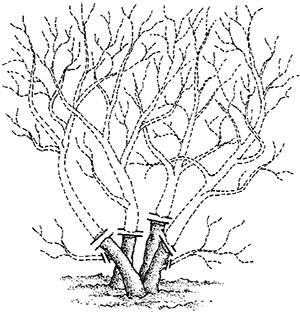
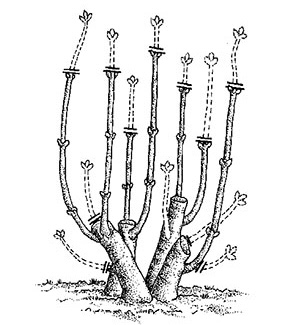
Correctly pruned shrub. The illustration is from Rutgers Agricultural Experiment Station.
Lesson #2 from Pruning 101: When removing an entire branch, make the cut at the branch collar (the place where it flares) to promote optimal healing outcomes.

SPRAYING: Alright, your houseplants had a summer vacation out in the yard. Then it turned cold and you brought them in not realizing they had let space on their bodies to a variety of lessees. It’s a thing. Plants take in boarders and they are very lax with the vetting process. In other words, they’ll let just about anybody move in (or on, as the case may be). And now those lessees are getting all warm and cozy in YOUR house. You, being a bit more discerning as to who might overwinter in your domicile, have decided that they gotta go.
It’s alright. Happens all the time. Your neighbor who has been a Master Gardener since before dirt has bugs in her house, too. Take a deep breath (while standing back from the offending plant—don’t want to inhale one of them vermin). Pick a warmish day and remove the plants outdoors. Apply the appropriate chemical(s) per the label on the pesticide container and KILL THEM SUCKERS DEAD! Be sure to bring the plants back in prior to any freezing temperature exposure.


A Mealybug nymph and a Mealybug extended family or potential “Lessees” on your houseplants.
Photo from US National Collection of Scale Insects Photographs Archive, USDA ARS, http://www.insectimages.org and https://www.flickr.com/photos/scotnelson/
HOW TO AVOID “CAN’T GARDENITIS” FOR THE NEXT TWO MONTHS: Sorry, there’s no vaccine. Two words that can help: SEED CATALOGUES. If you really want to grow it, somebody out there in seed catalogue land has it. This includes seeds for seedless watermelon. ‘Splain that. Another favorite past time is to Google, ‘NC Native Plants’, and see if there is an interesting plant to add to your garden. Or you can build a fire and roast chestnuts. Ponder the history of the American Chestnut and hope that one day, you too can grow one. Stay warm and dry and if it snows, well, it’ll be gone in a couple of days. Enjoy it while you can.
Personally, I’m headed to the Caribbean until April. (In my dreams.)
ADDITIONAL READING MATERIAL TO KILL TIME:
- General pruning notes: https://content.ces.ncsu.edu/before-the-cut
- Pruning Techniques: https://content.ces.ncsu.edu/general-pruning-techniques
- Pruning Tools: https://content.ces.ncsu.edu/tools-to-make-the-cut
- Pruning Specific Plants with Table of Common Trees, Shrubs: https://content.ces.ncsu.edu/how-to-prune-specific-plants
- Pruning Flowering Shrubs: https://njaes.rutgers.edu/fs1221/
- Pests on HousePlants “Lessees”: https://hgic.clemson.edu/factsheet/common-houseplant-insects-related-pests/
- Growing Asparagus in NC: https://content.ces.ncsu.edu/asparagus
Short Link: https://wp.me/p2nIr1-3OF