
By Marcia Kirinus NC State Extension Master Gardener SM volunteer of Durham County
Images by Marcia Kirinus unless otherwise noted.
If Halloween is your thing, you need this plant in your garden. Its stalk is mottled like snakeskin, its flower is dark and dramatic, and the whole thing smells like death.
Ten years ago, a friend gave me a small, dried-out corm and told me to plant it in a protected spot with dappled sunlight. So I did. I planted it on the north side of the house, where it gets an hour or two of sun just before sunset.
Every year since, an interesting stalk patterned like snakeskin has emerged, followed by one giant leaf that unfurls like a giant umbrella. It has always been the drama queen of the garden.


Left: The corms of Amorphophallus sp. Right: The umbrella-like foliage of Amorphophallus rises above a mottled, snakeskin-patterned stalk. The dramatic foliage is a garden spectacle in its own right, even when the plant isn’t blooming.
As temperatures cooled in the fall, it was one of the first plants to die back. My instructions were to lift the corm after the foliage died, but I never bothered. Instead, I added mulch each year to protect it through the winter. By now, the corm is probably buried fairly deep in the ground.
I believe my plant is Amorphophallus konjac, commonly known as voodoo lily or devil’s tongue. It is native to East Asia and has long been cultivated for its starchy corm, which is processed to make konjac flour and konnyaku, a traditional Japanese food. The raw corm is not edible because it contains irritating calcium oxalate crystals and must be properly processed before consumption.
A. konjac grows well for NC Piedmont gardeners, and is one of the easier species to grow. NC State Extension lists it as hardy in USDA Zones 6a through 11.

The dark, ruffled bloom of Amorphophallus konjac is striking to look at, but it smells like rotting meat when it is fully ‘ripe’.
The Genus
Amorphophallus is a genus of roughly 200 species of plants in the arum family (Araceae), the same family as jack-in-the-pulpit, calla lily, and philodendron. The genus is native primarily to tropical and subtropical regions of Africa and Asia, extending into Australasia. Its name comes from Greek words meaning “misshapen” and “phallus,” a reference to the unusual shape of its central flowering structure.
I was already familiar with this genus, which includes Amorphophallus titanum, the titan arum, famous for producing the world’s largest unbranched inflorescence. These spectacular plants can reach more than eight feet tall, and botanical gardens often invite the public to visit when one blooms. The opportunity to see – and smell – one is a rare event.

Amorphophallus titanum, commonly called the corpse flower, in bloom at the North Carolina State University Plant Collection Greenhouse. This species has one of the largest flower structures in the plant kingdom. (Image credit: Dee Shore)
Having experienced that spectacle before, I decided to invite my own neighborhood to smell my much smaller version when, to my delight, I noticed that it was sending up a flower structure instead of its usual leaf stalk. This was the first time it had bloomed in the ten years I had grown it, a sign that the corm had finally reached flowering size. Instead of an eight-foot giant like A.titanum, mine was a more modest four feet tall, typical of A. konjac.

In comparison to A. titanum, A. konjac, (above) is much less dramatic. The entire structure (inflorescence) stands four feet tall which is typical for A. konjac. It lasts only a few days before the whole thing withers. It will not send anything above ground for the rest of the year.
Ten Years in the Making
The corm is the engine of the plant. It stores energy underground, then sends up either a single leaf or flower each year, never both at once. The leaf looks like an umbrella atop a mottled, snakeskin-patterned stalk and is the form most gardeners see. The flower structure appears only when the corm has grown large enough. After ten years, mine was finally ready for its big debut.
Amorphopallus konjac’s Big Debut:
When the flower structure emerged, I announced it on my neighborhood listserv. Then I taped a sign in the middle of the street that read, “Look at Me, Smell Me,” and chalked arrows up the driveway so visitors could easily find it.
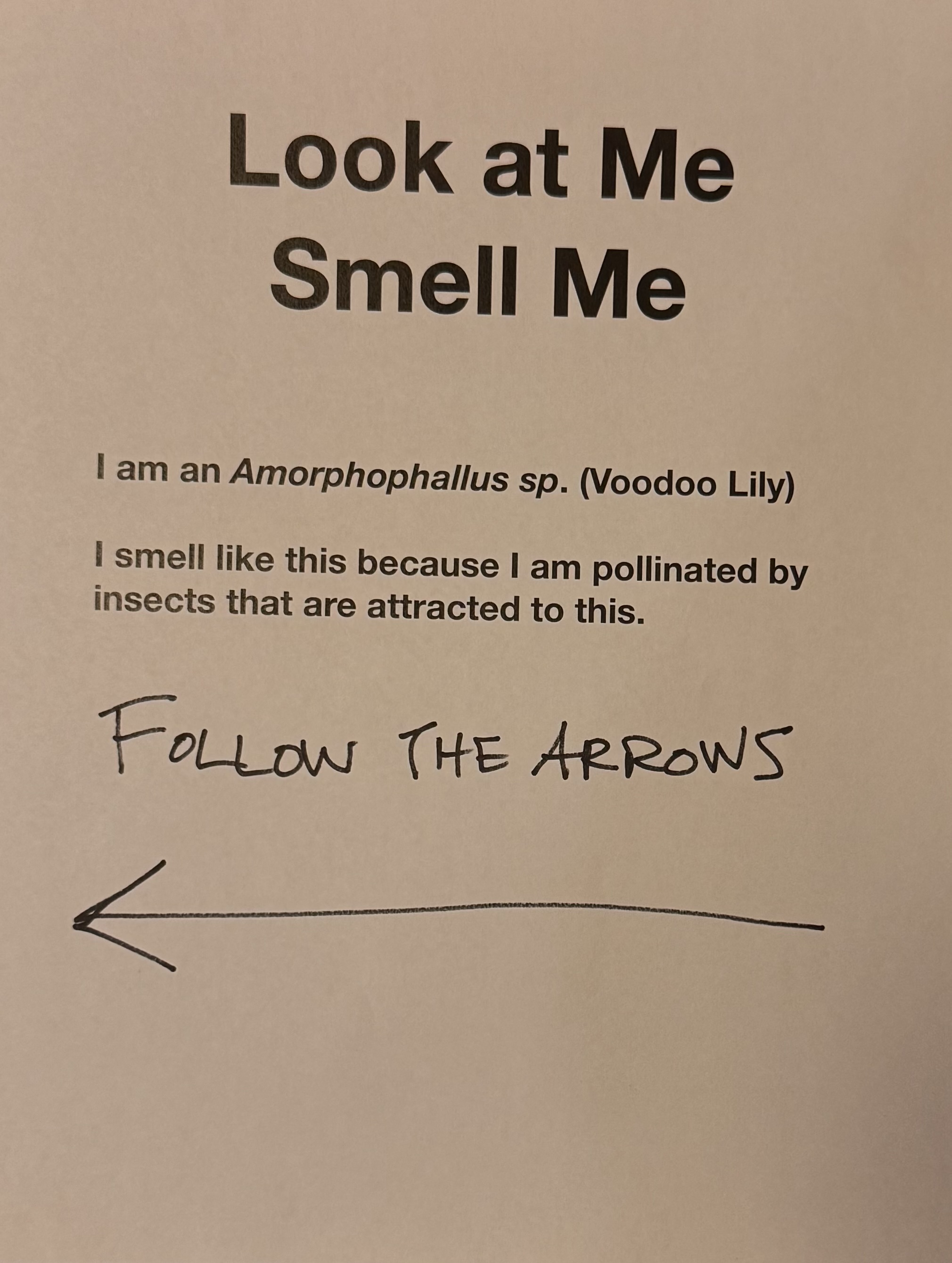

After announcing the bloom on our neighborhood listserv, I taped a sign in the street guiding neighbors to the stinky A.konjac.
For the first two days, finding it wasn’t a problem. You could follow your nose right to the plant. The entire area smelled like rotting meat, and getting close to the bloom was almost unbearable. Neighbors came by for days, describing the odor as rotting fish, spoiled meat, or wet garbage. It was a stinky but fun neighborhood botanical event.
Why Smell Like That?
The odor is a pollination strategy, not an accident. Amorphophallus blooms can mimic the smell of rotting meat to attract carrion-seeking insects, including flies and beetles. The dark maroon color, powerful odor, and heat produced by the spadix work together to lure potential pollinators.
The tiny flowers are hidden near the base of the spadix, inside the spathe. In some species, insects are temporarily trapped within the flower structure. The female flowers become receptive first, allowing insects carrying pollen from another plant to pollinate them. The male flowers release pollen later, when the female flowers are no longer receptive, helping prevent self-pollination.
In nature, this timing encourages insects to carry pollen between plants. Here in North Carolina, where a gardener may have only one plant, producing seeds is more complicated. Hand pollination is necessary, and successful seed production depends on having fresh pollen available at the right time.

Neighbor Kyler giving A. konjac a big sniff. When the bloom is older, as this one is, the scent fades. However you can still get the essence of it when you get close and personal.
Anatomy of the Bloom
What looks like one enormous flower is actually an inflorescence made up of two main structures: the spathe and the spadix. The tiny, individual flowers are clustered near the base of the spadix, hidden inside the spathe.
- Spathe: The dark maroon, ruffled structure surrounding the base. It is a modified leaf, not a petal. On my plant, it was glossy and wine-colored on the inside, rimmed with black and a wavy edge.
- Spadix: The tall, tapering spike rising from the center. Its upper, sterile portion, called the appendix, helps produce and release the odor. On my plant, the spadix stood approximately 2.5 feet tall and had a rough, wrinkled surface.
- Hidden flowers: The tiny true flowers sit in separate zones near the bottom of the spadix, inside the spathe. The female flowers are at the bottom, with the male flowers immediately above them.
- Stalk: The mottled green-and-brown stalk supporting the flower structure. Its snakeskin-like pattern is one of the plant’s most distinctive features and can also be seen on the stalk that supports its umbrella-like leaf.

Anatomy of the Inflorescence of Amorphophallus. (Image credit: The California Museum of Science)
A Fitting Halloween Flower
The voodoo lily is a fitting reminder that gardens can be strange as well as beautiful. Spending much of its life underground or displaying an elegant umbrella of foliage, it one day surprises the patient gardener by sending a towering, foul-smelling flower that gets the whole neighborhood talking. Between the dramatic appearance, stink and the parade of curious neighbors, this is a plant that earns its keep because of its sheer weirdness.