Meet Your New Favorite Plant at the Plant Sale on April 5

By Lissa Lutz, NC State Extension Master GardenerSM volunteer of Durham County

(Image credit: Allie Mullin)

It’s that time of year again. The sun is warm and friendly, mosquitoes are still snoozing, daffodils are perky amidst a flush of green, and that urge to work the soil begins anew. Though our rational minds know that fall is the better time for planting, there is something about spring that makes us want to contribute to its burst of verdant growth. We find joy in creating new garden spaces, starting the vegetable garden, converting lawn to habitat-friendly meadow, designing container displays, or just tucking a new plant or two into any available remaining space.

If you are lucky enough to live in the Triangle area, you may already know about the Friends of Durham County Extension Master Gardener annual spring plant sale. For a whirlwind few hours, shoppers peruse and take home the roughly 3,000 plants that have been lovingly seeded, divided, propagated, rooted and potted up by a dedicated team of Master Gardener volunteers. Despite the sale’s objective as sole fundraiser for the EMGV program, most team members participate because of their passion for growing and sharing the plants they love. Prices are competitive so everyone can take home a plant. In fact, at the Plant Festival that precedes the sale (March 22 this year), 250 people can take home a free plant.

This year, we asked Master Gardener volunteers who are plant sale team members to tell us about their favorite plants that are in the sale this year. Their picks may inspire you to try a new plant this year. If you cannot be at the April 5 sale in Durham (721 Foster St, 10am until sold out), look for these plants at your local nurseries and enjoy contributing to spring’s display!

Philodendrons

As I think about my favorite houseplant and why it is, so many thoughts and plants come to mind. But rather than being species-specific, philodendrons are one of my favorites that will be plentiful at this year’s sale. There are over 450 named philodendron varieties in the world. The diversity of form, habit, and coloring makes them versatile and desirable. Some of our offerings this year will be the ever-popular heartleaf to the more exotic-Blushing Philodendron (Philodendron erubescens).Wanda

Philodendron erubescens is a climbing tropical herbaceous perennial in the arum family (Araceae). The leaves, petioles, and spathe of this plant all exhibit the “blush” coloring. The leaves are glossy, deep green on the upper surface, and have a reddish or copper coloring on the underside. (Image credit: Dinesh Valke CC-BY-SA 2.0)

Gomphrena

It’s hard to believe that this little Gomphrena globosa ‘Fireworks’ seedling will grow up to be this vibrant spectacular plant on the right! Gomphrena ‘Fireworks’ has a hot pink flower with yellow tips, hence its name. It is an annual plant that thrives in sunny, hot, dry conditions, so is perfect in the Master Gardener Container Demonstration Gardens at Cocoa Cinnamon. It is a spectacular yet tough plant that will grow 3 to 4 feet tall and 4 feet wide, is a favorite of pollinators, and looks great in cut flower arrangements. —Deborah

Gomphrena globosa ‘Fireworks’ starts small but becomes a beautiful plant that is easy to grow and it is pollinator friendly. (Image credit: Deborah Pilkington)

Buckeye

I love the Painted Buckeye (Aesculus sylvatica) because it is such a harbinger of spring. One of the first trees to leaf out, this small understory tree is easy to spot in moist rich woods everywhere. The leaves are followed by a display of showy, creamy-yellow flowers. Buckeye has naturalized in my yard and the deer have ignored it. In the fall, the leathery seed capsules split open to reveal several shiny, smooth brown “buckeyes.” They are irresistible to touch; just don’t eat them as they contain toxic compounds. —Lissa

The Painted Buckeye (Aesculus sylvatica) is native to the Southeastern United States. It does best in sun to part shade in moist, well-drained soil. (Image credit: Dcrjsr CC BY 3.0, Suzanne Cadwell CC BY-NC 4.0)

Cherokee Sedge

Carex cherokeensis (Cherokee sedge) is a work horse in my garden. It’s a versatile plant that can be used as ground cover, edging, and as a companion plant for contrasting texture. I love the contrasting grassy texture in between my blooming flowers. It prefers moist conditions, so it can be used in the rain garden, but it is adaptable to various growing conditions. It thrives in my dry, full sun garden. It’s low maintenance and shade tolerant. If that’s not enough, it’s deer resistant and green all winter long. —Tram

Cherokee sedge is a native sedge. It blooms in spring and is followed by attractive drooping seedheads. The arching evergreen to semi-evergreen grass-like foliage is attractive all season. (Image credit: K Andre CC BY 2.0)

Sweet Prince Tomato

While I love all of our tomato varieties, I have a serious soft spot for ‘Sweet Prince.’ I’ve grown this variety the past two years in big pots, and by mid-season the plants have absolutely exploded with growth. They produce almost too many great little tomatoes right up until frost, and seem overall unbothered by disease. They’re actually a product of the NCSU tomato breeding program — I’m sure part of the reason they have such great disease resistance! —Ashley

The tomato breeding program, located at the Mountain Horticultural Crops Research and Extension Center develops parental breeding lines and F1 hybrids with superior genetics such as the ‘Sweet Prince’. (Image credit: NCSU Plant Breeding Consortium)

Aromatic Aster

Symphyotrichum oblongifolium is a favorite native plant of mine.  In the fall, it anchors this perennial garden in front of my barn, staying in bloom for a full two months at a time of year when most plants are shutting down.  Known as aromatic aster, it prefers poor soil, full sun, and is drought tolerant once established.  Spreading both by seed and stolons, it can try to take over, but is easily divided when needed.  Notice the color difference in the closeup photograph.  The darker reddish flower centers mean an older bloom that most likely has been pollinated, while the yellow center means a bloom that is younger and most likely not yet pollinated. —Peter

Aromatic aster is a native perennial wildflower in the Asteraceae (daisy) family. This plant was selected as the 2000 NC Wildflower of the Year. (Image credit: Peter Gilmer)

Anise Hyssop

I appreciate a plant that is self-sufficient, and Anise Hyssop (Agastache foeniculum) is that. Its needs are minor. A little water every now and then and a trim in early spring, and it does the rest. Its purple inflorescences start blooming in mid-summer and don’t stop until sometime in October. The spiky flower heads sway heavily with the weight of so many bees. I’ve paired it with goldenrod (Solidago rugosa), swamp sunflower (Helianthus angustifolius), and purple cone flower (Echinacea purpurea). Together they create a stunning display. I call them my “State Fair flowers” because they’re in full bloom when the Raleigh State Fair is in town. —Marcia

Anise Hyssop, (Agastache foeniculum) attracts bees, butterflies and birds to the garden and is resistant to deer and rabbits. (Image credit: Guettarda CC BY SA 4.)

Fish Pepper

I have been a little obsessed with the fish pepper (Capsicum annuum var. annum). This plant is a recent addition to my garden, but it is now a permanent fixture. I first heard about the fish pepper in an article in a cooking magazine in early 2021. The plant, prominent in the Black community, nearly disappeared but was lovingly resurrected by seed savers and food historians. By happenstance, I first encountered the actual pepper during my Master Gardener training class at Briggs’ Community Garden. I saved the seeds from the pepper I was given and have been growing them ever since. I use them as an unexpected and subtle new flavor in the Caribbean meals that I have learned from my mother. —Deandra

Debra Freeman explains the history and legacy of the fish pepper in the African American garden. You can read about it at this site: https://www.epicurious.com/ingredients/fish-peppers-african-american-garden-article (Image credit: Epicurious)

Spotted Bee Balm and Rattlesnake Master

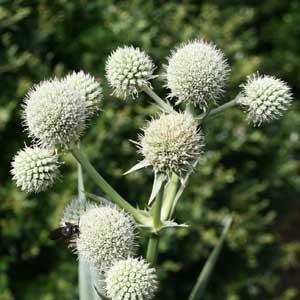
I love plants that come back year after year, and of the perennials I grow I especially love Spotted Bee Balm (Monarda punctata) for its absolutely strange shape and color. This plant throws out flower spikes that look like they belong on an alien planet and defy an easy description. This plant loves sun, is easy to grow, doesn’t creep much beyond where you plant it, and is beloved by pollinators. I already have it in my garden and plan to put it absolutely everywhere. It looks especially good next to the demure flowers of Blue Sage (which we sold last year!) and the wackier Rattlesnake Master (Eryngium yuccifolium), which we have available again this year, which adds a fantastic counterpoint of a blue-ish green leaf and tall, spiky, beautiful white flower “balls.” All three are perennial and complement each other with their looks and with what they provide for our local pollinators. —Ali

Spotted Bee Balm (Monarda punctata) and Rattlesnake Master (Eryngium yuccifolium) are available at the plant sale and are an excellent choice for a sunny pollinator garden. (Image credit: Susan Strine CC BY 2.0; Eleanor CC BY NC 4.0)

Peppers

Attempting to pick one favorite vegetable was difficult at best.  I realized I couldn’t pick just one…. So I decided to focus generally on the versatile pepper. Growing a variety of sweet and hot peppers offers so many options. I’m well known for my pepper casserole (just ask my neighbors). The dish I have adapted is the standard stuffed pepper recipe with ground meat, tomato, onions and rice, but I add corn and extra spices like good chili powder. Instead of stuffing the peppers, I cut up a variety of hot and sweet peppers into bite size pieces, quickly blanch them and then stir them into the casserole. Top it with cheese and bake until bubbly. Delish! (Note: Don’t eat meat? Replace it with black beans.)

And of course, I love to eat sweet lunchbox peppers right off the vine. The larger sweet Carmen (red) and Escamillo (yellow) are also great fresh, sliced into salads or stuffed. Grilled shishitos are a great touch to any meal; just don’t mix them up with your green cayenne peppers, as I have done. I grow the cute little Peach Wasp for the sole purpose of drying and grinding into pepper flakes. They are just a bit hotter than the ripe, red cayenne peppers and add a fruity taste. I haven’t even mentioned the Poblano! The possibilities are endless so try a few new peppers this year and experiment yourself. I would love to hear what you discover. —Bev

Peppers can be sweet, hot, large, or small and used in many culinary creations! (Image credit: Oregon State University, James Meyers)

To see all the plants that will be available for sale at the 2025 Plant Sale, see our website https://www.backyardtreasuresplantsale.org.

Article Short Link: https://wp.me/p2nIr1-5Lf

Deer-Resistant Native Gardening

By Lissa Lutz, N.C. State Extension Master GardenerSM volunteer of Durham County

(Image credit: Pixabay/MrsBrown)

Figuring out how to garden when you have deer is already a challenge, so you may be wondering how it can be done using only native plants. But fear not; with a little planning and careful plant selection it can be done. If you are just beginning to transition to native plants, keep in mind that a ratio of 70% native to 30% non-native is an acceptable and reasonable goal.1 While non-native plants are generally unable to host caterpillar species that are a critical food source for baby birds, there are some deer-resistant selections that can provide nectar for pollinators, habitat for animals, and structure and beauty in the garden design.

Plan for Structure in the Garden

When designing a new garden bed, it can be helpful to start with shrubs or small trees, particularly evergreens, that will provide structure or “bones” for the garden.The evergreen native yaupon holly (Ilex vomitoria) can be a solid backdrop to your other native plants.2 It tolerates sun to shade, comes in dwarf forms, and sports bright red berries in fall through winter which provide food for songbirds and small mammals. Sweet pepperbush (Clethra alnifolia), sweetshrub (Calycanthus floridus), and beautyberry (Callicarpa americana) are native shrubs that are not evergreen but can offer structure and texture to the winter design, and attractive foliage, flowers and berries during the other seasons. All three thrive in full sun to part shade. Calycanthus has fragrant spring blooms and Clethra’s late summer white flowers are a magnet for pollinators. Callicarpa sports a multitude of small bright purple berries as a valuable winter food source for birds and mammals.

Native shrubs that can provide structure for a garden include: (1) sweetshrub (Calycanthus floridus); (2) sweet pepperbush (Clethra alnifolia); (3) yaupon holly (Ilex vomitoria); (4) beautyberry (Callicarpa americana). (Image credit: Madeleine Bell CC-BY-SA 2.0); Susan Strine CC BY 2.0; Scott Zona CC BY-NC 2.0 ; Cathy DeWitt CC BY 4.0)

Some non-native options that are both hardy and striking include the evergreen tea olive (Osmanthus fragrans) and false holly (Osmanthus heterophyllus), with ‘Goshiki’ as a choice cultivar. Paperbush (Edgeworthia chrysantha) is not evergreen but has delightful fragrant blooms in the winter and is an underutilized deer resistant shrub with beautiful form with or without its leaves. All three thrive in full sun to part shade. For a lower growing shrub in a sunny garden, consider the evergreen creeping rosemary (Salvia rosmarinus ‘Prostratus’) which will happily cascade over a rock or retaining wall.

If your garden is on the shadier side, try the native evergreen anise tree (Illicium floridanum) or doghobble (Leocothoe fontanesiana). Illicium can grow to 10’ but is easily kept in bounds by pruning. It also comes in numerous cultivars with a variety of flower colors and size ranges including dwarf forms. Leucothoe boasts showy, fragrant white flowers in spring. 

(Left to right) Native plants that will thrive in shady gardens include anise tree (Illicium floridanum) or doghobble (Leocothoe fontanesiana).(Image credit: Cathy DeWitt CC BY-NC-ND 4.0; Suzanne_Cadwell CC BY-NC 2.0)

A non-native choice for the shadier garden might include the Japanese plum-yew (Cephalotaxus harringtonia). ‘Duke Gardens’ is a local cultivar noted for its compact shape.

Fill in the Garden with Perennials

Once you have anchored your garden design with some shrubs or small trees, it’s time to fill in with perennials. Many perennials can also provide structure and texture throughout the winter when you recognize the importance of leaving plants in the fall to provide winter habitat and food for animals. Hollow stems become nesting sites for solitary bees, and dried seed heads provide food for birds.

Choose Keystone Species

Significant deer pressure does narrow the palette but there are still many good plant options. A good place to start is to consider keystone species–plants that support the highest diversity and number of caterpillars. Goldenrods (Solidago spp.) are high on this list. If your garden is small consider some of the more well-mannered species such as sweet goldenrod (Solidago odora), white goldenrod (Solidago bicolor), or slender goldenrod (Solidago erecta). Most goldenrods bloom in the fall but using several different varieties can offer a spectrum of bloom time, shape, and color throughout the fall.3

(Left to right) White goldenrod (Solidago bicolor) and New England aster (Symphyotrichum novae-angliae) are two “keystone” species that should be on your list of the deer-resistant natives. Both offer colorful fall blooms to the landscape. (Image credit: Fritz Flohr Reynolds CC-BY-SA 2.0 ; Drew Avery CC BY 2.0)

Asters are also considered a keystone species. Asters may not be entirely deer resistant, especially under high deer pressure, but they tend to be so vigorous and bloom so late that deer browse is more like an early pruning and they will still often have a fine flower display in the fall. Consider incorporating aromatic aster (Symphyotrichum oblongifolium), New England aster (Symphyotrichum novae-angliae) or blue wood aster (Symphyotrichum cordifolium) to support specialized bees, caterpillars, songbirds and small mammals.

Plant Flowers with a Purpose

Flowers attract pollinators and add beauty. Many deer resistant natives are also great pollinator plants. Any of the mountain mints (Pycnanthemum spp.), will be swarming with hundreds of tiny pollinators throughout their bloom season, along with fragrant minty foliage. Blunt mountain mint (Pycnanthemum muticum) keeps evergreen through the winter, rising to several feet in the summer when it blooms. It can spread but is easy to pull up and share extra plants. Narrowleaf mountain mint (Pycnanthemum tenuifolium), has fine foliage and is more clumping. Hoary mountain mint (Pycnanthemum incanum) has silvery white foliage and fragrant leaves, but also likes to have some space and may be better for larger gardens. The mountain mints will tolerate partial shade.4

Boneset and thoroughwort (Eupatorium spp.) are underutilized native pollinator plants with excellent deer resistance. They have white flowers in summer and fall that attract bees and butterflies. Common boneset (Eupatorium perfoliatum) likes wet soils and will spread to form colonies. Roundleaf thoroughwort (Eupatorium rotundifolium) can tolerate both wet and dry conditions. Foxglove beardtongue (Penstemon digitalis) has showy white flowers in spring and its evergreen rosettes persist throughout the winter. An interesting and lesser-known plant that also has evergreen foliage in the winter is rattlesnake master (Eryngium yuccifolium), identifiable by its funky white ball-shaped flowers. Anise hyssop (Agastache foeniculum) is another key pollinator plant that has excellent deer resistance due to its licorice scent.

(Left to right) Common boneset (Eupatorium perfoliatum), foxglove beardtongue (Penstemon digitalis), and rattlesnake master (Eryngium yuccifolium) are striking native plants that are deer resistant and attractive to pollinators. (Image credit: Fritz Flohr Reynolds CC BY-ND 4.0; Julie Anne Workman CC BY-SA 3.0; Debbie Roos CC BY 2.0)

The beebalms (Monarda spp) seem to be less reliably deer resistant but are worth trying for their sheer flower power. Spotted beebalm (Monarda punctata) is an unusual species that seems to have somewhat higher deer resistance. It is a less aggressive spreader, and supports moths, butterflies, bees, hummingbirds, and several moth larvae.

(Left to right) Eastern bluestar‘s (Amsonia tabernaemontana) pale blue star-shaped flowers are attractive to beneficial insects but not to deer. These plants also provide fall color, as pictured here with the bright yellow leaves of the Arkansas bluestar (Amsonia hubrichtii). (Image credit: leonora Enking CC-BY-SA 2.0; Jim Robbins CC BY-NC-ND 4.0)

A must-have in the deer resistant native garden are the bluestars (Amsonia spp.). Eastern bluestar (Amsonia tabernaemontana) has delightful blue flowers in the spring and can grow to shrub-like sizes. Similarly Arkansas bluestar (Amsonia hubrichtii) can get quite large with fine textured foliage that turns dazzlingly yellow in the fall. Both species do well in full sun but can tolerate part shade.

Russian sage (Salvia yangii) is not native but attracts bees, butterflies and hummingbirds and sports showy blue flowers spring through fall. It tolerates drought and is highly deer resistant.

Add Native Grasses to Your Landscape

Don’t forget grasses (or ferns and sedges for the shady garden). Native grasses can also be excellent choices if you have full sun and deer. Pink muhly grass (Muhlenbergia capillaris) is a well-known grass with plumes of delicate pink in the fall. Little bluestem (Schizachyrium scoparium), splitbeard bluestem (Andropogon ternarius), and others can lend a prairie-like look in a more natural garden setting. Bottlebrush grass (Elymus hystrix) is a more shade-tolerant grass with a seed head that looks just like a bottle brush. These grass species stay beautiful throughout the winter and support butterfly and moth larvae.

(Left to right) Many grasses are both native and deer resistant. For sunny areas choose muhly grass (Muhlenbergia capillaris) or little bluestem (Schizachyrium scoparium) are good choices. For shady areas consider bottlebrush grass (Elymus hystrix). (Image credit: Jim Robbins CC BY-NC-ND 4.0); Hope Duckworth CC BY 4.0)

Ferns also tend to be deer resistant and are more shade tolerant, with many native and non-native varieties to choose from. Christmas fern (Polystichum acrostichoides) is an evergreen native fern that will slowly spread and naturalize. Southern shield fern (Thelypteris kunthii) is a deciduous native but tolerates a wide variety of conditions and will naturalize to form large colonies. Ostrich fern (Onoclea struthiopteris) has a more formal vase shape and will also spread readily in favorable conditions. The evergreen native Cherokee sedge (Carex cherokeensis) tolerates wet soils, shade, and deer.

The North Carolina Extension Gardener Plant Toolbox provides full descriptions and excellent pictures for all of these plants and many more. Use the information in the Toolbox to select plants that match your site conditions – sun, part sun, shade, wet, dry, etc. Knowing size, bloom time and other attributes of each plant will help you to design your own native garden that will grow and prosper even in the presence of hungry deer.

Design Diagrams for Deer-resistant Gardens

Some simple garden designs that you can start with are shown below. When you have created your plant list, start your shopping at the Friends of Durham County Master Gardener Plant Sale on Saturday, April 5, 2025, from 10am until sold out, at 721 Foster Street in Durham.

Sun-Loving Garden Design

Garden design by Deborah Pilkington. (Left to right) (1) Amsonia hubrichtii (Cathy Dewitt CC BY 4.0); (2) Agastache foeniculum (Magnus Manske CC BY-SA3.0); (3) Eryngium yuccifolium (Joshua Mayer CC BY-SA 4.0); (4) Allium cernuum (Judy Gallagher CC BY 2.0).

Shade-Tolerant Garden Design

Garden design by Deborah Pilkington. (Left to right) (1) Illicium parviflorum ‘Florida Sunshine’ (Tony Avent of Plant Delights Nursery); (2) Solidago odora (CC0); (3) Symphyotrichum cordifolium (Dan Mullen CC BY-NC-ND 2.0); (4) Cherokee sedge Carex cherokeensis (K. AndreCC BY 2.0).

Agastache foeniculum

Amsonia spp.

Callicarpa americana

Carex cherokeensis

Edgeworthia chrysantha

Elymus hystrix

Eryngium yuccifolium

Eupatorium spp.

Ferns, native and non-native

Grasses, native

Illicium floridanum

Monarda spp.

Osmanthus spp.

Penstemon digitalis

Pycnanthemum spp.

Salvia yangii

Solidago spp.

Symphyotrichum spp.

Notes

1–Nonnative plants reduce population growth of an insectivorous bird.

2–Take a deeper dive on the native shrub the yaupon holly.

3–A previous blog post gives an excellent review on the care and planting of different varieties of goldenrod.

4–Read more about mountain mint on our blog.

Resources and Additional Information

Residential yard management and landscape cover affect urban bird community diversity across the continental USA https://esajournals.onlinelibrary.wiley.com/doi/10.1002/eap.2455

Article Short Link: https://wp.me/p2nIr1-5HN