By Gary Crispell, NC State Extension Master Gardener SM volunteer of Durham County (aka the Accidental Cottage Gardener)
So, after nearly a year of minimal to no rain, we have been deluged. Not complaining here, but it sure would be nice to spread the precipitation out just a little more evenly. At deadline time 8.64” of the stuff has passed through the rain gauge with more predicted between now and the end of July. Needless to say, (but I’m gonna say it anyway) the Accidental Cottage Garden is bonkers. There are 19 varieties of plants in bloom. They are listed at the end of the post.
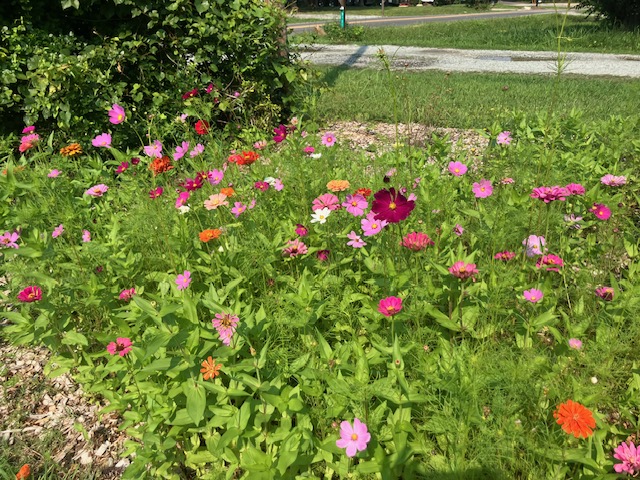
Zinnias and Cosmos are easy to start from seed and bloom abundantly in the Accidental Cottage Garden despite the weird weather. (Image credit: Gary Crispell)
All these plants have been remarkably nonchalant about the drought. They looked sad for a while, but as soon as they got a drink…they took off. The seeds that I sowed in April, Zinnia (Zinnia elegans) and Cosmos (Cosmos bipinnata), and that I stopped watering in mid-May are just fine, thank you. Bloomin’ their li’l hearts out, they are.
Enough about my compact world. The calendar is what you came for and here it is.
Lawn Care
Several species of grubs are actively feasting on lawn grass roots (probably yours) this time of the year. If you notice fist size brown spots on your lawn, it might just be grubs. Carefully dig up a spot to see if there is a grub down there. They are usually white or cream colored with a darker head. They are the larvae of various beetles, including the Japanese kind. There are several products on the market with which to treat them (i.e., kill ‘em dead). There are both liquid and granular products. Always read the label and follow the instructions. If you plan to renovate or reseed a cool season grass (fescue, bluegrass, perennial rye) lawn, then toward the end of the month is the time to prep (spray out weeds, core aerate, amend the soil, etc.) the area in question.
Fertilizing
If you are growing strawberries, they would be ecstatic if you threw a little nitrogen fertilizer in their general direction. DO NOT, he repeated, fertilize trees or shrubs between now and December at which time you may give them their holiday bonus in balanced fertilizer pellets.
Planting
Do you like to start plants from seed? It is fun to watch them sprout and develop. So, have I got a present for you! It’s time to get dirt under your fingernails and your shirt and shorts dirty. Start by sowing pansy seeds in flats. Pick a variety you can’t get at the big box store and be the envy of your neighbors when you set them out in September. There are also several perennials that can be direct sown now to get a jump on spring: Stokes aster (Stokesia leavis), hollyhock (Alcea rosea), and larkspur (Delphinium elatum and several more species) are good ones to try. There are many others. Search “perennial seeds” to learn more. Prep the bed by lightly loosening the soil surface. (No more deep tilling. Leave the sequestered carbon where it is.) Then sow the seeds per instructions on the package (or YouTube, naturally).
Plant a fall garden and eat fresh veggies for Thanksgiving. Salad greens such as Chinese cabbage, kale, many lettuces, arugula, and mustard will survive frost and light freezes. Root crops like beets, turnips, rutabagas, radishes and carrots will keep you in fresh vegetables nearly to the winter solstice. Other fast-growing veggies like winter squashes and cucumbers will be a pleasant surprise for your Thanksgiving dinner guests.
Pruning
Forget I even mentioned it. I would leave this topic blank, but that would raise more questions than telling you to put away all the pruning equipment until after Thanksgiving. The one exception would be if a named tropical cyclone lays waste to your landscape. In that case pruning would be appropriate. (The HOA would no doubt insist.)
Spraying
Not a whole lot different from July. The same heat-seeking, sap sucking, miserable insects and arachnids that found your garden to be a delectable feast in July are still there and many of them will be there until frost. Deal with it. Oh, right. Here’s how. Coniferous evergreens (juniper, cryptomeria, chamaecyparis, arborvitae, Leyland cypress, etc.) are a favorite target for spider mites. Azaleas and pyracantha will still be hosting lace bugs which are active year-round whenever leaf surface temperatures are above 40 degrees F. And anything and everything actively growing will attract aphids.
While we’re here (talking about insects) let’s have a conversation (monologue, actually) about white flies. For years they were the bane of my existence. I could not rid our hibiscus of them. This was serious because we have four hibiscus plants in 25-gallon pots. Them suckers would be 8 feet tall if’n I didn’t cut ‘em back every winter afore puttin’ ‘em in the garage (which seriously crowds the Mustang). They get wheeled out whenever there are going to be three or four nights above freezing. So, you see, we kinda like our hibiscus. Back to the dratted whiteflies. They are pernicious little…well, you know where that was going. I finally had success using an organic horticultural oil. It smothers all five (yes, five) stages of their life cycle (egg, crawler, nymph, pupae, adult). There are numerous other lethal chemicals available. See NCSU Entomology Insect Notes: Greenhouse Whitefly; Dr. Steven Frank and Dr. James Baker professors of entomology and plant pathology.
Only spray when necessary. Know your enemy (pest I.D.). ALWAYS read the label and FOLLOW the instructions. Did I repeat myself? It’s important. That’s why. Stay safe. Wear the proper clothing and equipment. This “stuff” can kill you or at least make you very ill. Be smart. I know you are. You read this.
Propagation
You can still take cuttings of most trees and shrubs.
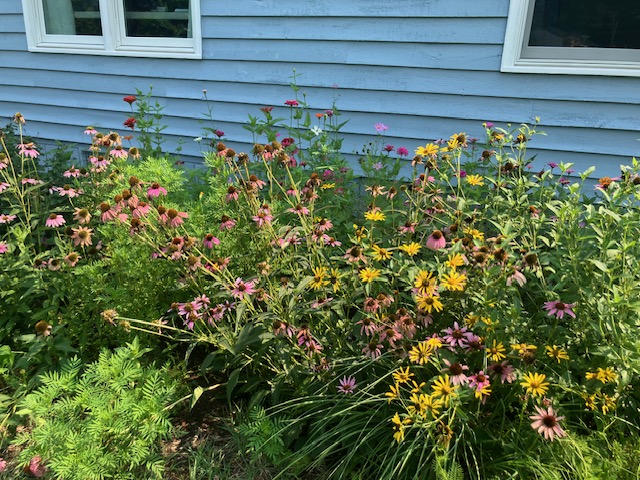
Purple coneflower is a star in the late summer garden. (Image credit: Gary Crispell)
So, if you really love the August heat you can do these:
Walk around the yard with your landscape plan (Everyone has one, right?) to see if there are changes you want to make.
Start a neighborhood pool concerning when the next rainstorm will pass by to the north or south.
Install an outdoor shower and live under it.
Catch the odd not blistering evening and dine al fresco on the deck or patio.
Stay hydrated. Cool and safe. September is just around the corner.
Accidental Cottage Gardener Plant List:
- Black-eyed susan (Rudbeckia hirta)
- Balloon flower (Platycodon grandiflorus)
- Daylily (Hemerocallis x “August Flame”)
- Blanket flower (Gallardia pulchella)
- African marigold (Tagetes erecta)
- Cosmos (Cosmos sulphureus, C. bipinnata)
- Purple coneflower (Echinacea purpurea)
- Zinnia (Zinnia elegans)
- Evening primrose (Oenothera lumarkiana)
- Chinese forget-me-not (Cynoglossum amabile)
- Canadian goldenrod (Solidago altissima)
- Canna lily (Canna x generalis)
- Butterfly bush (Buddleia davidii)
- Cypress vine (Ipomoea quamoclit)
- Mexican hat (Ratibida columnifera)
- Prairie sunflower (Helianthus petiolaris)
- Hydrangea “Limelight” (Hydrangea macrophila ‘Limelight’)
Additional Reading and Resources
Essential Gardening Tips for Drought Conditions
Article shortlink: https://wp.me/p2nIr1-7TN
Edited by Astrid Cook-Dail, NC State Extension Master GardenerSM volunteer of Durham County