By Gary Crispell, NC State Extension Master GardenerSM volunteer of Durham County
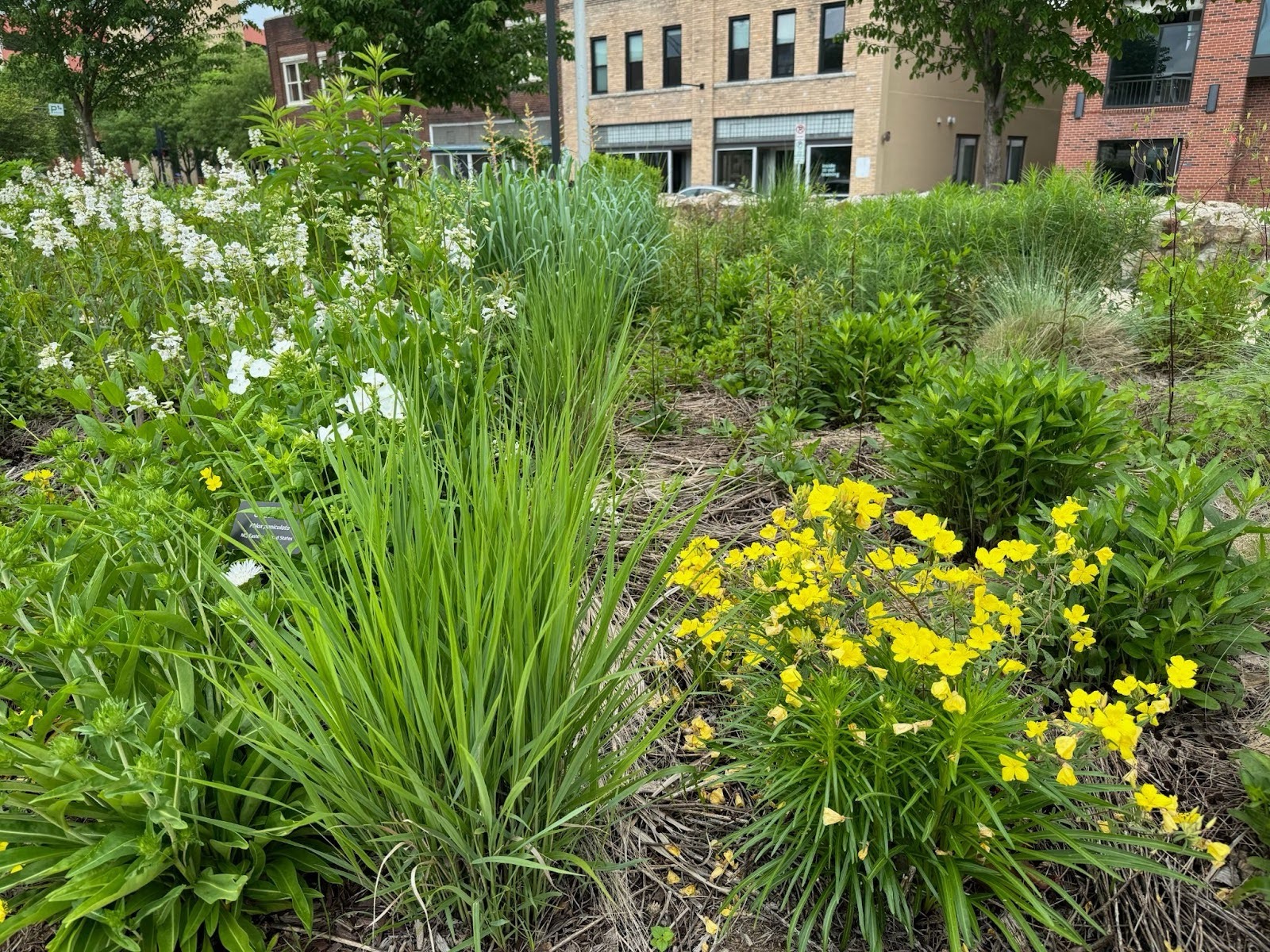
It is June. Another month of constant inconsistency. May was fun…for ducks and kayakers. It would seem that many of the April showers held off until May which has become more the norm than not. At least the drought monitor is all green again. No more yellows or tans until next month. And we are going into summer with a goodly amount of moisture in the soil. The Accidental Cottage Garden (ACG) has been very appreciative of the rain. It is an everchanging garden of delight. Late May brought us crimson clover (Trifolium incarnata), pink dianthus (D. deltoides ‘Bath’s Pink’), tickseed (Coreopsis lanceolata), English daisies (Bellis perennis) galore, the daintiest false vervain (Stylodon cerneus), and a few cornflowers (Centaurea cyanus). Some of the most spectacular and prolific bloomers were (and still are) Chinese forget-me-nots (Cynoglossom amabile), and sweet Williams (Dianthus barbatus). Newcomers are butterfly weed (Asclepias tuberosa), blanket flower (Gallardia pulchella), black-eyed Susans (Rudbeckia fulgida & R. hirta), Stoke’s aster (Stoksia laevis), ditch lilies (Hemerocallis fulva), Corsica lily (Lilium x ‘Corsica’), and an awesome surprise, doubtful knight’s spur (Consolida ajacis). I’m not sure where the doubt lies, whether ‘tis with the knight or the spur.


Beginning at the top and clockwise: blanket flower (Gallardia pulchella); butterfly weed (Asclepias tuberosa); Stoke’s aster (Stoksia laevis); Chinese forget-me-nots (Cynoglossom amabile); doubtful knight’s spur (Consolida ajacis); (Image credit: Gary Crispell)
Hmmm. There is a most vocal and threateningly dark cloud to the northwest indicating that I should abandon my heretofore pleasant post on the deck straight forth and relocate to a more substantial environment. I have little confidence in the patio umbrella’s ability to ward off the threatening onslaught. The following is a list of things that need attending to in gardens in general. Please do not try to do all of them at one time. We like you and hope you might return to this post in July. (The onslaught went somewhere else to do its slaughting.)
Lawn Care
There is a myriad of excuses for not having fertilized your warm season grasses (zoysia, Bermuda) before now, but it is time to get over them. “Just do it!,” as in immediately. Now, mark your calendar for September 1. That’s the day you will do your SOIL TEST. It is FREE until the end of November and will tell you how much fertilizer to apply next year thereby eliminating one of the excuses. Besides it will give you some other pertinent information about your soil.1 June is THE month (and really the only month) to fertilize centipede grass. For recommended application rates (when you haven’t done a soil test) the NC State Extension TurfFiles (https://www.turffiles.ncsu.edu/) are an excellent resource. Keep on mowing (as if the HOA would let you stop). Warm season grasses should be kept at a height of 1 ½” to 2” and cool season grasses 3” to 4.” Another trick to improve your lawn is core aeration. It will improve water and nutrient movement through the soil getting them to the roots where the plants can use them. The procedure is especially helpful on our clay soils.
Fertilizing
Side dressing the vegetable garden now will result in a better yield later in the season. A balanced fertilizer (10-10-10 or equivalent) will suffice. Dogwoods (Cornus spp) can be fertilized this month.
Planting
Wow! You haven’t planted your veggie garden yet? It is time to move on that with all due haste, friends. Plant selection (and you will need to do plants now) can get a bit sparse even at the big boxes by the end of the month. Besides, if you want tomatoes before Halloween…. To those of you who are already planning your fall/winter garden (I know who you are). You already know it is time to start seeds in the greenhouse (or whatever color house by a bright window). Cruciferous vegetables (broccoli, cabbage, greens of all sorts) can be started now to be transplanted into the garden mid-July (or in six weeks).
Pruning
Do you have some overgrown broadleaf or deciduous evergreens that you have considered to be candidates for the compost pile, but then would have to replace? Try severely cutting them back, like to 18” or so. They almost always come back and then you can control them without a step ladder. Plants are amazing! This procedure is not recommended for rapidly growing teenagers. It is frowned upon by law enforcement authorities to the extent that it will land you in one of their maximum security facilities for a very extended time where they may not allow you to garden and definitely not with sharp implements. Consider the preceding to be a public service bulletin. Continue pinching back chrysanthemums until mid-July for fall blooms. Azaleas, including Encore® and other repeat bloomers, can be pruned until the Fourth of July. The “old wives” who spread this tale were not just making it up. Later trimming can be detrimental to next year’s bloom production.
It is the season for die back on ericaceous (acid loving) plants. Make pruning cuts 6” below the symptoms (wilted and dead leaves and twigs) making sure you sanitize the pruning tool with 10% bleach or 70% alcohol solution between cuts. Burn all clippings.
Spraying
There are insidious organisms lurking about in your garden that you need to be aware of. Some have 6 legs, some eight and some are so small as to require an electron microscope to be seen at all. They all exist for the sole purpose of making your gardening life miserable. Controlling these organisms unfortunately usually involves toxic chemicals applied in liquid form by means of a sprayer of some description. (I apologize for the vagueness there, but there are SO many variables.) There are some general rules (OK, guidelines) for said applications. Always use the appropriate chemical, toxic or not, for the pest to be controlled. Use the least toxic chemical possible. And most importantly READ AND FOLLOW THE INSTRUCTIONS ON THE LABEL.
Common miscreants to be controlled are lace bugs on azaleas and pyracantha, leaf miners on boxwoods, spider mites predominantly on needle leaf evergreens, but elsewhere, also, bag worms on the same plants, and aphids on anything and everything.


Insects in the garden: Left: Aphids on a tomato leaf; Right: Strip flea beetle. (Image credit: NC Cooperative Extension. Photo taken by Debbie Roos)
The microscopic pest most frequently to cause insomnia is early tomato blight. It first appears on lower leaves as brown spots. Then yellowing will appear around the spots. Eventually the entire leaf will yellow and fall off where the fungal spores will hide until next year. (Crop rotation helps.) There are several fungicides to choose from, some of which are zero days to harvest. The vegetable garden is a veritable smorgasbord for a plethora of critters form the class insecta. Cucurbits (squash, cucumbers, melons) are susceptible to cucumber beetles and squash vine borers (Treat weekly until July.), flea beetles and our ubiquitous friends, the aphids. Continue the never ending spray program on roses, fruit trees, and bunch grapes.
THINGS TO DO TO WILE AWAY A SUMMER DAY IN THE MARVELOUS MONTH THAT FOLLOWS MAY AND WONDEROUSLY INCLUDES THE YEAR’S LONGEST DAY
Enjoy the relative silence that will exist when the raucous cicadas return to their underground domiciles for another 13 years. Enjoy in the evening the garden you have worked so hard in during the day. Granted, it will require something from you again tomorrow, but this evening, enjoy it. Grill out and chill out with friends and family. It’s people and relationships that make the world go ‘round.

“People who need people are the luckiest people in the world.” Jule Styme
Enjoy June, Y’all!
(Image credit: Photo by cottonbro studio on Pexels.com)
Notes
You can get test kits and instruction sheets from the Durham County Extension Office at 721 Foster St., Durham, or more information by calling (919) 560-0525. If you live in another county, check with your local extension office.
Resources and Additional Information
For more info on caring for your lawn see NC Cooperative Extension’s “Carolina Lawns: A Guide to Maintaining Quality Turf in the Landscape.” https://content.ces.ncsu.edu/carolina-lawns
To learn control strategies for the squash vine pest, see NC Cooperative Extension’s “Beat the Squash Vine Borer” Written By Dustin Adcock and last updated by Molly Alexi. https://stanly.ces.ncsu.edu/2016/06/beat-the-squash-vine-borer-2/
Read about how to control garden pests best using multiple methods in the NC Cooperative Extension’s “Integrated Pest Management.” https://content.ces.ncsu.edu/extension-gardener-handbook/8-integrated-pest-management-ipm
Article Short Link https://wp.me/p2nIr1-4zN