The Budding Orchardist: Rescue Pruning a Neglected Pear Tree

By Jeff Kanters, NC State Extension Master GardenerSM volunteer of Durham County

(Image credit: Jeff Kanters)

When counseling visitors on managing fruit trees at Briggs Avenue Community Gardens Teaching Orchard, I was occasionally asked about how to prune an older neglected fruit tree to a more manageable size. Typically, a homeowner had inherited a large, gnarly, tangled tree left from the previous homeowner or may have left a tree unmanaged over years.

Late fall of 2024 I had the opportunity to provide onsite consultation to a PTA volunteer crew at Hope Valley Elementary School seeking to renovate an older, 25-foot tall, neglected, unsightly Kieffer pear (Pyrus communis ‘Kieffer’) tree in a courtyard being re-landscaped.

Image of a Kieffer pear tree (Pyrus communis ‘Kieffer’) in bloom and closeup of its late-spring flowers. (Image credit: Gary Owens CC BY 2.0)

Researching the Tree

So what is a Kieffer pear? Kieffer pears are the result of an accidental cross between the Sand pear (Pyrus pyrifolia) native to Asia, and the common American Bartlett pear (Pyrus communis) during the 1860s. While it is often recommended to have two pear trees to produce the most fruit per cross-pollination, Kieffer pears, with their Asian ancestry, are self-fertile, meaning they are not as dependent on another pear nearby to cross-pollinate and set fruit. Kieffer pears are also very disease resistant.

Evaluating the Tree

To get started we inspected the tree, and observed the following:

  • Overall, the core trunk bark appeared intact and healthy.
  • The tree bore many pears during the past season and many large overripe pears were still hanging from the top upper most canopy as unreachable to harvest.
  • Numerous dead and broken, large, jagged limbs protruded at the base of the tree and from along the lower trunk opening the tree up to disease.
  • Rather than one central leader trunk, three competing leaders were all growing up close together and the crotch angles where the leaders grew from the core lower trunk were very narrow, and therefore weak and prone to splitting off from the tree during high winds.
  • Many of the older limbs had tall branches or whips growing directly upward, inward toward the trunk, downward to the ground, and crossing over each other. Pears are one of the more unruly fruit trees to manage with their tendency to wildly send new growth upward in columnar fashion and scaffold branching to grow out every which way. When the tree was leafed out, this would result in shading the interior of the tree reducing air circulation and inviting diseases.

Kieffer pear before start of first pruning. (Image credit: Debra Pilkington)

Developing a Plan

To complete the tree rehabilitation, we set up the following phased three-year corrective pruning plan:

  1. To begin, prune out about one third of the tree growth this first season. Since the tree was old,  taking too much would shock the tree and force unwanted, uncontrolled, excessive new branch growth the next season, making the canopy prone to sunburn and diseases. The team would follow this same method for the next three seasons to gradually reduce the tree height and shape.
  2. Prune out all dead, diseased, and broken limbs and branches.
  3. Prune out the branches growing upward, downward, inward, and crossing over into each other.
  4. Select the largest central leader from the multiple leaders and remove the other smaller competitive leaders, thus leaving only one. This would also open the center of the tree to more air and sunlight.
  5. After several years of corrective pruning, and bringing the top canopy down further, the rejuvenated tree should only require more manageable pruning, maintenance, and harvesting each year thereafter.

Identifying the Tools for the Job

Undertaking a project of this size required a team and key tools that included:

  1. Ladder
  2. Small battery powered hand chainsaw or small and large pruning saw, rather than a chain saw (Note of caution: No one should be alone and use any chain saw without the proper training, supervision, and use of personal protective equipment (PPE).
  3. Telescopic saw and loppers
  4. Hand loppers
  5. Standard hand pruning shears
  6. Safety helmet or head covering
  7. Safety goggles
  8. Gloves
  9. Non-snag clothing
  10. Heavy duty canvas pants
  11. Heavy work boots or chainsaw boots with protective guarding at front instep

Kieffer pear during first pruning. (Image credit: Jeff Kanters)

Phase one pruning was successfully completed. One experienced volunteer opted to use his handheld battery-operated chain saw for removal of a few of the larger limbs. A large pruning saw would also have sufficed.

Kieffer pear at completion of first phase of pruning. (Image credit: Jeff Kanters)

Considering This Type of Project in the Home Landscape

If you are considering undertaking a renewal project of this type in your home landscape, keep the following in mind. Depending on the size of the tree, what limbs or branches need to be removed, and your skill at pruning, it may be safest and best to hire a trained, reputable, experienced arborist to make initial key cuts on the tree. You can supervise, but let professionals handle the most heavy-duty work. If you choose to do it yourself, you should have a few helpers on hand. Projects of this size should not be left to one person to perform alone.

If you use a ladder, as the ground is typically never flat around a tree, no one should be alone on the ladder, but rather have another spotter below holding the ladder for that person.

A last thought. While it may be a worthwhile project, before you consider rescue-pruning a large overgrown fruit tree, ask yourself a few questions:

  • Is the tree viable, free of disease overall, and producing good fruit yet?
  • Is tree worth the expense, effort, time, and risk to prune back?
  • Would it be better to have the tree completely removed and replaced with a small young tree you can manage better from the outset?

Whatever your decision, rehabilitating an old fruit tree is something that can be done successfully.

Resources and Additional Information

Training and Pruning Fruit Trees in North Carolina:

https://content.ces.ncsu.edu/training-and-pruning-fruit-trees-in-north-carolina

How to Prune Neglected Apple Trees, Iowa State University Extension:

https://yardandgarden.extension.iastate.edu/how-to/how-prune-neglected-apple-trees#:~:text=Prune%20out%20all%20dead%2C%20diseased,over%202%20or%203%20years.

Pruning to Renovate Old Fruit Trees, Penn State Extension:

https://extension.psu.edu/home-gardening-pruning-to-renovate-old-fruit-trees

Operating a Chainsaw:

https://www.hse.gov.uk/treework/safety-topics/chainppe.htm

North Carolina Extension Gardener Plant Toolbox:

https://plants.ces.ncsu.edu/plants/pyrus-communis-kieffer

Article Short Link: https://wp.me/p2nIr1-5EE

Deer-Resistant Native Gardening

By Lissa Lutz, N.C. State Extension Master GardenerSM volunteer of Durham County

(Image credit: Pixabay/MrsBrown)

Figuring out how to garden when you have deer is already a challenge, so you may be wondering how it can be done using only native plants. But fear not; with a little planning and careful plant selection it can be done. If you are just beginning to transition to native plants, keep in mind that a ratio of 70% native to 30% non-native is an acceptable and reasonable goal.1 While non-native plants are generally unable to host caterpillar species that are a critical food source for baby birds, there are some deer-resistant selections that can provide nectar for pollinators, habitat for animals, and structure and beauty in the garden design.

Plan for Structure in the Garden

When designing a new garden bed, it can be helpful to start with shrubs or small trees, particularly evergreens, that will provide structure or “bones” for the garden.The evergreen native yaupon holly (Ilex vomitoria) can be a solid backdrop to your other native plants.2 It tolerates sun to shade, comes in dwarf forms, and sports bright red berries in fall through winter which provide food for songbirds and small mammals. Sweet pepperbush (Clethra alnifolia), sweetshrub (Calycanthus floridus), and beautyberry (Callicarpa americana) are native shrubs that are not evergreen but can offer structure and texture to the winter design, and attractive foliage, flowers and berries during the other seasons. All three thrive in full sun to part shade. Calycanthus has fragrant spring blooms and Clethra’s late summer white flowers are a magnet for pollinators. Callicarpa sports a multitude of small bright purple berries as a valuable winter food source for birds and mammals.

Native shrubs that can provide structure for a garden include: (1) sweetshrub (Calycanthus floridus); (2) sweet pepperbush (Clethra alnifolia); (3) yaupon holly (Ilex vomitoria); (4) beautyberry (Callicarpa americana). (Image credit: Madeleine Bell CC-BY-SA 2.0); Susan Strine CC BY 2.0; Scott Zona CC BY-NC 2.0 ; Cathy DeWitt CC BY 4.0)

Some non-native options that are both hardy and striking include the evergreen tea olive (Osmanthus fragrans) and false holly (Osmanthus heterophyllus), with ‘Goshiki’ as a choice cultivar. Paperbush (Edgeworthia chrysantha) is not evergreen but has delightful fragrant blooms in the winter and is an underutilized deer resistant shrub with beautiful form with or without its leaves. All three thrive in full sun to part shade. For a lower growing shrub in a sunny garden, consider the evergreen creeping rosemary (Salvia rosmarinus ‘Prostratus’) which will happily cascade over a rock or retaining wall.

If your garden is on the shadier side, try the native evergreen anise tree (Illicium floridanum) or doghobble (Leocothoe fontanesiana). Illicium can grow to 10’ but is easily kept in bounds by pruning. It also comes in numerous cultivars with a variety of flower colors and size ranges including dwarf forms. Leucothoe boasts showy, fragrant white flowers in spring. 

(Left to right) Native plants that will thrive in shady gardens include anise tree (Illicium floridanum) or doghobble (Leocothoe fontanesiana).(Image credit: Cathy DeWitt CC BY-NC-ND 4.0; Suzanne_Cadwell CC BY-NC 2.0)

A non-native choice for the shadier garden might include the Japanese plum-yew (Cephalotaxus harringtonia). ‘Duke Gardens’ is a local cultivar noted for its compact shape.

Fill in the Garden with Perennials

Once you have anchored your garden design with some shrubs or small trees, it’s time to fill in with perennials. Many perennials can also provide structure and texture throughout the winter when you recognize the importance of leaving plants in the fall to provide winter habitat and food for animals. Hollow stems become nesting sites for solitary bees, and dried seed heads provide food for birds.

Choose Keystone Species

Significant deer pressure does narrow the palette but there are still many good plant options. A good place to start is to consider keystone species–plants that support the highest diversity and number of caterpillars. Goldenrods (Solidago spp.) are high on this list. If your garden is small consider some of the more well-mannered species such as sweet goldenrod (Solidago odora), white goldenrod (Solidago bicolor), or slender goldenrod (Solidago erecta). Most goldenrods bloom in the fall but using several different varieties can offer a spectrum of bloom time, shape, and color throughout the fall.3

(Left to right) White goldenrod (Solidago bicolor) and New England aster (Symphyotrichum novae-angliae) are two “keystone” species that should be on your list of the deer-resistant natives. Both offer colorful fall blooms to the landscape. (Image credit: Fritz Flohr Reynolds CC-BY-SA 2.0 ; Drew Avery CC BY 2.0)

Asters are also considered a keystone species. Asters may not be entirely deer resistant, especially under high deer pressure, but they tend to be so vigorous and bloom so late that deer browse is more like an early pruning and they will still often have a fine flower display in the fall. Consider incorporating aromatic aster (Symphyotrichum oblongifolium), New England aster (Symphyotrichum novae-angliae) or blue wood aster (Symphyotrichum cordifolium) to support specialized bees, caterpillars, songbirds and small mammals.

Plant Flowers with a Purpose

Flowers attract pollinators and add beauty. Many deer resistant natives are also great pollinator plants. Any of the mountain mints (Pycnanthemum spp.), will be swarming with hundreds of tiny pollinators throughout their bloom season, along with fragrant minty foliage. Blunt mountain mint (Pycnanthemum muticum) keeps evergreen through the winter, rising to several feet in the summer when it blooms. It can spread but is easy to pull up and share extra plants. Narrowleaf mountain mint (Pycnanthemum tenuifolium), has fine foliage and is more clumping. Hoary mountain mint (Pycnanthemum incanum) has silvery white foliage and fragrant leaves, but also likes to have some space and may be better for larger gardens. The mountain mints will tolerate partial shade.4

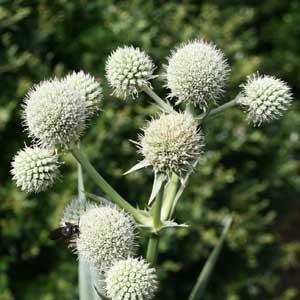
Boneset and thoroughwort (Eupatorium spp.) are underutilized native pollinator plants with excellent deer resistance. They have white flowers in summer and fall that attract bees and butterflies. Common boneset (Eupatorium perfoliatum) likes wet soils and will spread to form colonies. Roundleaf thoroughwort (Eupatorium rotundifolium) can tolerate both wet and dry conditions. Foxglove beardtongue (Penstemon digitalis) has showy white flowers in spring and its evergreen rosettes persist throughout the winter. An interesting and lesser-known plant that also has evergreen foliage in the winter is rattlesnake master (Eryngium yuccifolium), identifiable by its funky white ball-shaped flowers. Anise hyssop (Agastache foeniculum) is another key pollinator plant that has excellent deer resistance due to its licorice scent.

(Left to right) Common boneset (Eupatorium perfoliatum), foxglove beardtongue (Penstemon digitalis), and rattlesnake master (Eryngium yuccifolium) are striking native plants that are deer resistant and attractive to pollinators. (Image credit: Fritz Flohr Reynolds CC BY-ND 4.0; Julie Anne Workman CC BY-SA 3.0; Debbie Roos CC BY 2.0)

The beebalms (Monarda spp) seem to be less reliably deer resistant but are worth trying for their sheer flower power. Spotted beebalm (Monarda punctata) is an unusual species that seems to have somewhat higher deer resistance. It is a less aggressive spreader, and supports moths, butterflies, bees, hummingbirds, and several moth larvae.

(Left to right) Eastern bluestar‘s (Amsonia tabernaemontana) pale blue star-shaped flowers are attractive to beneficial insects but not to deer. These plants also provide fall color, as pictured here with the bright yellow leaves of the Arkansas bluestar (Amsonia hubrichtii). (Image credit: leonora Enking CC-BY-SA 2.0; Jim Robbins CC BY-NC-ND 4.0)

A must-have in the deer resistant native garden are the bluestars (Amsonia spp.). Eastern bluestar (Amsonia tabernaemontana) has delightful blue flowers in the spring and can grow to shrub-like sizes. Similarly Arkansas bluestar (Amsonia hubrichtii) can get quite large with fine textured foliage that turns dazzlingly yellow in the fall. Both species do well in full sun but can tolerate part shade.

Russian sage (Salvia yangii) is not native but attracts bees, butterflies and hummingbirds and sports showy blue flowers spring through fall. It tolerates drought and is highly deer resistant.

Add Native Grasses to Your Landscape

Don’t forget grasses (or ferns and sedges for the shady garden). Native grasses can also be excellent choices if you have full sun and deer. Pink muhly grass (Muhlenbergia capillaris) is a well-known grass with plumes of delicate pink in the fall. Little bluestem (Schizachyrium scoparium), splitbeard bluestem (Andropogon ternarius), and others can lend a prairie-like look in a more natural garden setting. Bottlebrush grass (Elymus hystrix) is a more shade-tolerant grass with a seed head that looks just like a bottle brush. These grass species stay beautiful throughout the winter and support butterfly and moth larvae.

(Left to right) Many grasses are both native and deer resistant. For sunny areas choose muhly grass (Muhlenbergia capillaris) or little bluestem (Schizachyrium scoparium) are good choices. For shady areas consider bottlebrush grass (Elymus hystrix). (Image credit: Jim Robbins CC BY-NC-ND 4.0); Hope Duckworth CC BY 4.0)

Ferns also tend to be deer resistant and are more shade tolerant, with many native and non-native varieties to choose from. Christmas fern (Polystichum acrostichoides) is an evergreen native fern that will slowly spread and naturalize. Southern shield fern (Thelypteris kunthii) is a deciduous native but tolerates a wide variety of conditions and will naturalize to form large colonies. Ostrich fern (Onoclea struthiopteris) has a more formal vase shape and will also spread readily in favorable conditions. The evergreen native Cherokee sedge (Carex cherokeensis) tolerates wet soils, shade, and deer.

The North Carolina Extension Gardener Plant Toolbox provides full descriptions and excellent pictures for all of these plants and many more. Use the information in the Toolbox to select plants that match your site conditions – sun, part sun, shade, wet, dry, etc. Knowing size, bloom time and other attributes of each plant will help you to design your own native garden that will grow and prosper even in the presence of hungry deer.

Design Diagrams for Deer-resistant Gardens

Some simple garden designs that you can start with are shown below. When you have created your plant list, start your shopping at the Friends of Durham County Master Gardener Plant Sale on Saturday, April 5, 2025, from 10am until sold out, at 721 Foster Street in Durham.

Sun-Loving Garden Design

Garden design by Deborah Pilkington. (Left to right) (1) Amsonia hubrichtii (Cathy Dewitt CC BY 4.0); (2) Agastache foeniculum (Magnus Manske CC BY-SA3.0); (3) Eryngium yuccifolium (Joshua Mayer CC BY-SA 4.0); (4) Allium cernuum (Judy Gallagher CC BY 2.0).

Shade-Tolerant Garden Design

Garden design by Deborah Pilkington. (Left to right) (1) Illicium parviflorum ‘Florida Sunshine’ (Tony Avent of Plant Delights Nursery); (2) Solidago odora (CC0); (3) Symphyotrichum cordifolium (Dan Mullen CC BY-NC-ND 2.0); (4) Cherokee sedge Carex cherokeensis (K. AndreCC BY 2.0).

Agastache foeniculum

Amsonia spp.

Callicarpa americana

Carex cherokeensis

Edgeworthia chrysantha

Elymus hystrix

Eryngium yuccifolium

Eupatorium spp.

Ferns, native and non-native

Grasses, native

Illicium floridanum

Monarda spp.

Osmanthus spp.

Penstemon digitalis

Pycnanthemum spp.

Salvia yangii

Solidago spp.

Symphyotrichum spp.

Notes

1–Nonnative plants reduce population growth of an insectivorous bird.

2–Take a deeper dive on the native shrub the yaupon holly.

3–A previous blog post gives an excellent review on the care and planting of different varieties of goldenrod.

4–Read more about mountain mint on our blog.

Resources and Additional Information

Residential yard management and landscape cover affect urban bird community diversity across the continental USA https://esajournals.onlinelibrary.wiley.com/doi/10.1002/eap.2455

Article Short Link: https://wp.me/p2nIr1-5HN