
By Gary Crispell, NC State Extension Master Gardener SM volunteer of Durham County (aka the Accidental Cottage Gardener)
November. The ninth month of the year, right? Well, it was until a couple of Roman egos got in the way. I reckon they wanted to be remembered as balmy and pleasant and that’s why they didn’t just tack July and August on to the end of the year. Egos—bleh.
So, it is the eleventh month and should probably be Elvember. Named after the elves who live under all the mushrooms we would see if it should rain. You remember rain, right? No? It’s that wet stuff that used to fall out of the sky. (Not snow! That’s COLD and wet and much less desirable.)
November is also a month of holidays. We start with election day, then Veteran’s Day (thank you for your service, fellow vets), after which we have Thanksgiving for four days in the middle of which is Black Friday. Oh, yes, it is a holiday. You ask my Aunt Helen.
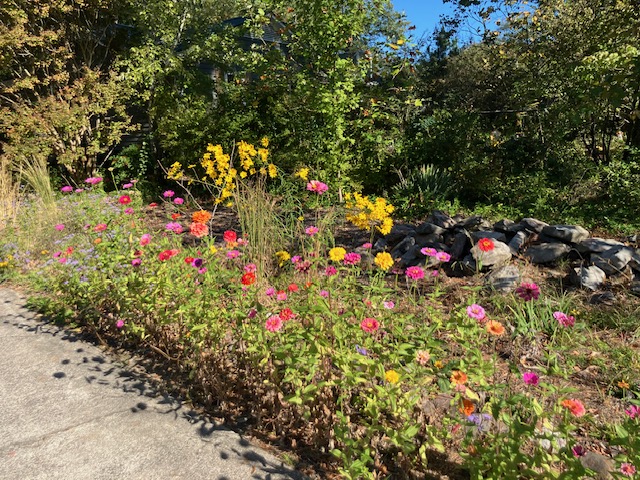
Accidental Cottage Garden border going strong as the end of the year approaches. (Image credit: Gary Crispell)
The Accidental Cottage Garden (ACG) looks pretty darn good considering we’re in month 14 (less July) of a drought and it’s November. Perennial gardens aren’t supposed to look bright and perky in November. Many of the perennials in the ACG have succumbed to the change in day length (the diurnal effect) and will reappear in the Spring. There are a few stout souls who refuse to be defined by day length or drought, for that matter.
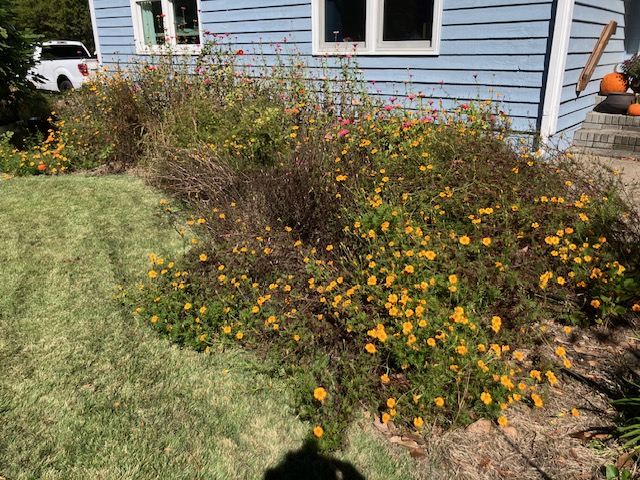
More Accidental Cottage Garden borders still flowering even as they start to senesce. (Image credit: Gary Crispell)
The hardy ageratum or mist flower (Conoclinum coelestinum) has been spectacular this year. It has managed to fill the right-of-way ditch in front of the house. African marigolds (Tagetes erecta) have competed with the ageratums to see which one can cover the most square feet. Ageratum is ahead by a quarter of a ditch. Both plants will have to be reined in next year. My most dependable friend in the garden is the gallardia (Gallardia pulchella). It starts blooming in mid-June and it is still hard at it. They will continue until a killer frost bursts all their cell walls.
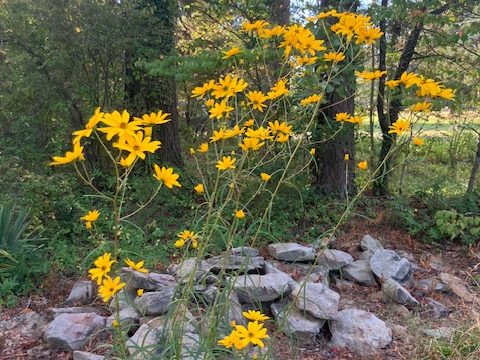
Swamp sunflower (Helianthus angustifolia) in the Accidental Cottage Garden. (Image credit: Gary Crispell)
The other long-blooming plant still kicking is black-eyed susan (Rudbeckia hirta). We love the variety of yellow/brown/black combinations they display. If you are really into yellow, have I got a plant for you. Swamp sunflower (Helianthus angustifolia). She is YELLOW!! And she is tall (6-8’). There’s a stalk or six rough goldenrod (Solidago rugosa) still showing color, but the stars of the circus have been the annual (prolific re-seeders!) zinnias (Zinnia elegans) and cosmos (Cosmos bipinnata) that I sowed seeds for in May. They have been the proverbial riot of color since August. We have had continuous cut flower arrangements all Summer and Fall.
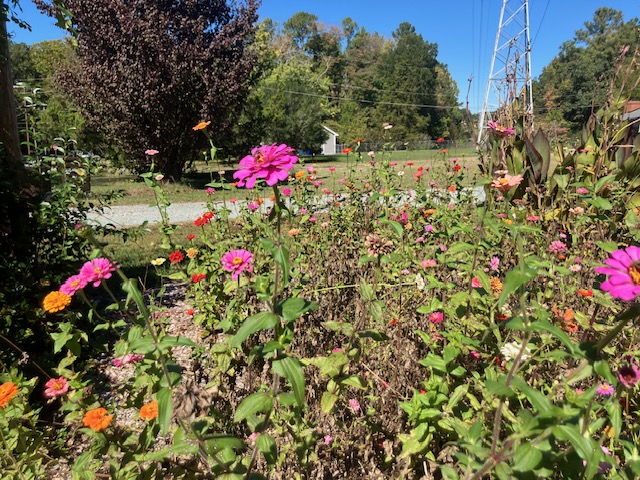
Many colors of zinnias (Zinnia elegans) providing blooms into November. (Image credit: Gary Crispell)
I guess I have prattled on about long enough. I suppose you are reading this to find out what can/should/might be done in the garden in poor misnamed month (in the middle of four misnamed months). Here ‘tis.
LAWN CARE
Leaf removal is job #1. If your lawn consists of warm season grass (Bermuda, zoysia, centipede), that’s about all you need to know. These grasses will soon be going dormant not to be heard from until spring.
Should you have cool season grass (tall fescue, bluegrass, perennial rye) you are still mowing (3”-4”) and either bagging or mulching clippings and leaves (preferably the latter). Bagged debris should be composted. The landfill doesn’t need them.
If you overseeded or started a new lawn, be sure it gets ½” of water twice a week at a minimum.
FERTILIZING
Pretty much zilch here. You can add lime to correct a low pH (<6.0) at a rate indicated on the SOIL TEST results you received from NCDOA. (Come on! They’re still free until the end of the month, y’all.) Lime is best incorporated into the soil as it doesn’t move through the soil to the root zone very well.
PLANTING
Have I ever mentioned “FALL IS FOR PLANTING” before?
Trees and shrubs can be transplanted this month.
It is not too late to plant spring-flowering bulbs (daffodils, tulips, crocuses, etc.) but try to complete this task before the end of the month.
One-year-old asparagus crowns can be transplanted now.
PRUNING
Ahh, the perennial garden. Any day now, if it hasn’t happened already, Jack Frost or his insidious sibling Harriet Hardfreeze will drop in for a visit and finish any destruction not previously inflicted by Minerva Moisturestress. After that you need to ignore what your grandmother told you about cutting back the dead stems. There may well be native solitary bees or other beneficial insect eggs in or on those stems. Leave them, please. Try to overcome your OCD (I did. Well, not yours. My own.) and think of them as winter interest.

Small carpenter bee nesting in sumac stem. (Image credit: Heather Holm)
Dead or diseased wood can be trimmed from trees and shrubs. When removing entire branches make the pruning cuts at the outer edge of the branch collar (the flair at the base of the branch) to promote quicker healing.
It is a good time to clean up the rest of the garden and landscape in general. You can yank weeds and other undesirable plants (the definition of a weed) and toss ‘em in the compost pile.
SPRAYING
If you’ve been doing battle with lace bugs all summer hit ‘em with a good dose of horticultural oil and put the sprayer away…well, clean it first, of course. (Might I suggest moving the offending azaleas to a less sunny location in the yard. They are an understory plant and are stressed when in full sun thereby inviting the lace bugs which prefer stressed plants. That’s your cause-and-effect lesson for this month.)
OTHER ENTERTAINING, ENLIGHTENING AND ENCHANTING ENDEAVORS TO ENJOY IN PIEDMONT NORTH CAROLINA IN AUTUMN
Take a leaf hike in your neighborhood or local park.
Make a leaf pile for your kids or grandkids to play in.
Invite the neighbors over for an evening around the firepit. Hot cider and donuts are not optional.
Enjoy the last few user-friendly days of 2026. They are numbered at this point.
May you have a wondrous Thanksgiving shared with people you love.
Resources and Additional Information
- Provide Nesting Habitat for Native Bees Through Plant Stems in Your Garden: By NC Extension Agent of Chatham County, Debbie Roos
- Build a Bug Snug Durham EMG blog on supporting insects over winter in the garden
- General Pruning techniques: Pruning Trees and Shrubs from NCSU
Edited by Astrid Cook Dail, NC State Extension Master GardenerSM volunteer of Durham County