Achieving Peak Tomato Performance

A bounty of beautiful tomatoes. (Image credit: Kathryn Hamilton)

By Kathryn Hamilton, NC State Extension Master GardenerSM volunteer of Durham County

This summer, Durham County is one of eight counties in North Carolina to participate in a state-wide tomato trial. We will compare yields of three tomatoes created by NC State against ‘Cherokee Purple’ regarded for its flavor, productivity, and resistance to cracking. Check out our page on the blog called “Tomatoes on Trial” The 2024 Tomato project here. While we are busy conducting the trials, here are some tips to help you maximize your harvest.

Water Carefully and Consistently

Cracking occurs when tomatoes get a huge amount of water all at once (as an example, after a major storm) causing the fruit to swell and the skin, because it cannot grow fast enough, to crack. Calcium travels from the soil through water, and if water is insufficient the calcium never reaches the fruit, resulting in blossom end rot. This condition usually affects the first tomatoes and can be reversed with regular watering.

(Left to right) Cracking often occurs after a heavy rain. The skin can’t keep up with the swelling of pulp and consequently splits. (Image credit: Mary Knierim) Blossom end rot is preventable by consistent watering which brings calcium up into the fruit. (Image credit: NCSU Plant Disease and Insect Clinic)

During the growing season, tomatoes need 1 – 2” of water per week, the equivalent of two to four gallons. One way to measure this is to time how long it takes to fill a two-gallon container, then count along each time you water. To reduce the incidence of soil-borne diseases splashing on to the tomato vine, water at soil level, preferably in the morning to allow any leaves to dry out during the day. It is best to water deeply once or twice a week to encourage root development. The soil should be damp 6 – 8” down. Use a water meter, a trowel, or your finger to get a “reading.”

Mulch Your Bed, or at Least your Plants

Mulching carries multiple benefits. It keeps the soil moist and can help reduce both weeds and the spread of soil-borne diseases. Organic options include dried grass clippings, which have not been treated with an herbicide, and shredded cardboard or newspaper. Other options include hay or straw, and leaves (provided they are not from the black walnut tree). Avoid sawdust and wood chips which will draw nitrogen out of the soil as they decompose. There are pros and cons regarding plastic mulches. Black can heat up the soil too much; clear can foster the growth of weeds. Research at Clemson University has shown that red mulch (now available in small quantities at some on-line garden retailers) can boost tomato yields by 20 percent while conserving water and controlling weeds.

(Left to right) Grass, untreated with herbicide, is an excellent mulch; Red plastic mulch developed by Clemson University and the US Department of Agriculture is now available in smaller quantities from some on-line retailers. Use it to increase yields, prevent weeds, and retain moisture. This is not to be confused with red-dyed wood mulch. (Image credits: Kathryn Hamilton)

Feed Wisely

A three-number code on each bag of fertilizer identifies its composition. The first number relates to nitrogen (think greenery); the second to phosphorous (flowers and fruit formation), and the third, potassium (contributing strong stems and disease resistance). Once the plant has started to set fruit (usually 4 to 6 weeks after planting) side dress the tomatoes with a balanced fertilizer (i.e. 8-8-8), or one in which the first number is smaller than the others. An over-abundance of nitrogen will promote vine growth at the expense of fruit. Among the best analyses for tomatoes, according to the University of Missouri are 8-32-16 and 6-24-2. Follow package directions in terms of fertilizer amount and frequency.

Practice Rigorous Maintenance

To reduce contamination by soil-borne diseases, prune the bottom leaves up by as much as a foot. Be rigorous in removing diseased and rotting leaves.
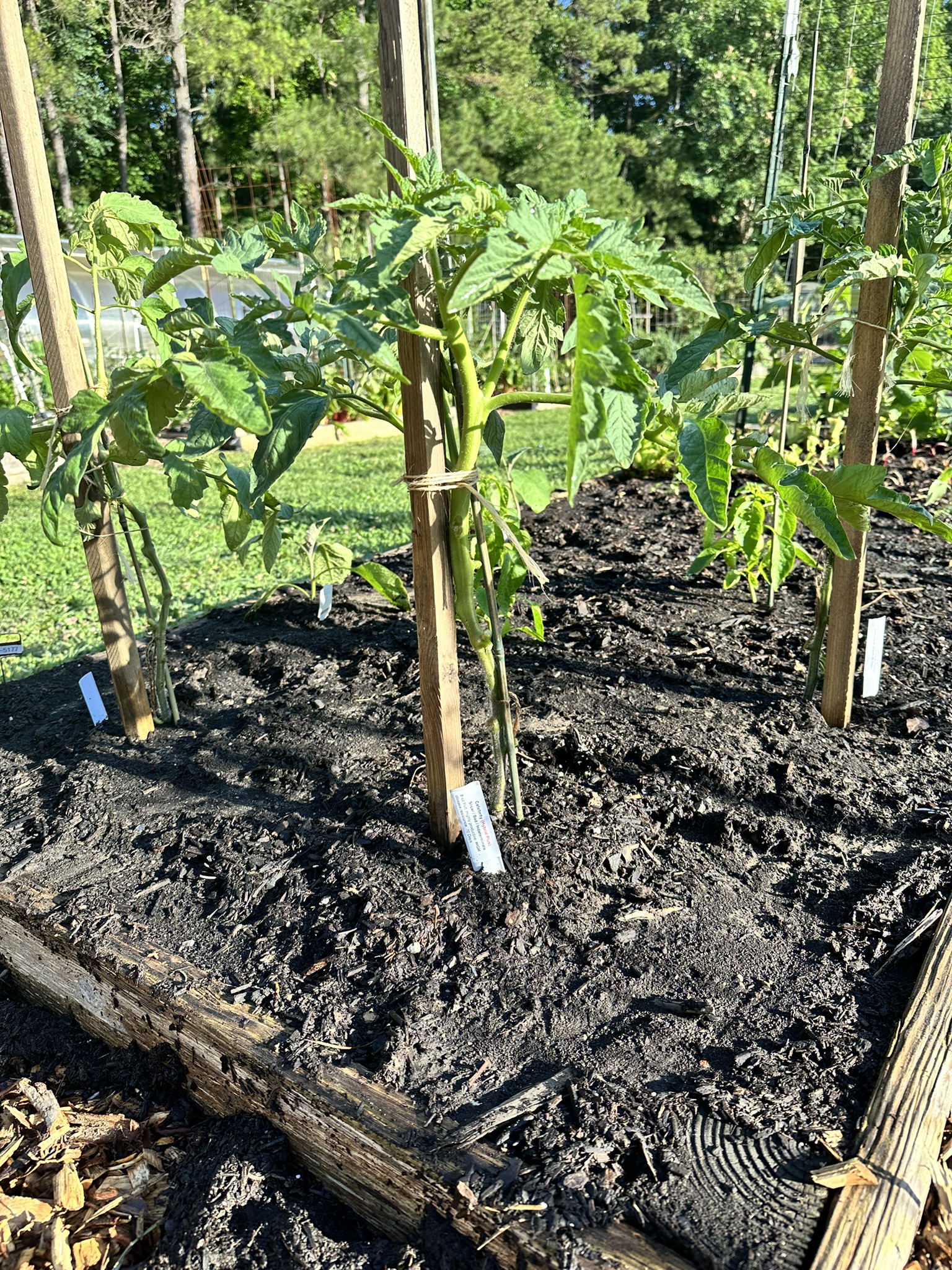
Pruning leaves up to 18″ from the ground reduces transmission of soil-borne diseases. (Image credit: Kathryn Hamilton)
Diatomaceous Earth

Diatomaceous earth is a highly porous powder made from the sediment of fossilized algae. Sprinkled at the base of the plant and on the leaves and fruit it can help control a variety of insects. Diatomaceous earth is not a poison; it causes insects to dry out and die by absorbing the oils and fats from their exoskeleton. To be effective it must remain dry and undisturbed. The Food and Drug Administration lists diatomaceous earth as “generally recognized as safe.” Food-grade diatomaceous products are “purified.” It is generally available in garden centers, and sometimes even at stores such as Walmart.

Dusting fruit, plant, and earth with diatomaceous earth significantly reduced predation from pests such as these Rollie Pollies. (Image credit: Kathryn Hamilton)
Fungicides

Fungicides can be helpful as both a protectant and preventative against fungal disease. Fungicides labeled for use on tomatoes and containing either chlorothalonil or mancozeb can reduce the spread of fungal leaf diseases. Copper-containing fungicides protect plants from leaf diseases caused by bacteria and some fungi. Preventative activity occurs when a fungicide is present on or in the plant before the pathogen (disease) arrives or begins to develop. Preventative fungicides can still be used if the disease is present at low levels, since they will prevent new infections from occurring on the unaffected leaf tissue. A curative situation occurs when the fungicide stops the early growth of the pathogen. But, it must be applied within 24 to 72 hours of the infection. Fruit treated with some fungicides can be eaten immediately; other fungicides require a waiting period. As with any chemicals, read the label carefully before use.

Prune for Air and Yield

In terms of yield, pruning suckers is a choice. Cutting them out will yield fewer but bigger tomatoes. Leaving them in will increase quantity. However, pruning suckers will help to increase air flow and potentially decrease air-borne disease. This can be particularly helpful if, like most tomato fans, you over-plant your garden bed.

Suckers sprout from where the stem and branch of a tomato meet. Bonus: they will root in water to produce a new tomato plant (Image credit: Kathryn Hamilton)

Growing tomatoes can be both challenging and rewarding. To help with the challenging issues, please find additional information in the following links.

Resources and Additional Information

Learn more about organic and inorganic mulch as well as cover crops to optimize tomato growth. Mulches for the Home Vegetable Garden (UVA) https://www.pubs.ext.vt.edu/content/dam/pubs_ext_vt_edu/426/426-326/SPES-256.pdf

This article covers tips for the home gardener and summarizes common problems related to growing tomatoes. How to Grow Tomatoes in your Garden (Utah State)
https://extension.usu.edu/yardandgarden/research/tomatoes-in-the-garden

A nice review of the disease cycle and when to use preventive or curative fungicides.
Preventive vs Curative Fungicides (Iowa State) https://crops.extension.iastate.edu/cropnews/2008/07/preventative-vs-curative-fungicides

This resource provides an overview of how to diagnose tomato diseases and treatment options. A Valuable Resource on Tomato Diseases (NCSU)

https://vegetables.ces.ncsu.edu/tomatoes-diseases/

Article Short Link: https://wp.me/p2nIr1-4BD

Plant Detective: Identifying Black Knot Disease

By Melinda Heigel, NC State Extension Master GardenerSM volunteer of Durham County

This is the first in an ongoing series called Plant Detective, where we’ll uncover science-based information on strange and mysterious sightings in the plant world.

I often learn the most about the wondrous world of plant life through observation. Taking our dogs for daily walks in the neighborhood, around local parks, and on greenways provides great opportunities to study trees, flowers, plants, weeds, and sometimes what are strange unidentified objects. I jokingly call these “case files,” and they often turn into fun research projects that enrich my understanding our environment. I ran into one such puzzler recently.

(Left to right, top to bottom) Glorious late-winter color of the Japanese flowering apricot (Prunus mume); unsightly black wart-like structure on a blooming branch; closeup of a gall encircling a branch; and proliferation of this material on the blooming tree. (Image credit: Form, in bloom jr CC BY-NC 2.0; Melinda Heigel)

Who doesn’t love the sight of blooming trees in mid-February like this Japanese flowering apricot (Prunus mume)? As my eyes were drawn to the stunning pink flowers against the bright February blue sky, I noticed something a lot less attractive: black wart-like clumps of material on the limbs of the tree. What was this unsightly vision? Turns out it is a pathogen that affects numerous species of the Prunus genus. While I won’t disclose the initial terms I typed into the search engine (hint: it’s often referred to as cat poop on a stick), I quickly discovered this growth was the fungal disease known as black knot (Apiosporina morbosa).

The fungal pathogen Apiosporina morbosa occurs on wild, native, and cultivated plums, prunes and cherries and, according to Cornell University, it’s been identified on 24 species of trees. As in our “investigation,” it can sometimes also target others in the Prunus genus including chokecherries and apricots. While initially discovered in the US Northeast in the early 19th century and thought to be a native pathogen, black knot can now be found throughout all of North America.

Evidence of Black Knot Disease

(Left to right) At an earlier stage in the infection, springtime swellings of fungal tissue often have a velvet-like appearance and are olive green in color. By fall, these structures rupture, harden and turn dark brown to black. As the disease progresses, knots continue to spread girdling twigs, limbs, and sometimes the trunk. If left unchecked, black knot weakens the tree, can make it more susceptible to insects and other pathogens, and can lead to its death. (Image credit: Melinda Heigel)

Black knot is a slowly developing disease, and the first visual evidence is subtle. Generally after a tree has been infected for a year, small light-brown swellings or nodes will appear on woody new growth, often at the base of leaves. The spring and early summer’s warm, moist weather provides perfect conditions for this pathogen to flourish, and the seasonal flush of new leaves makes detection tough. Fungal spores that cause the infection are carried by wind and water.

This fungus overwinters on the tree, and these swellings continue to grow and take on a distinctive spongey, velvety texture and green hue in the spring. As the growing season progresses, the knots elongate over time, some encircling branches and twigs. The galls eventually rupture, harden and turn dark and brittle in the fall. By the second year, more and more galls become evident, making detection easy work, especially in winter once leaves have fallen. In the spring, the fugal life cycle begins again.

In addition to the galls, changes in leaves and bark can also signal black knot disease. While some cultivars resistant to the pathogen can sport healthy green leaves in the presence of galls, leaves on more susceptible Prunus species may appear wilted, brown, or die back as the infection progresses. Changes in trunk appearance like black, bumpy and swollen bark and oozing from cracks in the bark are also potential indicators.

Fall-time view of Prunus sp. with with established black knot infection. The black warty galls are made up of both fungal and plant tissues. (Image credit: Melinda Heigel)

Management of Black Knot Disease

How do homeowners, home fruit growers, or ornamental tree lovers attempt to prevent or mitigate black knot infections in their beloved Prunus?

Vigilant Inspection: Continually monitor tree health throughout the year and look for signs and symptoms year round. While it’s a challenge to initially identify, early detection can provide the opportunity to prolong and potentially save the tree if infected. Look for any swelling, discoloration, or galls especially around newly emerging leaves (where first signs appear). Inspection also comes into play when selecting and purchasing a tree at the nursery. Like with all plants purchases, you want to buy a healthy specimen that has no visible signs of this disease or any other disease.

Location Awareness: When locating a Prunus in your landscape, make sure you know if there are other wild or cultivated cherry or plum trees close by which might harbor the fungus either now or later. Since the fungal spores are dispersed by wind and water, plant any new nursery specimen upwind at the very least. Avoid planting new trees around any site where a known problem exists with black knot among wild or cultivated trees. As an example, a local pocket park in my neighborhood has trees with black knot problems and a homeowner adjacent to the park has just identified this disease on her Japanese flowering apricot trees.

Pruning and Proper Disposal: One of the best strategies for controlling black knot is to remove infected plant material, which helps control future spore dispersal and disease progression. Most experts recommend thoroughly pruning all shoots and branches with knots in the fall and winter. This timing is important because the diseased plant parts are most evident and it’s before springtime spore dispersal, which happens around the time of bud break. Some recommend a second inspection and pruning just prior to bud break.

Make cuts on infected limbs 4 – 8 inches past a gall to ensure removal of affected material. If a large branch has multiple galls or is engulfed with knots, consider removing the entire branch. Sanitation is paramount, so disinfect your pruners or loppers between every pruning cut you make.1

Proper handling and disposal of affected plant material are critical. Take care not to drop any diseased or pruned material, as spores could be transmitted to the nearby ground where they can survive. Likewise, don’t compost or place the pruned material at the curb for yard waste pickup. It’s best to destroy the diseased clippings or bag them and put them in the trash. You should likely consider removing seriously infected trees.

Chemical Controls: While most experts agree that certain fungicides can be an important tool in controlling this problem, chemical controls alone cannot stem disease progression without the pruning and sanitation measures mentioned above. If homeowners decide to explore the use of appropriate fungicides in an integrated pest management approach, note that it can be complex: timing based on weather conditions, temperatures, and bloom stage is critical. Copper sprays applied during dormancy and Neem oil have been shown to help inhibit fungal spore production but not eradicate the disease. If you decide to include the use of any chemical controls, make sure you have properly identified the pathogen, read and follow all label directions for timing, application, warnings, and use of personal protective equipment. Some experts recommend that homeowners with ornamental and fruit-bearing trees affected by black knot leave the spraying to commercial growers and stick to to cultural and sanitation controls only. (See resources below)

Disease-resistant Varieties and Alternatives: When choosing Prunus cultivars to plant in your home landscape or for fruit production, look for disease resistant (not disease proof) options. Talk with your local nursery about what types do best in your area, especially if you live in a hot and humid environment like central North Carolina. If you are looking specifically for spectacular spring-blooming trees for ornamental purposes, a native tree like the redbud (Cercis canadensis) or the serviceberry (Amelanchier genus) can certainly fit the bill.

Keep an eye out next time you are walking. Who knows what intriguing things you might see! As spring and summer are on the horizon, what plant mystery will we solve next?

___________________________________________________

Notes

1–Rubbing alcohol (70% isopropyl alcohol) or a 10 percent solution of household bleach are great options for sanitizing garden tools. See Iowa State University’s Extension and Outreach site for more details. https://hortnews.extension.iastate.edu/faq/how-do-i-sanitize-my-pruners-prevent-spread-disease

Resources and Additional Information

To learn more about growing fruit from the Prunus genus like plums in the home landscape, including great varieties suited to central North Carolina, consult the online version of the North Carolina Extension Gardener Handbook.

https://content.ces.ncsu.edu/extension-gardener-handbook/15-tree-fruit-and-nuts#section_heading_9399

For more detailed information on black knot (Apiosporina morbosa), check out the following online factsheets from West Virginia Extension and Cornell University.

https://extension.wvu.edu/lawn-gardening-pests/plant-disease/tree-fruit-disease/an-introduction-to-black-knot

http://plantclinic.cornell.edu/factsheets/blackknot.pdf

Article Short Link https://wp.me/p2nIr1-437

Assistant plant detectives Baby and Cole are always on the case. (Image credit: Melinda Heigel)