

By Kathryn Hamilton, NC State Extension Master GardenerSM volunteer of Durham County
This summer, Durham County is one of eight counties in North Carolina to participate in a state-wide tomato trial. We will compare yields of three tomatoes created by NC State against ‘Cherokee Purple’ regarded for its flavor, productivity, and resistance to cracking. Check out our page on the blog called “Tomatoes on Trial” The 2024 Tomato project here. While we are busy conducting the trials, here are some tips to help you maximize your harvest.
Water Carefully and Consistently
Cracking occurs when tomatoes get a huge amount of water all at once (as an example, after a major storm) causing the fruit to swell and the skin, because it cannot grow fast enough, to crack. Calcium travels from the soil through water, and if water is insufficient the calcium never reaches the fruit, resulting in blossom end rot. This condition usually affects the first tomatoes and can be reversed with regular watering.


(Left to right) Cracking often occurs after a heavy rain. The skin can’t keep up with the swelling of pulp and consequently splits. (Image credit: Mary Knierim) Blossom end rot is preventable by consistent watering which brings calcium up into the fruit. (Image credit: NCSU Plant Disease and Insect Clinic)
During the growing season, tomatoes need 1 – 2” of water per week, the equivalent of two to four gallons. One way to measure this is to time how long it takes to fill a two-gallon container, then count along each time you water. To reduce the incidence of soil-borne diseases splashing on to the tomato vine, water at soil level, preferably in the morning to allow any leaves to dry out during the day. It is best to water deeply once or twice a week to encourage root development. The soil should be damp 6 – 8” down. Use a water meter, a trowel, or your finger to get a “reading.”
Mulch Your Bed, or at Least your Plants
Mulching carries multiple benefits. It keeps the soil moist and can help reduce both weeds and the spread of soil-borne diseases. Organic options include dried grass clippings, which have not been treated with an herbicide, and shredded cardboard or newspaper. Other options include hay or straw, and leaves (provided they are not from the black walnut tree). Avoid sawdust and wood chips which will draw nitrogen out of the soil as they decompose. There are pros and cons regarding plastic mulches. Black can heat up the soil too much; clear can foster the growth of weeds. Research at Clemson University has shown that red mulch (now available in small quantities at some on-line garden retailers) can boost tomato yields by 20 percent while conserving water and controlling weeds.


(Left to right) Grass, untreated with herbicide, is an excellent mulch; Red plastic mulch developed by Clemson University and the US Department of Agriculture is now available in smaller quantities from some on-line retailers. Use it to increase yields, prevent weeds, and retain moisture. This is not to be confused with red-dyed wood mulch. (Image credits: Kathryn Hamilton)
Feed Wisely
A three-number code on each bag of fertilizer identifies its composition. The first number relates to nitrogen (think greenery); the second to phosphorous (flowers and fruit formation), and the third, potassium (contributing strong stems and disease resistance). Once the plant has started to set fruit (usually 4 to 6 weeks after planting) side dress the tomatoes with a balanced fertilizer (i.e. 8-8-8), or one in which the first number is smaller than the others. An over-abundance of nitrogen will promote vine growth at the expense of fruit. Among the best analyses for tomatoes, according to the University of Missouri are 8-32-16 and 6-24-2. Follow package directions in terms of fertilizer amount and frequency.
Practice Rigorous Maintenance
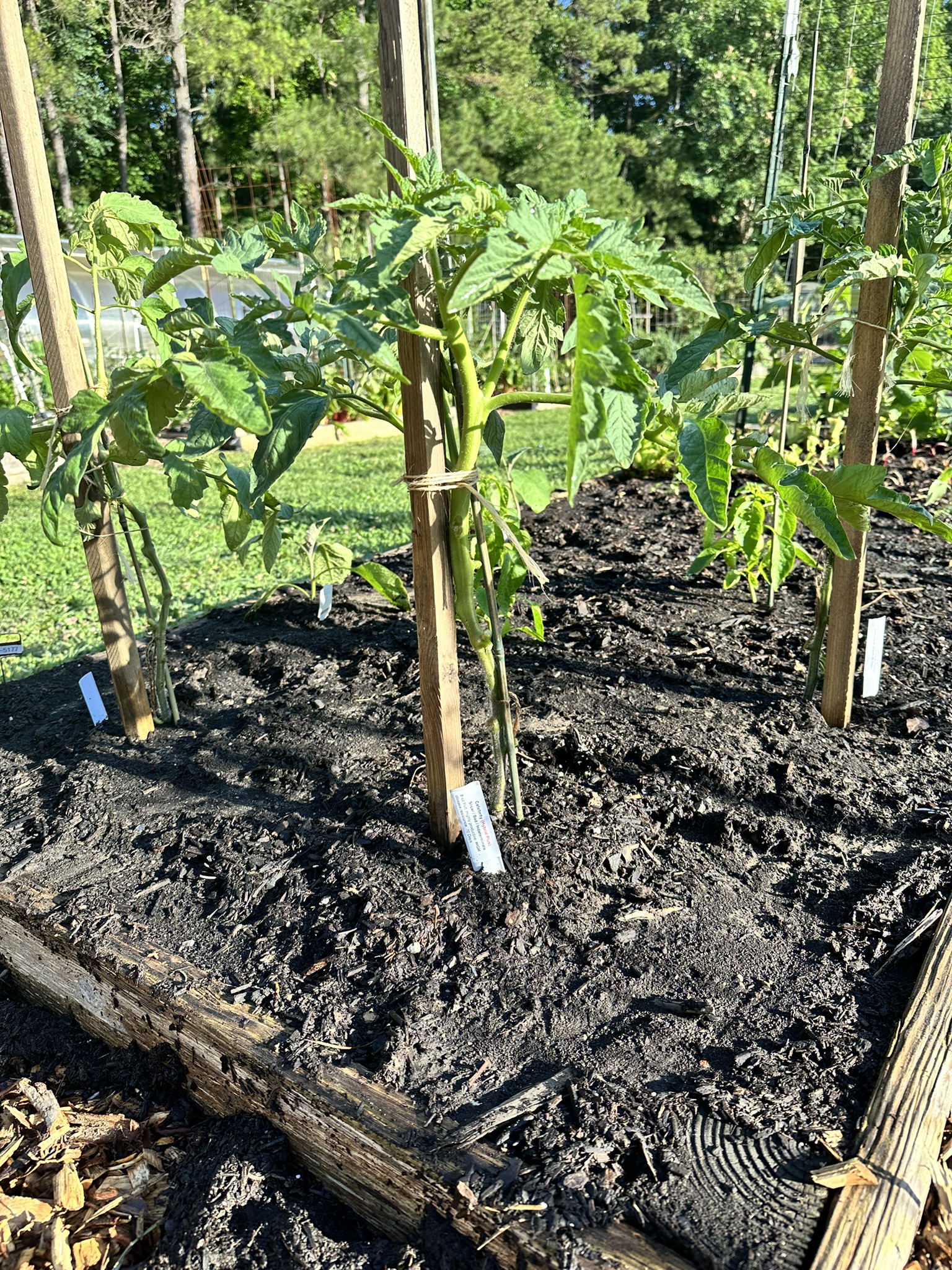
To reduce contamination by soil-borne diseases, prune the bottom leaves up by as much as a foot. Be rigorous in removing diseased and rotting leaves.
Diatomaceous Earth
Diatomaceous earth is a highly porous powder made from the sediment of fossilized algae. Sprinkled at the base of the plant and on the leaves and fruit it can help control a variety of insects. Diatomaceous earth is not a poison; it causes insects to dry out and die by absorbing the oils and fats from their exoskeleton. To be effective it must remain dry and undisturbed. The Food and Drug Administration lists diatomaceous earth as “generally recognized as safe.” Food-grade diatomaceous products are “purified.” It is generally available in garden centers, and sometimes even at stores such as Walmart.

Fungicides
Fungicides can be helpful as both a protectant and preventative against fungal disease. Fungicides labeled for use on tomatoes and containing either chlorothalonil or mancozeb can reduce the spread of fungal leaf diseases. Copper-containing fungicides protect plants from leaf diseases caused by bacteria and some fungi. Preventative activity occurs when a fungicide is present on or in the plant before the pathogen (disease) arrives or begins to develop. Preventative fungicides can still be used if the disease is present at low levels, since they will prevent new infections from occurring on the unaffected leaf tissue. A curative situation occurs when the fungicide stops the early growth of the pathogen. But, it must be applied within 24 to 72 hours of the infection. Fruit treated with some fungicides can be eaten immediately; other fungicides require a waiting period. As with any chemicals, read the label carefully before use.
Prune for Air and Yield
In terms of yield, pruning suckers is a choice. Cutting them out will yield fewer but bigger tomatoes. Leaving them in will increase quantity. However, pruning suckers will help to increase air flow and potentially decrease air-borne disease. This can be particularly helpful if, like most tomato fans, you over-plant your garden bed.

Growing tomatoes can be both challenging and rewarding. To help with the challenging issues, please find additional information in the following links.
Resources and Additional Information
Learn more about organic and inorganic mulch as well as cover crops to optimize tomato growth. Mulches for the Home Vegetable Garden (UVA) https://www.pubs.ext.vt.edu/content/dam/pubs_ext_vt_edu/426/426-326/SPES-256.pdf
This article covers tips for the home gardener and summarizes common problems related to growing tomatoes. How to Grow Tomatoes in your Garden (Utah State)
https://extension.usu.edu/yardandgarden/research/tomatoes-in-the-garden
A nice review of the disease cycle and when to use preventive or curative fungicides.
Preventive vs Curative Fungicides (Iowa State) https://crops.extension.iastate.edu/cropnews/2008/07/preventative-vs-curative-fungicides
This resource provides an overview of how to diagnose tomato diseases and treatment options. A Valuable Resource on Tomato Diseases (NCSU)
https://vegetables.ces.ncsu.edu/tomatoes-diseases/
Article Short Link: https://wp.me/p2nIr1-4BD


