To Do in the Garden: July 2024

By Gary Crispell, NC State Extension Master GardenerSM volunteer of Durham County

The brilliant hot-pink blooms of the lily ‘Stargazer’ are worthy of hours of gazing. (Image credit: Gary Crispell)

Greetings from the Hudson Valley of New York where it is wet and cool. Eat your hearts out. We are on a family trip back to the various “home places” of our youth(s). When we left, the Accidental Cottage Garden (ACG) was so very sad after breakfast. Not too bad before that, but after…. There is a plethora of things in bloom. Black-eyed Susans (Rudbeckia spp.) are the current dominant genus.

(Left to right) Black-eyed Susans (Rudbeckia spp.) and lilies (like this Lilium lancifolium) are the stars of the show in the ACG this July. (Image credit: Gary Crispell)

There are R. hirta of various cultivars, R. fulgida, and R. amplexicaulis. Also gracing the garden are purple cone flower (Echinacea purpurea), balloon flowers (Platycodon grandiflorus) which were spectacular this year, and corn flowers/bachelor’s buttons (Centaurea cyanus). The evening primrose (Oenothera lamarckiana). It was a prolific re-seeder last year, and now even after donating ten plants to the plant sale, I have I don’t know how many. If you want one (some?) let me know.

Purple cone flowers (Echinacea purpurea) and the abundant evening primroses (Oenothera lamarckiana) are definitely beating the heat. (Image credit: Gary Crispell)

The Chinese forget-me-nots (Cynoglossum amabile) are still contributing their delightful blue blossoms to the palette. Gallardia (G. pulchella), tiger lilies (Lilium lancifolium), and ‘Stargazer’ lilies (Lilium auratum ‘Stargazer’) round out the ACG’s offering for the moment. I’m sure those of you who have not already melted are ready for a break from the relentless heat and humidity. We shall attempt to send some relief, or perhaps bring it personally with us when we return. Until then, soldier on. There are still things that must be done in the garden (early in the morning, I
suppose).

Lawn Care

Warm season grasses (Bermuda, zoysia, St. Augustine) can still be fertilized if you have not already done so. Mow these grasses by removing the top 1/3 of the new growth, down to a height of 2”-2 ½.” Mow cool season grasses to a height of 3”-4.” Lower than that stresses the grass and promotes weed growth.

Fertilizing

Last call for fertilizing landscape plants (trees, shrubs) until 2025. Now is a fantastic time to do a soil test. For one thing July is not a real busy time in the garden. Two, It is relatively quick and easy, so you shouldn’t get over heated doing it. Three, the information gleaned will be invaluable in growing the best plants (including grass) possible, and four, it’s a FREE SERVICE, until the end of November. Test kits are available at the Durham County (and most other counties) Office at 721 Foster Street, Durham. For more information click here or call (919) 560-0528.

Planting

It is not too late (but getting there) to plant pumpkins, broccoli, beans, collards, carrots, Brussels sprouts, and even tomato plants. Start seeds for a fall garden. Sow cruciferous (cabbage, broccoli, Brussels sprouts, cauliflower, kale, etc.) seeds in starter pots to be transplanted into the garden in mid-August. Pot up or replant house plants in fresh soil.

Pruning

Trees that bleed when cut (maple, birch, elm, dogwood) can be pruned this month. Another “last call:” prune back overgrown or unshapely shrubbery and trees. Pruning after July is a no-no until December. Coniferous plants (produce seeds in cones) can be lightly pruned now. These plants frequently do not respond well to severe pruning, so be judicious. Keep garden mums pinched back until mid-month for fall blooms. Otherwise let ‘em go to flower as they please.

Spraying

There are critters out there that would delight in making a total disaster of your garden. Generally, by sucking the plants dry. Some of the most notorious ones (Their pictures should be on the walls at the Post Office.) include bagworms. You will have to remove the bags and (Owoo…gross) smush them. There are leaf miners (They can be found inside the leaves using little tiny pickaxes and microdroplets of trinitrotoluene.), spider mites (You’ll find them on the web—Sorry, couldn’t resist.), aphids, who like the new growth of anything green, lace bugs (Their great grandmothers taught them how to do that.), and Japanese beetles who prefer their sushi vegetarian style. Spray when appropriate using the proper chemical and following all the label instructions. Be aware of tomato blight and treat as necessary. Continue any rose, fruit tree, and/or bunch grape programs—like, ad infinitum. Veggie pests attempting to reduce your harvest include cucumber beetles (guess where), flea beetles (Nope, not there. Check the tomatoes, eggplants, and beans.), and aphids on all the above and all the rest of them, too.

Things to do that will improve the quality of your “What I did this summer” essay (I know you remember those) to the point where the teacher will read it to the end:

  • July in the piedmont of North Carolina (and South Carolina and Georgia, for that matter) can be brutal. Your plants feel the heat as much as you do and require much the same treatment i.e. hydration, hydration, hydration. If Nature doesn’t provide it, it’s on you. At least an inch of water per week is necessary for continued good health. (For the plants. You probably need a bit more.)
  • Build a cold frame or a greenhouse if you are feeling particularly ambitious. That will give you a place to play in the dirt all winter.
  • Sip on a cool beverage in the shade (or in the AC, heat wimps).
  • Chill (mentally, if not physically). July is a time to sit back (maybe with a water hose) and watch the garden flourish.

Resources and Additional Information

For more information on planning for fall gardening, as well as year-round planting, see our previous blog post “Garden Veggies year Round: One Gardener’s Calendar,” by Kathryn Hamilton.

https://wp.me/p2nIr1-2F1

For all things lawn related, check out NCSU’s TurfFiles, a comprehensive how-to guide for caring for turf grass. There you can search by your warm or cool season grass type.

https://www.turffiles.ncsu.edu/grasses

Want to learn more about both beneficial insects and how to sustainably manage pest insects in your landscape? NCSU offers a one-stop shop resource on their website.

https://gardening.ces.ncsu.edu/integrated-pest-management/insects-2

Check out out previous blog post on how to control Japanese beetles in the garden.

Article Short Link https://wp.me/p2nIr1-4G9

Achieving Peak Tomato Performance

A bounty of beautiful tomatoes. (Image credit: Kathryn Hamilton)

By Kathryn Hamilton, NC State Extension Master GardenerSM volunteer of Durham County

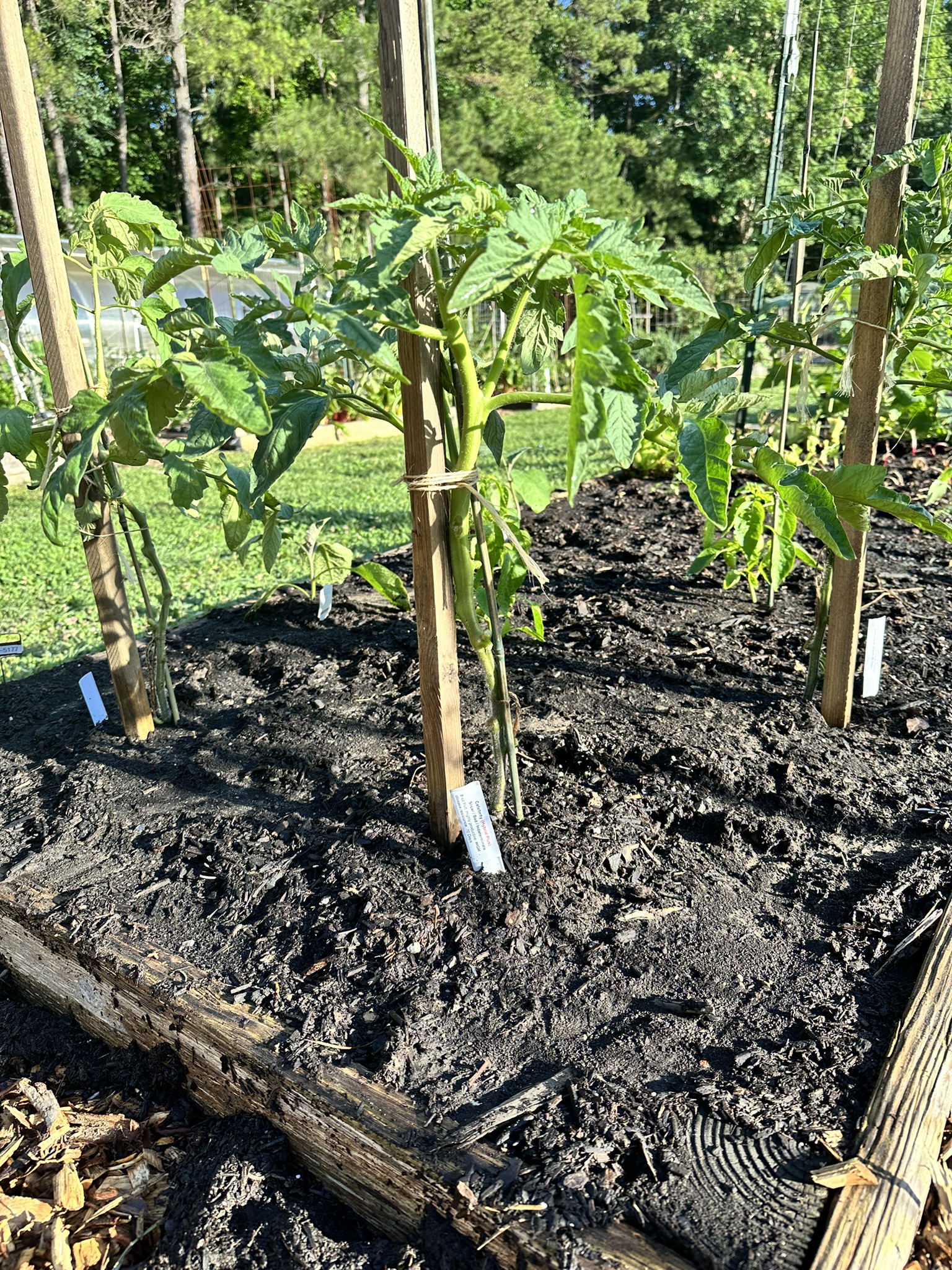
This summer, Durham County is one of eight counties in North Carolina to participate in a state-wide tomato trial. We will compare yields of three tomatoes created by NC State against ‘Cherokee Purple’ regarded for its flavor, productivity, and resistance to cracking. Check out our page on the blog called “Tomatoes on Trial” The 2024 Tomato project here. While we are busy conducting the trials, here are some tips to help you maximize your harvest.

Water Carefully and Consistently

Cracking occurs when tomatoes get a huge amount of water all at once (as an example, after a major storm) causing the fruit to swell and the skin, because it cannot grow fast enough, to crack. Calcium travels from the soil through water, and if water is insufficient the calcium never reaches the fruit, resulting in blossom end rot. This condition usually affects the first tomatoes and can be reversed with regular watering.

(Left to right) Cracking often occurs after a heavy rain. The skin can’t keep up with the swelling of pulp and consequently splits. (Image credit: Mary Knierim) Blossom end rot is preventable by consistent watering which brings calcium up into the fruit. (Image credit: NCSU Plant Disease and Insect Clinic)

During the growing season, tomatoes need 1 – 2” of water per week, the equivalent of two to four gallons. One way to measure this is to time how long it takes to fill a two-gallon container, then count along each time you water. To reduce the incidence of soil-borne diseases splashing on to the tomato vine, water at soil level, preferably in the morning to allow any leaves to dry out during the day. It is best to water deeply once or twice a week to encourage root development. The soil should be damp 6 – 8” down. Use a water meter, a trowel, or your finger to get a “reading.”

Mulch Your Bed, or at Least your Plants

Mulching carries multiple benefits. It keeps the soil moist and can help reduce both weeds and the spread of soil-borne diseases. Organic options include dried grass clippings, which have not been treated with an herbicide, and shredded cardboard or newspaper. Other options include hay or straw, and leaves (provided they are not from the black walnut tree). Avoid sawdust and wood chips which will draw nitrogen out of the soil as they decompose. There are pros and cons regarding plastic mulches. Black can heat up the soil too much; clear can foster the growth of weeds. Research at Clemson University has shown that red mulch (now available in small quantities at some on-line garden retailers) can boost tomato yields by 20 percent while conserving water and controlling weeds.

(Left to right) Grass, untreated with herbicide, is an excellent mulch; Red plastic mulch developed by Clemson University and the US Department of Agriculture is now available in smaller quantities from some on-line retailers. Use it to increase yields, prevent weeds, and retain moisture. This is not to be confused with red-dyed wood mulch. (Image credits: Kathryn Hamilton)

Feed Wisely

A three-number code on each bag of fertilizer identifies its composition. The first number relates to nitrogen (think greenery); the second to phosphorous (flowers and fruit formation), and the third, potassium (contributing strong stems and disease resistance). Once the plant has started to set fruit (usually 4 to 6 weeks after planting) side dress the tomatoes with a balanced fertilizer (i.e. 8-8-8), or one in which the first number is smaller than the others. An over-abundance of nitrogen will promote vine growth at the expense of fruit. Among the best analyses for tomatoes, according to the University of Missouri are 8-32-16 and 6-24-2. Follow package directions in terms of fertilizer amount and frequency.

Practice Rigorous Maintenance

To reduce contamination by soil-borne diseases, prune the bottom leaves up by as much as a foot. Be rigorous in removing diseased and rotting leaves.

Pruning leaves up to 18″ from the ground reduces transmission of soil-borne diseases. (Image credit: Kathryn Hamilton)
Diatomaceous Earth

Diatomaceous earth is a highly porous powder made from the sediment of fossilized algae. Sprinkled at the base of the plant and on the leaves and fruit it can help control a variety of insects. Diatomaceous earth is not a poison; it causes insects to dry out and die by absorbing the oils and fats from their exoskeleton. To be effective it must remain dry and undisturbed. The Food and Drug Administration lists diatomaceous earth as “generally recognized as safe.” Food-grade diatomaceous products are “purified.” It is generally available in garden centers, and sometimes even at stores such as Walmart.

Dusting fruit, plant, and earth with diatomaceous earth significantly reduced predation from pests such as these Rollie Pollies. (Image credit: Kathryn Hamilton)
Fungicides

Fungicides can be helpful as both a protectant and preventative against fungal disease. Fungicides labeled for use on tomatoes and containing either chlorothalonil or mancozeb can reduce the spread of fungal leaf diseases. Copper-containing fungicides protect plants from leaf diseases caused by bacteria and some fungi. Preventative activity occurs when a fungicide is present on or in the plant before the pathogen (disease) arrives or begins to develop. Preventative fungicides can still be used if the disease is present at low levels, since they will prevent new infections from occurring on the unaffected leaf tissue. A curative situation occurs when the fungicide stops the early growth of the pathogen. But, it must be applied within 24 to 72 hours of the infection. Fruit treated with some fungicides can be eaten immediately; other fungicides require a waiting period. As with any chemicals, read the label carefully before use.

Prune for Air and Yield

In terms of yield, pruning suckers is a choice. Cutting them out will yield fewer but bigger tomatoes. Leaving them in will increase quantity. However, pruning suckers will help to increase air flow and potentially decrease air-borne disease. This can be particularly helpful if, like most tomato fans, you over-plant your garden bed.

Suckers sprout from where the stem and branch of a tomato meet. Bonus: they will root in water to produce a new tomato plant (Image credit: Kathryn Hamilton)

Growing tomatoes can be both challenging and rewarding. To help with the challenging issues, please find additional information in the following links.

Resources and Additional Information

Learn more about organic and inorganic mulch as well as cover crops to optimize tomato growth. Mulches for the Home Vegetable Garden (UVA) https://www.pubs.ext.vt.edu/content/dam/pubs_ext_vt_edu/426/426-326/SPES-256.pdf

This article covers tips for the home gardener and summarizes common problems related to growing tomatoes. How to Grow Tomatoes in your Garden (Utah State)
https://extension.usu.edu/yardandgarden/research/tomatoes-in-the-garden

A nice review of the disease cycle and when to use preventive or curative fungicides.
Preventive vs Curative Fungicides (Iowa State) https://crops.extension.iastate.edu/cropnews/2008/07/preventative-vs-curative-fungicides

This resource provides an overview of how to diagnose tomato diseases and treatment options. A Valuable Resource on Tomato Diseases (NCSU)

https://vegetables.ces.ncsu.edu/tomatoes-diseases/

Article Short Link: https://wp.me/p2nIr1-4BD