Yuccas are not Yucky!

By Cathy Halloran, NC State Extension Master GardenerSM volunteer of Durham County
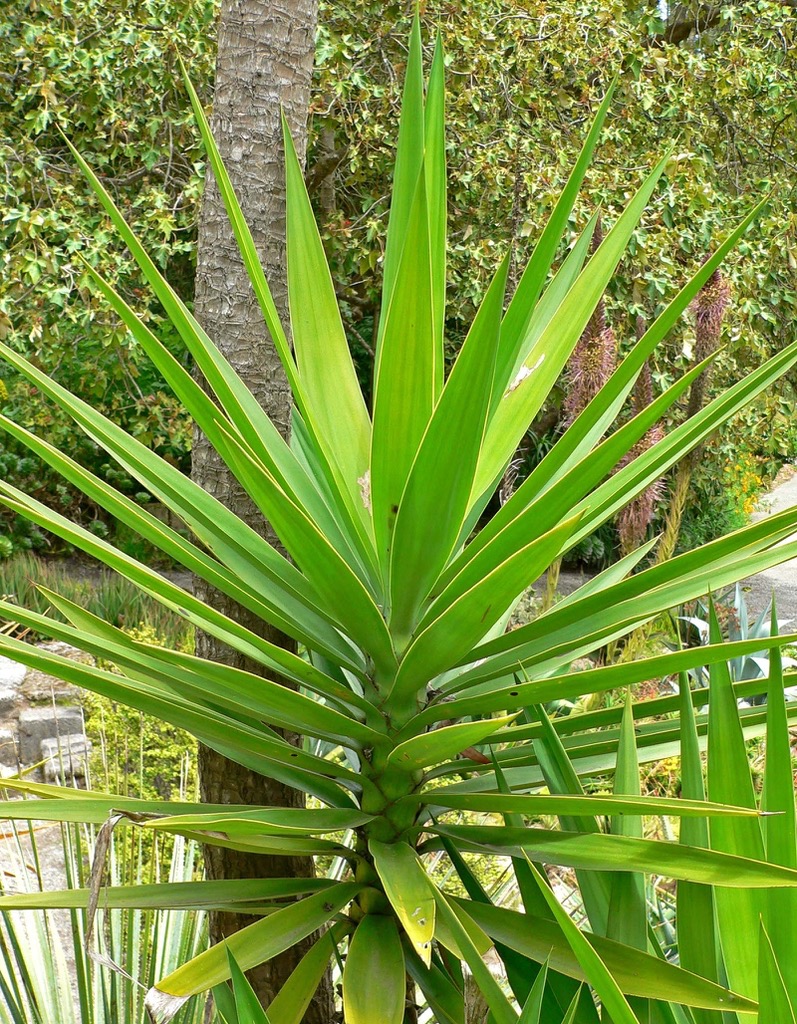
(Left to right) Delightful details of yucca plants: the crown-like splendor of Spanish dagger (Yucca aloifolia) and the creamy bell-shaped flowers and striking foliage of the Adam’s needle yucca (Yucca filamentosa). (Image credit: Stan Shebs CC BY-SA 3.0; Maja Dumat CC BY 2.0 ;M Kuhn CC BY-NC-SA 2.0)

I’ve changed my mind on including yuccas in my garden designs. I used to think they were funny looking and the flowers out of scale and consistency with the foliage and plant structure. However, time, combined with a warmer, drier Piedmont climate, has me rethinking where yuccas can be included in gardens. To do so, I had to learn about yuccas.

On a macro level, yuccas are low maintenance, slow growing with attractive leaves and interesting blooms. There are about 50 species worldwide, on every continent except Antartica. Closer to home, Yucca filamentosa, or Adam’s needle, also known as Curlyleaf or Spoonleaf, is native to the Southeastern US. It is a perennial, broadleaf, evergreen, clumping shrub in the asparagus family, Asparagaceae. Depending on variety, it grows 2-8 feet tall and 2-5 feet wide. It is resistant to deer, rabbits, poor soil, salt spray, drought, and heat. I would call that a real price-performer!

They have arrow-like leaves that are attractive all year round but also very sharp. Flowers bloom on large stalks that emerge from the center of the plant. Based on type and variety, they bloom anywhere from spring to mid-late summer. Flower stalks are tall and the flowers are usually white or cream. Hummingbirds, bees, moths, small mammals, and songbirds are attracted to the plant to collect nectar and pollen.

Yuccas provide texture and architectural interest in Durham’s public gardens this year. (Image credit: Cathy Halloran)

The City of Durham has a horticulturist on staff named Ben Bergmann, PhD, who has designed and planted pocket gardens in prior blank concrete areas in downtown Durham. Due to the heat, lack of irrigation, and not-so-great soil, he has incorporated eye-catching yuccas. I have included some photos from a pocket garden at the corners of East Chapel Hill-Mangum-Morris (see above). I lucked out and captured them while beginning to bloom!

How can yucca be incorporated in a garden? This plant can be used to add some thrill and variety to a garden, while not requiring much water or maintenance. Its sword-shaped leaves provide visual interest which is different from the common round, oval, serrated shapes we often encounter. The leaf colors of Yucca filamentosa range from green to a creamy white to pale yellow and green leaves. The color can draw the eye into the garden. It does well in mass plantings, and when used with companion plants such as black-eyed Susan, coreopsis, lantana, lavender, salvia, and sedum. 

I’ve come around to appreciate yuccas. They are a nice low maintenance, low water, and attractive plant to add to my repertoire.

Resources and Additional Information

To learn more about our native-variety yucca, Yucca filamentosa, check out NCSU’s plant toolbox site.

https://plants.ces.ncsu.edu/plants/yucca-filamentosa

Clemson Cooperative Extension’s factsheet on yuccas offer more details on a variety of species.

Check out University of Florida’s Extension page for more general growing information.

Article Short Link https://wp.me/p2nIr1-4Hq

To Do in the Garden: July 2024

By Gary Crispell, NC State Extension Master GardenerSM volunteer of Durham County
The brilliant hot-pink blooms of the lily ‘Stargazer’ are worthy of hours of gazing. (Image credit: Gary Crispell)

Greetings from the Hudson Valley of New York where it is wet and cool. Eat your hearts out. We are on a family trip back to the various “home places” of our youth(s). When we left, the Accidental Cottage Garden (ACG) was so very sad after breakfast. Not too bad before that, but after…. There is a plethora of things in bloom. Black-eyed Susans (Rudbeckia spp.) are the current dominant genus.

(Left to right) Black-eyed Susans (Rudbeckia spp.) and lilies (like this Lilium lancifolium) are the stars of the show in the ACG this July. (Image credit: Gary Crispell)

There are R. hirta of various cultivars, R. fulgida, and R. amplexicaulis. Also gracing the garden are purple cone flower (Echinacea purpurea), balloon flowers (Platycodon grandiflorus) which were spectacular this year, and corn flowers/bachelor’s buttons (Centaurea cyanus). The evening primrose (Oenothera lamarckiana). It was a prolific re-seeder last year, and now even after donating ten plants to the plant sale, I have I don’t know how many. If you want one (some?) let me know.

Purple cone flowers (Echinacea purpurea) and the abundant evening primroses (Oenothera lamarckiana) are definitely beating the heat. (Image credit: Gary Crispell)

The Chinese forget-me-nots (Cynoglossum amabile) are still contributing their delightful blue blossoms to the palette. Gallardia (G. pulchella), tiger lilies (Lilium lancifolium), and ‘Stargazer’ lilies (Lilium auratum ‘Stargazer’) round out the ACG’s offering for the moment. I’m sure those of you who have not already melted are ready for a break from the relentless heat and humidity. We shall attempt to send some relief, or perhaps bring it personally with us when we return. Until then, soldier on. There are still things that must be done in the garden (early in the morning, I
suppose).

Lawn Care

Warm season grasses (Bermuda, zoysia, St. Augustine) can still be fertilized if you have not already done so. Mow these grasses by removing the top 1/3 of the new growth, down to a height of 2”-2 ½.” Mow cool season grasses to a height of 3”-4.” Lower than that stresses the grass and promotes weed growth.

Fertilizing

Last call for fertilizing landscape plants (trees, shrubs) until 2025. Now is a fantastic time to do a soil test. For one thing July is not a real busy time in the garden. Two, It is relatively quick and easy, so you shouldn’t get over heated doing it. Three, the information gleaned will be invaluable in growing the best plants (including grass) possible, and four, it’s a FREE SERVICE, until the end of November. Test kits are available at the Durham County (and most other counties) Office at 721 Foster Street, Durham. For more information click here or call (919) 560-0528.

Planting

It is not too late (but getting there) to plant pumpkins, broccoli, beans, collards, carrots, Brussels sprouts, and even tomato plants. Start seeds for a fall garden. Sow cruciferous (cabbage, broccoli, Brussels sprouts, cauliflower, kale, etc.) seeds in starter pots to be transplanted into the garden in mid-August. Pot up or replant house plants in fresh soil.

Pruning

Trees that bleed when cut (maple, birch, elm, dogwood) can be pruned this month. Another “last call:” prune back overgrown or unshapely shrubbery and trees. Pruning after July is a no-no until December. Coniferous plants (produce seeds in cones) can be lightly pruned now. These plants frequently do not respond well to severe pruning, so be judicious. Keep garden mums pinched back until mid-month for fall blooms. Otherwise let ‘em go to flower as they please.

Spraying

There are critters out there that would delight in making a total disaster of your garden. Generally, by sucking the plants dry. Some of the most notorious ones (Their pictures should be on the walls at the Post Office.) include bagworms. You will have to remove the bags and (Owoo…gross) smush them. There are leaf miners (They can be found inside the leaves using little tiny pickaxes and microdroplets of trinitrotoluene.), spider mites (You’ll find them on the web—Sorry, couldn’t resist.), aphids, who like the new growth of anything green, lace bugs (Their great grandmothers taught them how to do that.), and Japanese beetles who prefer their sushi vegetarian style. Spray when appropriate using the proper chemical and following all the label instructions. Be aware of tomato blight and treat as necessary. Continue any rose, fruit tree, and/or bunch grape programs—like, ad infinitum. Veggie pests attempting to reduce your harvest include cucumber beetles (guess where), flea beetles (Nope, not there. Check the tomatoes, eggplants, and beans.), and aphids on all the above and all the rest of them, too.

Things to do that will improve the quality of your “What I did this summer” essay (I know you remember those) to the point where the teacher will read it to the end:

  • July in the piedmont of North Carolina (and South Carolina and Georgia, for that matter) can be brutal. Your plants feel the heat as much as you do and require much the same treatment i.e. hydration, hydration, hydration. If Nature doesn’t provide it, it’s on you. At least an inch of water per week is necessary for continued good health. (For the plants. You probably need a bit more.)
  • Build a cold frame or a greenhouse if you are feeling particularly ambitious. That will give you a place to play in the dirt all winter.
  • Sip on a cool beverage in the shade (or in the AC, heat wimps).
  • Chill (mentally, if not physically). July is a time to sit back (maybe with a water hose) and watch the garden flourish.

Resources and Additional Information

For more information on planning for fall gardening, as well as year-round planting, see our previous blog post “Garden Veggies year Round: One Gardener’s Calendar,” by Kathryn Hamilton.

https://wp.me/p2nIr1-2F1

For all things lawn related, check out NCSU’s TurfFiles, a comprehensive how-to guide for caring for turf grass. There you can search by your warm or cool season grass type.

https://www.turffiles.ncsu.edu/grasses

Want to learn more about both beneficial insects and how to sustainably manage pest insects in your landscape? NCSU offers a one-stop shop resource on their website.

https://gardening.ces.ncsu.edu/integrated-pest-management/insects-2

Check out out previous blog post on how to control Japanese beetles in the garden.

Article Short Link https://wp.me/p2nIr1-4G9