
By Gary Crispell, NC State Extension Master Gardener SM volunteer of Durham County (aka the Accidental Cottage Gardener)
Welcome to September. The month North Carolina natives and long-time residents have looked forward to since late May (and maybe even longer this year). It is the month we hope will bring us cooler temperatures or at least less humidity. This year we shall see. After ten months of parching drought we had one month of three months’ rain. August was back to being a little dry. September…who knows? Climate change has scrambled things a bit. At least we are not literally burning up nor are we drowning. See, it’s all good (well, mostly) in this the “goodliest state.”
The Accidental Cottage Garden is just full of itself, what with all the rain and sunshine. Once again there are twenty-one species in bloom. The goal of zinnias (Zinnia elegans) and cosmos (Cosmos sulphureus & C. bipinnata) for cut flower arrangements has been attained (and attained and attained). Apparently ¼ pound of zinnia seeds and 2 ounces of cosmos for 150 sq. ft. is overkill. Who knew? They are right pretty, though. The list of all the others will be at the end of the post.
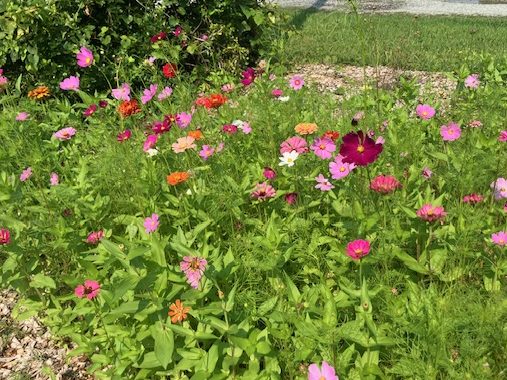
Zinnias and Cosmos continue to thrive in the ACG, even with the heat and drought. (Image credit: Gary Crispell)
Lawn Care
Time to rejuvenate cool season lawns (tall fescue, bluegrass, perennial rye). Unless you irrigated this summer, they probably look rather sad. We assume that you did avail yourself of the FREE SOIL TEST service from NCDOA this year and know how much lime and N-P-K (nitrogen, phosphorus, potassium) fertilizer you need to add to your soil. So, there are basically three approaches to rejuvenation.
They all start with spreading the lime and fertilizer over the yard. The first method is for those of you who only have some relatively small bare patches. Loosen the soil in the areas to be reseeded, scatter seed on the loose soil and tamp it down (Not stomp…just walk over it firmly.). Spread a light covering of wheat straw over any patch larger than one square foot. Keep moist until germination and then water thoroughly as needed to give it about an inch of water per week.
Method two involves a core aerator. Spread chemicals as above and core aerate the lawn twice in perpendicular directions. Spread seed over entire lawn and cover large bare areas with wheat straw. Water as above.
The third method is drastic. It is used when your lawn looks like my backyard…totally nekkid. Spread lime and fertilizer then till up the whole yard. Spread seed and roll yard to achieve optimal seed/soil contact. Cover yard with wheat straw and water as above. The book says all this should be done by the second week of October. The book ain’t wrong. A little conservative maybe, but not wrong.
Do not fertilize any warm season grasses (Bermuda, zoysia, centipede) anymore this year. They are getting ready for a long winter’s nap and unlike bears they do not need to fatten up.
Grub control efforts are still worthwhile until the middle of the month when the grubs, too, are going into hibernation (having already fattened up on your lawn’s roots).
Pruning
Nope. Nicht. Non. Nyet. No! Sharpen the pruning shears and loppers and oil ‘em up then hang ‘em up until Black Friday or Boxing Day even.
Spraying
The same culprits that you were saying bad things about in August are still out there—all of them and most likely in the same places they were then. They are tenaciously pernicious. Get them! I shall forthwith reveal their identities and their likely hideouts. Wooly adelgids will be creeping around hemlocks while spider mites are not so discerning. They will lurk on the underside of any coniferous evergreen’s needlelike leaves and on most other plants that might be under stress. (They have no mercy.) Tea scales will be found on euonymus and camellias. These will either have to sprayed with a horticultural oil to smother them or you can pick them off individually and smush them. Well, not necessarily with your bare fingers. That is rather yucky. Lace bugs will be hanging out on pyracantha and azaleas, especially those growing in sunny locations. (Azaleas are an understory plant, after all.)


Most tree species are fed upon by spider mites (NC State Extension) including spruce and oak.
As always, continue any rose maintenance program.
Propagation
Here is your chance to get dirt under your fingernails. I know you want to.
Dig up spring-flowering bulbs and tubers and rhizomes and divide them. Daffodils really like the attention as do irises and day lilies. The reward you get in the spring will more than compensate for having to get your nails done again. (Real men aren’t afraid of the manicurist.)
Peonies that need transplanting can receive that attention now. Dig a big hole and a big root ball. Just be aware of not planting too deep. Only as deep as the hole they came out of. Cut back any old stems and mulch well.
OTHER STUFF TO DO SHOULD SEPTEMBER TURN OUT TO BE ABSOLUTELY SPECTACULAR
It could happen, you know. It’d be a shame to get to October before you realized that September had been spectacular. Stay aware.
It’s not too late to plant a fall garden.
Go camping with the grandkids.
Get the firepit ready for that first crisp fall evening.
Just go outside and revel in the goodness and wonder of nature.
Remember: FALL IS FOR PLANTING
ACG PLANT LIST:
- Black-eyed susan (Rudbeckia hirta)
- Balloon flower (Platycodon grandiflorus)
- Blanket flower (Gallardia pulchella)
- African marigold (Tagetes erecta)
- Cosmos (Cosmos sulphureus)
- C. bipinnata
- Purple coneflower (Echinacea purpurea)
- Zinnia ` (Zinnia elegans)
- Evening primrose (Oenothera lumarkiana)
- Chinese forget-me-not (Cynoglossum amabile)
- Canadian goldenrod (Solidago altissima)
- Common goldenrod (S. canadensis)
- Canna lily (Canna x generalis)
- Butterfly bush (Buddleia davidii)
- Cypress vine (Ipomoea quamoclit)
- Prairie sunflower (Helianthus petiolaris)
- Hydrangea Limelight (Hydrangea macrophila ‘Limelight’)
- Resindot sunflower (Helianthus resinosus)
- False vervain (Verbena carnea)
- Common tradescantia (Tradescantia virginiana)
- Chinese chives (Allium tuberosum)
Additional Reading and Resources
Want a quick tutorial on how to plant spring flowering bulbs?
https://forsyth.ces.ncsu.edu/news/fall-is-the-time-to-add-flowering-bulbs-in-your-garden
Editor: Martha Keehner Engelke
Shortlink: https://wp.me/p2nIr1-826