Achieving Peak Tomato Performance

A bounty of beautiful tomatoes. (Image credit: Kathryn Hamilton)

By Kathryn Hamilton, NC State Extension Master GardenerSM volunteer of Durham County

This summer, Durham County is one of eight counties in North Carolina to participate in a state-wide tomato trial. We will compare yields of three tomatoes created by NC State against ‘Cherokee Purple’ regarded for its flavor, productivity, and resistance to cracking. Check out our page on the blog called “Tomatoes on Trial” The 2024 Tomato project here. While we are busy conducting the trials, here are some tips to help you maximize your harvest.

Water Carefully and Consistently

Cracking occurs when tomatoes get a huge amount of water all at once (as an example, after a major storm) causing the fruit to swell and the skin, because it cannot grow fast enough, to crack. Calcium travels from the soil through water, and if water is insufficient the calcium never reaches the fruit, resulting in blossom end rot. This condition usually affects the first tomatoes and can be reversed with regular watering.

(Left to right) Cracking often occurs after a heavy rain. The skin can’t keep up with the swelling of pulp and consequently splits. (Image credit: Mary Knierim) Blossom end rot is preventable by consistent watering which brings calcium up into the fruit. (Image credit: NCSU Plant Disease and Insect Clinic)

During the growing season, tomatoes need 1 – 2” of water per week, the equivalent of two to four gallons. One way to measure this is to time how long it takes to fill a two-gallon container, then count along each time you water. To reduce the incidence of soil-borne diseases splashing on to the tomato vine, water at soil level, preferably in the morning to allow any leaves to dry out during the day. It is best to water deeply once or twice a week to encourage root development. The soil should be damp 6 – 8” down. Use a water meter, a trowel, or your finger to get a “reading.”

Mulch Your Bed, or at Least your Plants

Mulching carries multiple benefits. It keeps the soil moist and can help reduce both weeds and the spread of soil-borne diseases. Organic options include dried grass clippings, which have not been treated with an herbicide, and shredded cardboard or newspaper. Other options include hay or straw, and leaves (provided they are not from the black walnut tree). Avoid sawdust and wood chips which will draw nitrogen out of the soil as they decompose. There are pros and cons regarding plastic mulches. Black can heat up the soil too much; clear can foster the growth of weeds. Research at Clemson University has shown that red mulch (now available in small quantities at some on-line garden retailers) can boost tomato yields by 20 percent while conserving water and controlling weeds.

(Left to right) Grass, untreated with herbicide, is an excellent mulch; Red plastic mulch developed by Clemson University and the US Department of Agriculture is now available in smaller quantities from some on-line retailers. Use it to increase yields, prevent weeds, and retain moisture. This is not to be confused with red-dyed wood mulch. (Image credits: Kathryn Hamilton)

Feed Wisely

A three-number code on each bag of fertilizer identifies its composition. The first number relates to nitrogen (think greenery); the second to phosphorous (flowers and fruit formation), and the third, potassium (contributing strong stems and disease resistance). Once the plant has started to set fruit (usually 4 to 6 weeks after planting) side dress the tomatoes with a balanced fertilizer (i.e. 8-8-8), or one in which the first number is smaller than the others. An over-abundance of nitrogen will promote vine growth at the expense of fruit. Among the best analyses for tomatoes, according to the University of Missouri are 8-32-16 and 6-24-2. Follow package directions in terms of fertilizer amount and frequency.

Practice Rigorous Maintenance

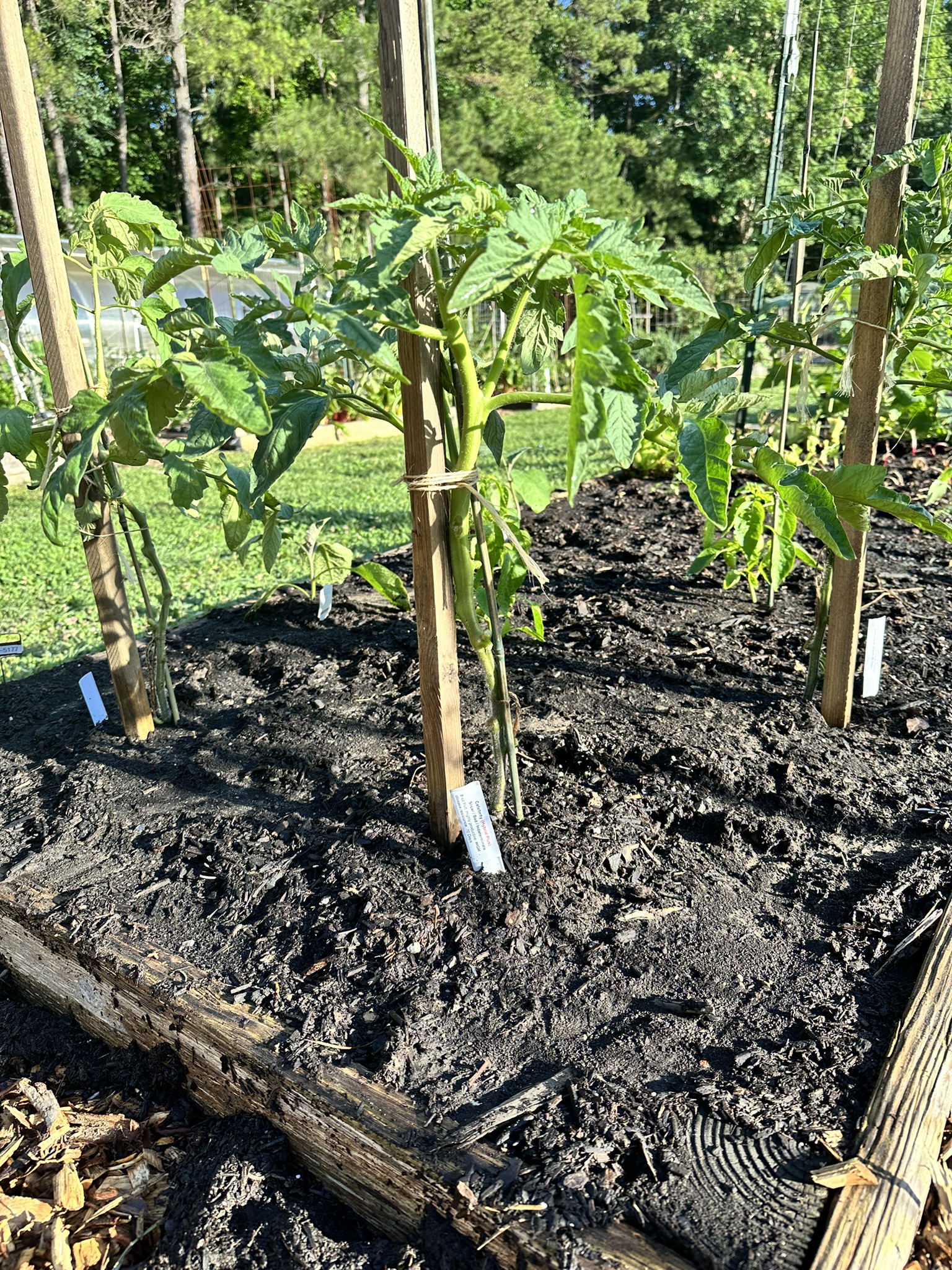
To reduce contamination by soil-borne diseases, prune the bottom leaves up by as much as a foot. Be rigorous in removing diseased and rotting leaves.

Pruning leaves up to 18″ from the ground reduces transmission of soil-borne diseases. (Image credit: Kathryn Hamilton)
Diatomaceous Earth

Diatomaceous earth is a highly porous powder made from the sediment of fossilized algae. Sprinkled at the base of the plant and on the leaves and fruit it can help control a variety of insects. Diatomaceous earth is not a poison; it causes insects to dry out and die by absorbing the oils and fats from their exoskeleton. To be effective it must remain dry and undisturbed. The Food and Drug Administration lists diatomaceous earth as “generally recognized as safe.” Food-grade diatomaceous products are “purified.” It is generally available in garden centers, and sometimes even at stores such as Walmart.

Dusting fruit, plant, and earth with diatomaceous earth significantly reduced predation from pests such as these Rollie Pollies. (Image credit: Kathryn Hamilton)
Fungicides

Fungicides can be helpful as both a protectant and preventative against fungal disease. Fungicides labeled for use on tomatoes and containing either chlorothalonil or mancozeb can reduce the spread of fungal leaf diseases. Copper-containing fungicides protect plants from leaf diseases caused by bacteria and some fungi. Preventative activity occurs when a fungicide is present on or in the plant before the pathogen (disease) arrives or begins to develop. Preventative fungicides can still be used if the disease is present at low levels, since they will prevent new infections from occurring on the unaffected leaf tissue. A curative situation occurs when the fungicide stops the early growth of the pathogen. But, it must be applied within 24 to 72 hours of the infection. Fruit treated with some fungicides can be eaten immediately; other fungicides require a waiting period. As with any chemicals, read the label carefully before use.

Prune for Air and Yield

In terms of yield, pruning suckers is a choice. Cutting them out will yield fewer but bigger tomatoes. Leaving them in will increase quantity. However, pruning suckers will help to increase air flow and potentially decrease air-borne disease. This can be particularly helpful if, like most tomato fans, you over-plant your garden bed.

Suckers sprout from where the stem and branch of a tomato meet. Bonus: they will root in water to produce a new tomato plant (Image credit: Kathryn Hamilton)

Growing tomatoes can be both challenging and rewarding. To help with the challenging issues, please find additional information in the following links.

Resources and Additional Information

Learn more about organic and inorganic mulch as well as cover crops to optimize tomato growth. Mulches for the Home Vegetable Garden (UVA) https://www.pubs.ext.vt.edu/content/dam/pubs_ext_vt_edu/426/426-326/SPES-256.pdf

This article covers tips for the home gardener and summarizes common problems related to growing tomatoes. How to Grow Tomatoes in your Garden (Utah State)
https://extension.usu.edu/yardandgarden/research/tomatoes-in-the-garden

A nice review of the disease cycle and when to use preventive or curative fungicides.
Preventive vs Curative Fungicides (Iowa State) https://crops.extension.iastate.edu/cropnews/2008/07/preventative-vs-curative-fungicides

This resource provides an overview of how to diagnose tomato diseases and treatment options. A Valuable Resource on Tomato Diseases (NCSU)

https://vegetables.ces.ncsu.edu/tomatoes-diseases/

Article Short Link: https://wp.me/p2nIr1-4BD

A Greener Plant Sale

by Lissa Lutz, NC State Extension Master GardenerSM volunteer of Durham County

If you’ve ever tried to reduce your carbon footprint, you know that it can take patience, persistence, creativity, and sometimes compromise. As the plant sale committee works to make our community a greener place with plants, we are also trying to keep our efforts green in the process.

As our Backyard Treasures Plant Sale name implies, much of our inventory has traditionally been sourced through generous donations from Master GardenerSM volunteer gardens. In recent years, however, we’ve grown to understand the risks of transferring unwanted species far and wide–not just invasive plants but also unintended species such as weeds and soil-dwelling creatures that may come along for the ride. The first way to combat this problem has been to increase the number of plants we start from seed.

Starting Plants from Seed

Our veggie and herb selections have always comprised almost a third of what we sell and are lovingly home-grown by a dedicated team of seed starters. In addition we now have a team growing a variety of native plants from seed. Many of these plants are challenging to start, their seeds often requiring complex temperature cycling to initiate germination. We also rely on our propagation team, another spin-off from the plant sale committee, for providing us with a variety of propagated plants. All of these plants, whether started from seed or propagated, are grown in clean potting mixes that reduce the spread of unintended species.

A variety of native seedlings get their start under grow lights before transitioning outdoors and then they will be sold at the Backyard Treasures Plant Sale! (Image credit: Lissa Lutz)

Growing Plants by Division

Many wonderful plants that we share are still sourced through the division of garden-grown favorites, and those plants are now thoroughly washed to remove all soil from the roots before they are potted up in fresh potting mix. While not perfect, this system can vastly decrease the chance of sharing undesirable plants and organisms.

Root washing to remove contaminants reveals the beautiful intricacies of the root systems. Clockwise from left: aromatic aster (Symphyotrichum oblongifolium); Canadian wild ginger (Asarum canadense); Formosa lily (Lilium formosanum); celandine poppy (Stylophorum diphyllum); Columbine sp (Aquilegia sp). (Image credit: Lissa Lutz)

Searching for the Right Potting Mix

Two years ago the committee began efforts to move away from peat-based potting mixes. Peatbogs, the source of peat for these mixes, are unique ecosystems and carbon sinks that are extremely slow to replenish. The committee had fun developing its own formula of a non-peat-based growing mix using coconut coir, perlite, vermiculite and compost. We tested the look and feel of various mixes to try to replicate the consistency of our traditional brand.

Soil mixing party with Durham Master GardenerSM volunteers Bev Tisci, Lissa Lutz, and Durham County Extension Agent Ashley Troth. (Image credit: Lissa Lutz)

Scaling up proved to be challenging, time consuming and very dusty! There is a reason the best mixes are proprietary secrets, and indeed the seedlings in our concocted mix languished. For now we continue to start seeds in a peat-based mix for best results, while still searching for an economical and sustainable alternative. We have found an acceptable non-peat-based mix that we use for divisions and potting up seedlings once they are established.

From Plastic to CowPots®

This year, our focus has been on reducing our reliance on single-use plastics, specifically with respect to the pots we use. Most garden pots and flats are difficult to recycle because of the mix of plastics. Our approach to this problem will be twofold. First, we are trying to use a single pot size more consistently, namely what we call a quart pot. We are tagging plastic quart pots this year with a label that reads, “Return clean, intact quart pots to 721 Foster Street by May 31st.”

Our hope is that our local buyers will rinse and return the pots once they have planted their purchases. With a little extra care we should get at least one more season out of them and are excited to see what percentage of pots come back to us. In addition, we are spreading the word about how pots and flats can be recycled.

Second, we are piloting a biodegradable pot in our sale. After researching a variety of biodegradable options, we landed on CowPots®, a pressed pot made from dehydrated cow manure sourced from a dairy farm in Connecticut. The size is roughly equivalent to our plastic quart pots. They can be fragile to handle especially when wet, but the entire pot can and should be planted in the ground with the plant and should be completely degraded by the end of the growing season.

Plants grown in CowPots® are reported to have healthier root systems because of air pruning, a process that starts when the roots begin to grow through the sides of the pot. When the root tips meet air on the outside of the pot, it stimulates lateral growth from the root back inside the pot, as opposed to the circling of the root that occurs when it meets the side of a plastic pot. Additionally, the pot itself provides amendments and a small amount of nutrients to the garden soil as it slowly decomposes. These pots are only slightly more expensive than the plastic pots. It will be interesting to see how they are received by the public. Only a small percentage of plants this year will be grown in the CowPots, to give us a chance to evaluate them and address any problems that arise.

Adding these green initiatives to our plant sale practices has not necessarily made the work easier, less expensive, or even better in some cases. But it does feel like we are moving in the right direction to be responsible stewards of our land and to set an example for our community.

Resources and Additional Information

To learn more about the environmental impacts of plastic horticultural pots, check out “2023 State of the Pot” by the Association of Professional Landscape Designers’ and Healthy Pot, Healthy Planet Initiative.

https://www.healthypotshealthyplanet.org/_files/ugd/5ceae1_56fb60127c1f4794a94b0c38b3cd90a0.pdf

For more information on Cowpots®, an example of a more environmentally garden pot, visit their site.

https://cowpots.com/marketing

To learn about additional ways to be green in the garden, see our August 2022 blog post “Minimizing the Use of Plastic in the Garden” by Extension Master GardenerSM volunteer Wendy Diaz and NC Cooperative Extension’s factsheet.

https://durhammastergardeners.com/wp-admin/post.php?post=9832&action=edit

https://pender.ces.ncsu.edu/2021/10/recycling-plastic-plant-pots-and-containers/

Article Short Link: https://wp.me/p2nIr1-4p9