
By Gary Crispell, NC State Extension Master Gardener volunteerSM of Durham County


(Left to right) Lanceleaf coreopsis (Coreopsis lanceolata) and Stoke’s aster (Stokesia laevis) are strutting their stuff this June in the ACG thanks to all the rain we received in May. (Image credit: Debbie Roos CC BY 2.0; Melinda Heigel; Hope Duckworth CC BY 4.0)
Will you looky here, it is June. I must have turned my back in April, and May happened while I wasn’t looking. I do remember some rain…in bunches. My gauge reads 6.15” on the 29th with a bit more in the forecast. We’ll need it this month as things begin to heat up. The last couple of Junes have been a little stingy in the rain department.
The Accidental Cottage Garden (ACG) has been spectacular all spring. Right now, there is a plethora of blooms and an exciting palette of colors. I counted nineteen different species in bloom. There are Chinese forget-me-nots (Cygnoglossum amabile), lance leaf coreopsis (C. lanceolata), purple cone flower (Echinacea purpurea), English daisies (Bella perennis) and gallardia (G. pulchella). There is the luscious pink of the Corsica lily (Lilium x Corsica), and the blue/purple of the Stoke’s aster (Stoksia laevis) playing off each other. There are two varieties of day lily, Hemerocallis x Stella d’Oro and the species typical orange “ditch lily.”
Another very orange plant currently in bloom is the butterfly weed (Asclepias tuberosa). Speaking of butterflies, the butterfly bush (Buddleia davidii) brings some height to the WNW side of the garden. The sweet William (Dianthus barbatus) is still blooming, though not as profusely as last month and the same can be said of the spiderwort (Tradescantia virginiana).


(Left to right) New to the ACG this season is the New Jersey tea (Ceanothus americanus), a native deciduous shrub that can be found in all parts of North Carolina. Its blossoms are stunning and total pollinator magnets. The conical Mexican hat (Ratitida columnifera) offers up some whimsy. (Image credit: Debbie Roos CC BY 2.0)
A surprise to me (Mostly due to unfamiliarity with the plant.) is the New Jersey Tea (Ceanothus americanus) plants installed to replace two crape myrtles in front of the house. The bees of all types have been all over the white ping pong ball inflorescences. In front of them the false vervain (Verbena carnea) and forking larkspur (Consolida regalis) provide two different shades of violet. In the same vicinity are Mexican hat (Ratitida columnifera), tickseed (Coreopsis verticillata) and fire engine red gladiolus (G. communis x hybrid). Oops. I left out the cornflower (Centaurea cyanus) and the perennial garden mum (Chrysanthemum x ‘Too-Many-Choices’). And that’s just the front yard.
There’s a lot to do in June, so let’s get started before it gets too hot.
Lawn Care
Last call to get off your duff and feed those warm season grasses (Bermuda, zoysia). Well, perhaps not THE last call, but if you want a lush green lawn all summer…just sayin’. Of course, we all know that you sent in a FREE SOIL TEST last fall or this spring so you know exactly what N-P-K ratio to use and in what quantity to apply…right? (Come on, friends. They are FREE from April through November.)
June is THE month to apply fertilizer to centipede lawns. If you, too, didn’t get your soil tested the recommended application rate is ½ pound of 15-0-14 or equivalent per 1000 square feet.
June is as good a month as any (and better than most) to core aerate your lawn. It will facilitate getting water and nutrients down into the root zone where the plants can use it. And it puts air into our heavy Triassic Piedmont soils. Win, win, win!
Fertilizing
This is a great time to fertilize dogwoods (Cornus sps.).
Vegetable gardens will reward you later if you give them a side dressing of a balanced (10-10-10 or equivalent) fertilizer about now.
Planting
For everyone trying to outlast the frost, it’s gone. No more until October (maybe). Therefore, you may plant all the things in the vegetable garden safely. (Safely, from cold. No guarantees against critters and single-celled pests.) It is borderline too late for seeding. Transplants would be a safer (There’s that word again.) bet.
Pruning

(Image credit: NC State Extension)
June is a fine time to prune lots of stuff. Make sure the tools are sharp and lubricated. (Just the tools, now. The operator should not be lubricated.)
Coniferous (seeds from cones) trees and shrubs such as cedar, pine, arborvitaes, chamaecyparis, junipers, cryptomeria, etc. may be pruned judiciously now. Be gentle as these plants do not generally put out new growth below the pruning cut.
Azaleas should be pruned before the Fourth of July except for Encores®. The only information I could find recommended pruning them in the spring immediately after the first blooming.
Some ericaceous plants (acid-loving) may suffer from a disease called die back. As the name implies, the branches die back from the terminal ends. Prune these branches out as soon as you detect it by making cuts 4” to 6” below the diseased part of the branch. Be sure to sanitize your pruner with a 10% bleach solution between each cut.
Hydrangea macrophylla (macro=big, phylla=leaf) can be pruned when the flowers fade.
Keep garden mums (Chrysanthemum sps.) pinched back until mid-July for nice full plants and lots of fall blooms.
Spraying
Be vigilant in looking for June’s usual suspects—lace bugs on azaleas and pyracantha, leaf miners, especially on boxwoods, bagworms on evergreens and aphids like everywhere on everything. If the bagworms have already ensconced themselves in their little bags you will have to pick them off individually and dispose of them as you see fit. I smush ‘em. Treat the others with the appropriate pesticide applied as per the label.


(Left to right) Be on the lookout for these pathogens and pests this June: circular dark spots on tomato leaves signal early blight of tomatoes; leaf miners on boxwoods leave blister mines and discolored leaves; and aphids, as seen here on a tulip poplar leaf, leave a shiny, sticky residue behind called honeydew. (Image credit: Inga Meadows, NC State Extension; SD Frank, NC State Extension)
Be watchful for tomato early blight. It is caused by two closely related fungi, Alternaria tomatophila, and A. solani. (See, I can do research.) The initial symptoms are dark spots on the leaves. The spots will eventually form concentric circles. The leaves will then become yellow, turn brown and fall off spreading the spores to the soil to wait until you plant tomatoes there again next year. And the cycle repeats itself. Gaaaah! Nature can be sooo frustrating! In order to try to interrupt the cycle, remove the diseased leaves and treat the rest of the plant with an appropriate fungicide. There are organic options.
While we’re in the veggie garden (If one grows tomatoes amongst the flowers, is it a flower garden with tomatoes or a tomato garden with flowers? Philosophy is so much fun.) there are vast hordes of insects who think that every week is “Restaurant Week” in the garden. There are several different moth larvae feeding on the cruciferous veggies (broccoli, cabbages, etc.), cucumber beetles on cucumbers (I mean really? Where else would one expect to find cucumber beetles?) and melons (Oh. There.), squash vine borers on cucurbits (squash, melons, not cucumbers), flea beetles on beans, tomatoes, and eggplants, and the ubiquitous aphids about whom we have already gossiped.

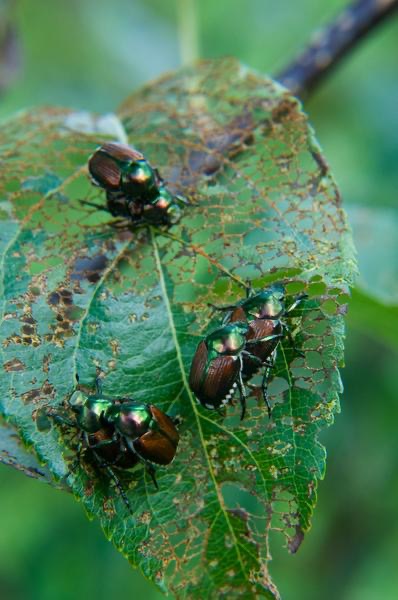
“The Beetles are Coming!” Keep your eyes open this month for Japanese beetles (Popillia japonica). They attack a variety of trees, shrubs, and edible crops. (Right) Among other plant parts, Japanese beetles devour leaf tissue, leaving a “skeletonized” leaf with only the veins remaining. (Image credit: Steve Schoof, NCSU/NCSU Extension)
Japanese beetles will make their grand entrance sometime this month. Spray them, powder the plants, pick them off and drown (or squish) them. Back in the cretaceous period, my Dad gave me a penny per beetle collected in a one pound tobacco can with kerosene in the bottom (No longer recommended, of course, but water made sudsy with dish soap is a safe and effective alternative.) Pretty soon there won’t even be pennies. This is progress.
Poison ivy/oak, kudzu, and honeysuckle are ripe for eradication efforts this month.
Per usual, continue spray programs for roses, bunch grapes, and fruit trees.
OTHER WONDER-FILLED AND GARDEN-RELATED OUTDOOR ACTIVITIES TO BE PURSUED IN JUNE
Watering. I know, Mother Nature has on several occasions in May attempted to drown your plants…all of them. It would be foolhardy to assume that this will continue. The last few Junes have tended toward the dry side. Plants in general including the lawn need about 1” of water per week. If they are in pots or planters, they may need more. It is best to water in the morning to minimize evaporation and disease spread. Mother Nature is aware of these admonitions but doesn’t read this blog.1
Strawberry beds can be renovated now because strawberry fields aren’t forever as it turns out.
Patios and decks should receive maximum use this month. Cool beverages, light hors-d’oeuvres, or charcuterie boards along with lively conversation are highly recommended. Organic varieties of each are available.
Have a sensational and scintillating summer, Y’all!!
Notes:
1–Later this month on the blog, Extension Master Gardener volunteer Eric Wiebe will be walking us through sustainable and effective drip irrigation (It’s easier than you think!) Stay tuned.
Resources and Additional Information:
More on pruning hydrangeas in Martha Engelke’s previous blog post “When Should I Prune My Hydrangea?… It Depends:” https://wp.me/p2nIr1-3oH
General pruning tips with NC State Extension: https://content.ces.ncsu.edu/general-pruning-techniques
Address Japanese beetle pressure with Kathryn Hamilton’s blog article “Coping During Japanese Beetle “Season:” https://durhammastergardeners.com/2022/06/15/coping-during-japanese-beetle-season-2/
Tips on eradicating poison ivy with Clemson Cooperative Extension: https://hgic.clemson.edu/factsheet/poison-ivy/
Article Short Link: https://wp.me/p2nIr1-63r