
By Kathryn Hamilton, NC State Extension Master GardenerSM volunteer of Durham County
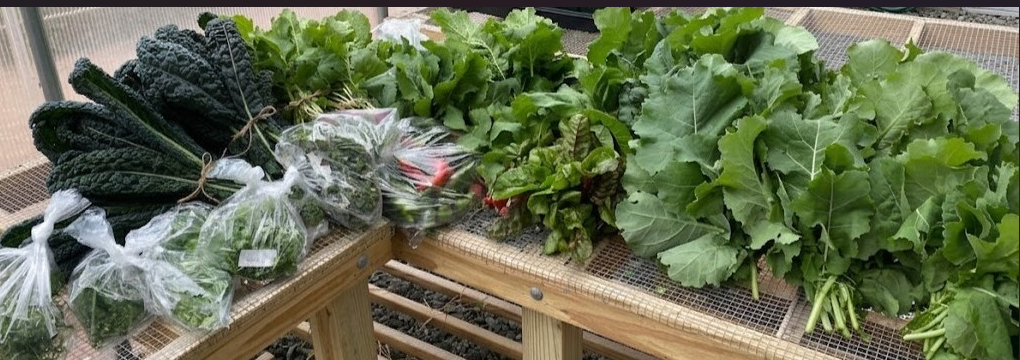
This mid-November harvest included collards, Swiss chard, radishes, Lacinato kale, mustard greens, and a few bags of parsley. (Image credit: Kathryn Hamilton)
Among the beneficiaries of Briggs Avenue Community Garden is the Durham Tech Harvest Food Bank. Each Tuesday we harvest food grown expressly for them in our “pantry” beds and deliver to the school. With a goal of maximizing our harvest, we continuously experiment with new vegetable varieties. High priority are hardy “cut and come again” veggies we can harvest over a longer period. Here are some “favorite fall and winter greens” that have worked for us along with some personal favorites and a few recommendations from Durham County Extension Master Gardener volunteers.
Swiss Chard

Swiss chard, planted in early September, is ready to harvest eight weeks later. Broccoli is growing to the left. (Image credit: Kathryn Hamilton)
Under a row cover, Swiss chard overwinters beautifully. For the last several years, colorful and cold-tolerant “Celebration,” has been a winner for us. In October we’ll harvest colorful, youngish leaves until the heavy frosts set in then tuck it under a row cover for some “cold storage.” Come February it will begin springing back to life. This year we picked leaves until mid-July.
For her own garden, Durham Extension Master Gardener volunteer Caryl Cid favors the even more colorful “Bright Lights.” Though not as cold hardy, it is more bolt resistant adding to a longer spring harvest. To round things out even further, this year we will add “Ford Hook,” a heavy-yielding, cold hardy green Swiss chard, likely the one found in your grocery store.
Pak Choi
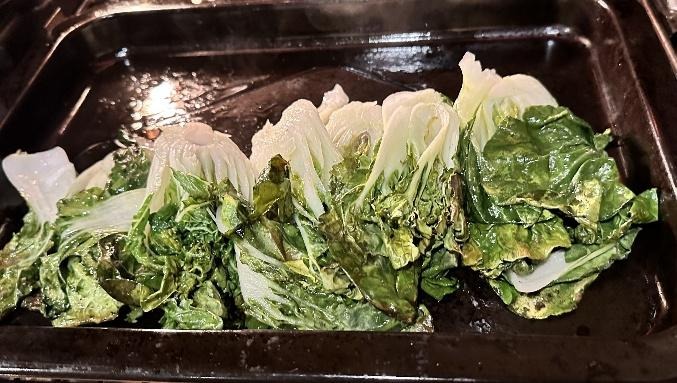
Small, but dense and heavy, the “Green Gem” Pak Choi are delicious broiled with some garlic and olive oil. (Image credit: Kathryn Hamilton)
For small or single servings, we find “Green Jewel” minis hard to beat. Plump, solid plants are only four inches tall, about five inches in diameter, and heavy for their size. They are very erect, easy to protect against insects, and ready in about 45 days giving us an early-season harvest. We can usually harvest two crops before the Persephone period sets in mid-November, then start again in early spring.
Collards

“Georgia Southern, Creole” is a favorite of volunteer John Murray, who prefers to hold harvest until after the first frost or two when the collards “sweeten up.” (Image credit: John Murray)
Thanks to a recommendation from pantry-team member and Durham Extension Master Gardener volunteer Eric Wiebe, our go-to collard is “Champion.” Like any brassica they need to be protected from slugs, aphids (especially as young plants), and cabbage worms. Except in the worst multi-night freezes, they can remain uncovered all winter, getting even sweeter. We begin our leaf-by-leaf harvest in September and can often harvest through March.
When I asked Durham Extension Master Gardener volunteers to share their favorite fall/winter veggies two other collard varieties emerged.
John Murray favors “Georgia Southern, Creole,” which he purchases in bulk from Stone Brothers & Byrde. Around August 20, he direct sows three seeds about 2.5 feet apart then thins to one plant once the seeds germinate in about 10 days. He harvests after the first couple of frosts.
Gene Carlone is partial to ”Vates” and “Morris Heading” varieties for “their taste, smaller leaves, and cold hardiness.”
Kale
The long, narrow, dark curly leaves of “Lacinato” (also known as Tuscan or dinosaur kale) are most familiar to many gardeners, if only because it’s the variety also sold in grocery stores. The baby leaves of this hardy plant, that has a maturity of 60 – 65 days, can be harvested within 30 days. It has been a staple at Briggs for its cold hardiness (it has survived snow without a row cover) along with resistance to early bolting. This year to balance the picture we are adding “Dwarf Siberian” kale. This kale produces a low, compact, spreading rosette. It is considered hardier than Lacinato in the extreme cold, but will also bolt and turn bitter faster in warmer weather. It has a slightly faster maturity and is regarded as one of the quicker kales to “bulk up.”
Lettuce
Over the years, two of the most reliable lettuces for the pantry have been “Paris Island Cos” and “Little Gem.” We alternate these plants in the same row to minimize space and extend the harvest. This past year, we harvested 94 pounds of lettuce between March and May. Both lettuces stand upright helping to minimize insect predation and “bounce up” soil from watering. When harvesting, we have found lettuce knives to be invaluable in helping make a clean cut that keeps the outermost leaves in tact.

The larger plants are “Paris Island Cos,” the smaller “Little Gem.” They will mature at slightly different times. The shredded paper is an attempt to make it more difficult for roly-polys to take up residence in the lettuce. (Image credit: Kathryn Hamilton)
This year we are adding “Winter Density,” (AKA Winter Gem). It checks many of our boxes: sits high on the stem, is both heat and bolt tolerant and can be grown “year round” with winter protection. Other winter lettuces Extension Master Gardener volunteers have grown successfully over winter include: “Marvel of Four Seasons,” “Gustav,” “Red Sail,” and “Cegolaine.”
More Fall/Winter Greens We Love
Some veggies just aren’t practical for us to grow for a food bank. For some it takes too many leaves to make a meal; sometimes they just grow up full of dirt and are hard to clean and too tender to preserve. Others are just “one and done.” Among my personal favorites (and always in my fall / winter garden) are broccoli, spinach, and arugula.
Broccoli
Broccoli can be tricky to start from seed. It wants to germinate warm, but grow fast and cool. RGB grow lights are the way to go if you are starting from seeds. But for most gardeners the best alternative is to find the healthiest starts at retail in late August / early September, with Labor Day as the target planting date. This will allow them to mature prior to and during the Persephone period. Two varieties stand out: ”Lieutenant” (60 days) and “Green Magic” (57 days). “Lieutenant’s” advantage is that it is bred for the stress of Durham’s heat and humidity and has good resistance to downy mildew. I have grown both, and both are delicious.
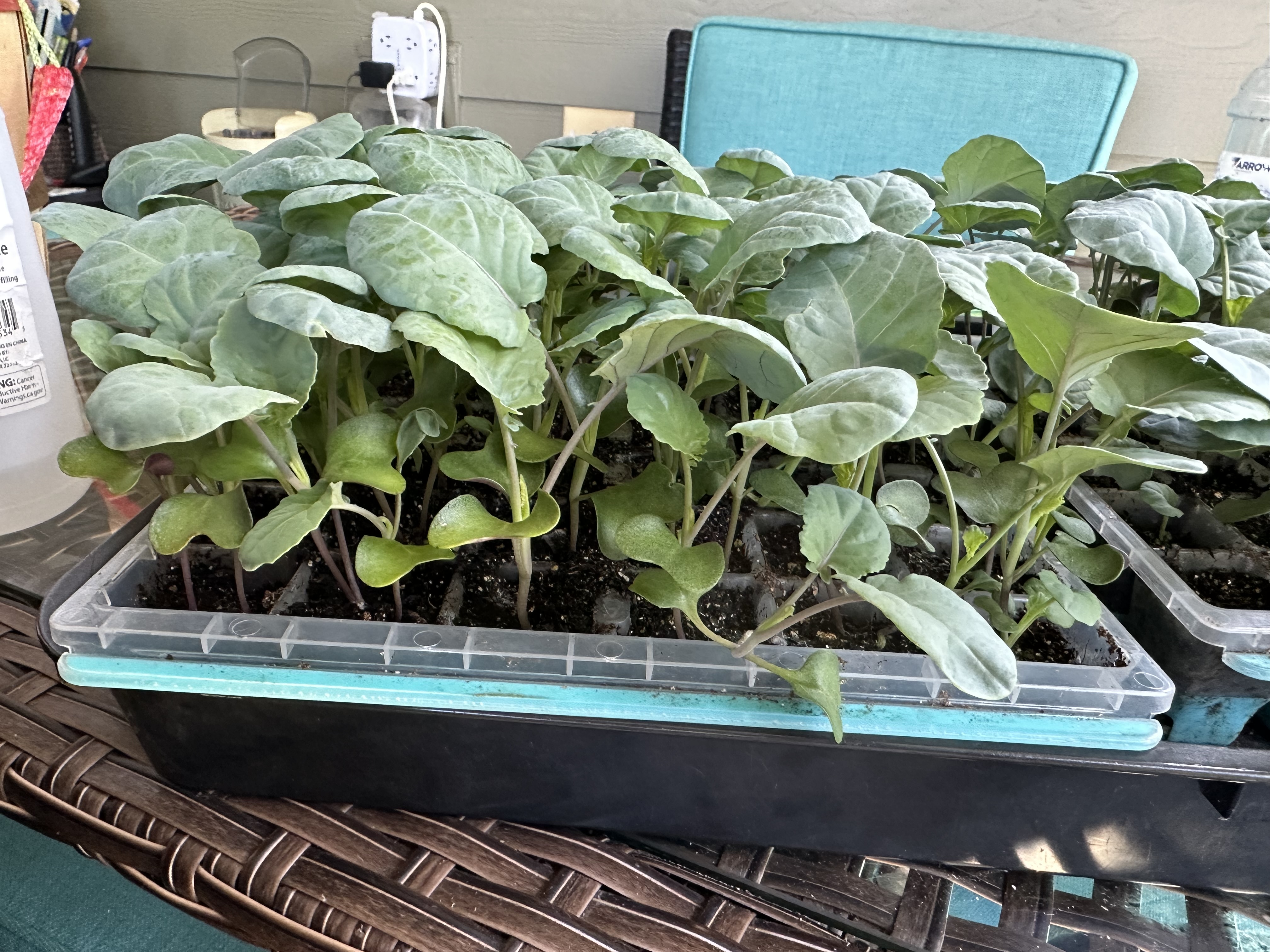
Broccoli, under full-spectrum LED grow lights, four weeks after seeding. Sizeable, healthy plants should be ready for transplanting in the first or second week of September. (Image credit: Kathryn Hamilton)
This year, to extend the harvest, I am adding “Iron Man.” This variety is slightly more cold resistant and has a longer maturity window, extending our harvest into January or February. My spring broccoli crop will be planted around Valentine’s Day.
Spinach
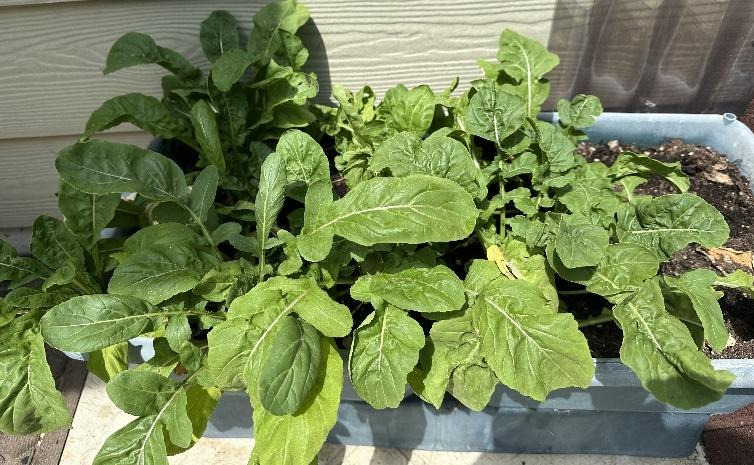
I have tried several varieties of spinach including: “Monstreux de Viroflay” and “Abundant Bloomsdale.” Through research and my own personal experience, “Longstanding Bloomsdale” is the way to go. I love the flavor and the deeply savoyed leaves that add texture to almost everything. And the adjective “longstanding” is very apt.
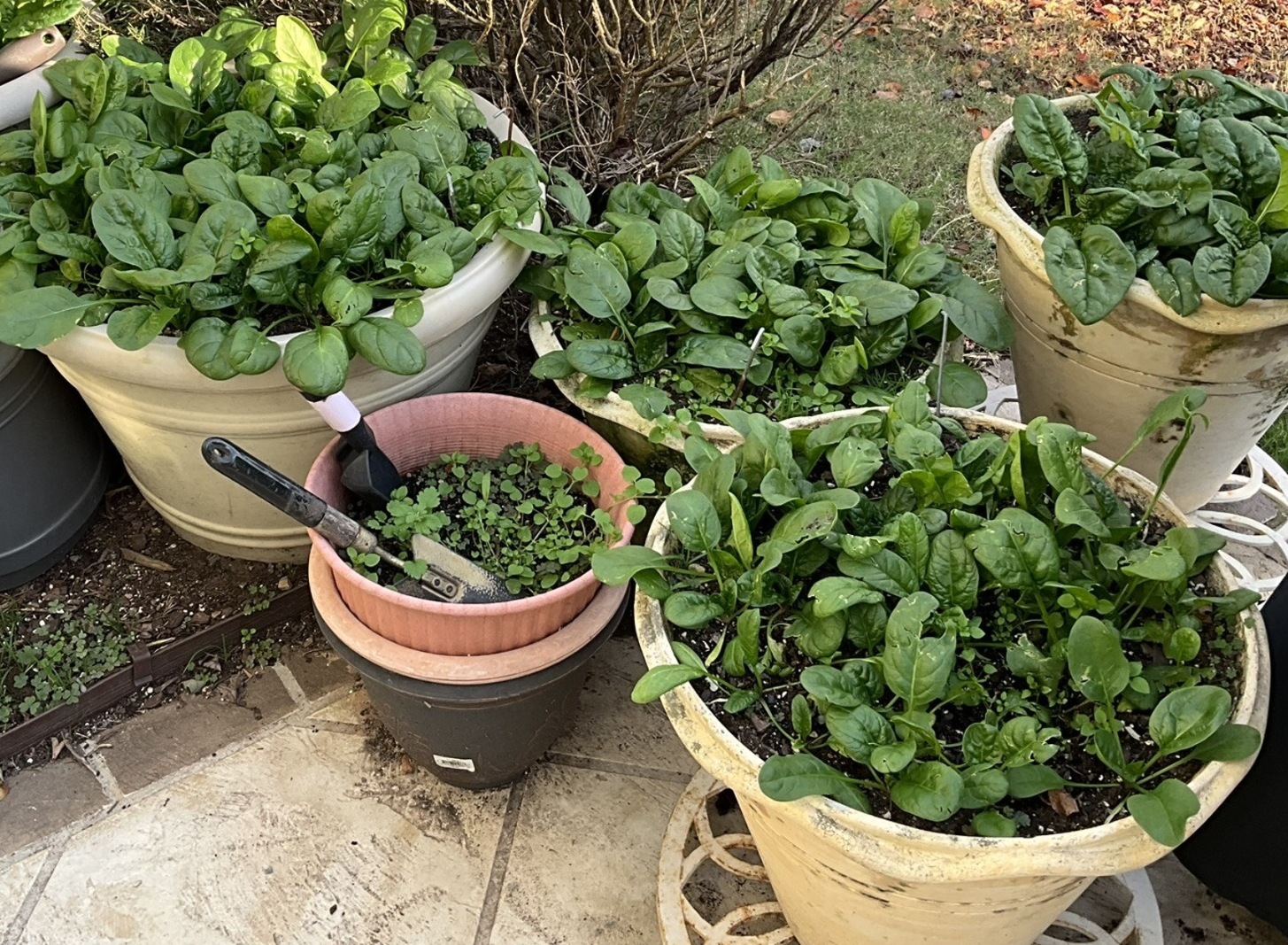
Started in August, this spinach will carry me through to March or April when it’s time to seed pollinator flowers in these pots. (Image credit: Kathryn Hamilton)
Spinach is a frustrating vegetable to get started. Research and personal experience are all over the board: warm soil; cool soil; soak the seeds; refrigerate the seeds; germinate in tissues. I’ve tried them all with varying degrees of success. My preferred method, to start them in a hurricane, happened accidentally. One August I seeded the pots on my patio just as a hurricane passed through. With the heat and a LOT of rain I had a bounty. So, for the last several years, that’s how I’ve been doing it.
Arugula

Annual “Rocket” arugula in August and in December–note Santa’s appearance. (Image credit: Kathryn Hamilton)
This peppery vegetable grows on my patio all year. While it is more prone to bolt in the summer, the leaves can be continuously picked, and it grows so easily it is a cinch to seed continuously. I literally toss some seeds on top of the pot and water them in. When it does bolt you can let it go to seed and have even more of your favorite variety.
There are two types of arugula. Standard salad arugula (Eruca sativa) and wild /perennial arugula (Diplotaxis tenuifolia). With their broad, lobed leaves in a fairly open rosette structure, “Rocket” and “Astro” are the more common salad varieties. Wild rocket or “Sylvetta” has deeply serrated narrow leaves which are often smaller and more numerous.
Fall Planting Planning and Cultivation
Almost all of our fall/winter decisions are dictated by the Persephone period, which in Durham lasts between November 25 and January 17.
During this time, when there are fewer than 10 hours of daylight, veggies take a nap and grow slowly if at all. Our goal is to time our planting so that we can harvest some veggies before that, others during the dormant period, and still others in early spring when they get a new burst of energy. To insure they get a good start on the Persephone period, by having healthy, strong plants, we usually start our fall veggies in seed trays in Mid-July through late August, depending on the variety and its maturation date, and transplant in early September. For more tender vegetables in particular, it also means extra watering and vigilance against aphids, slugs, and cabbage worms.
It’s not too late to start many of these leafy veggies, especially if you are not racing against the Persephone period and are happy to harvest later in the winter or early spring. Many actually prefer to be direct sown. But if growing your own from seeds is not in the cards this year, be sure to visit the Briggs Avenue Community Garden Festival and Plant Sale on September 12.
Resources and Additional Information
Mustard: It’s Not Just for Hot Dogs
Growing and Preparing Collards
Edited by Astrid Cook-Dail, NC State Extension Master GardenerSM volunteer of Durham County
Article Short Link: https://wp.me/p2nIr1-7Ve